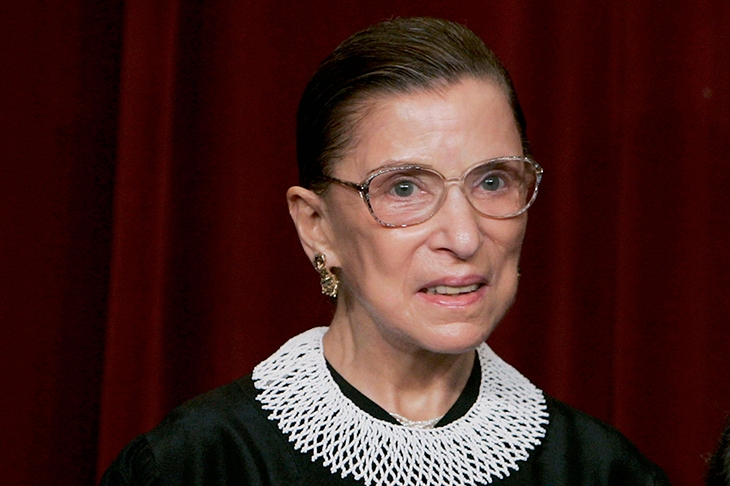
My wife and I recently experienced a production of Suzie Miller’s acclaimed one-woman play, RBG: Of Many, One. We knew that Ruth Bader Ginsburg was a remarkable woman and the performance conveyed that clearly.
The play skilfully condenses Ginsburg’s 87-year life story into a 100-minute stage performance, graphically capturing her passion for championing women’s rights. It not only celebrates her achievements but also exposes a tension between principle and passion – an important lesson for us today.
Miller once said in an interview: ‘I think women have been dancing backwards in high heels through life. Ruth had that awareness, and that’s what fuelled her.’
The play was specially written for Sydney actress Heather Mitchell AM, who clearly identifies with Ginsburg’s driving force and is ideally suited for the role. Adding to Miller’s comments, she said, ‘But she was also driven by a great optimism and zest for life. She saw women as they were before they had social constructs built around them. She saw people as equals.’
Using only voice, facial expressions, gestures and a few costume changes, Mitchell presented RBG’s life story from a 16-year-old schoolgirl to a frail 87-year-old woman. Her meetings with several US presidents included amusing impersonations of Bill Clinton, Barack Obama, and Donald Trump.
We heard about the love of RBG’s life – her lawyer husband, Martin Ginsburg. From our seat near the front, we saw her grief at Martin’s death aged 56, when real tears trickled down her cheeks. Only the most accomplished actors have this skill – Heather fully deserved her standing ovation after the performance.
But the play also revealed Ginsburg’s greatest folly: allowing passion to supplant principle.
Ginsburg was committed to the ideals of the US Constitution, including the importance of maintaining the separation of the judiciary from the legislature.
For example, in 2013 President Obama invited Justice Ginsburg to lunch in the White House, hoping to gently persuade her to resign from the Supreme Court so he could nominate her successor. But Ginsburg reminded him of the separation of powers in the US Constitution. She said it would be wrong for a president to pressure a judge. She refused to step down.
But then came the 2016 presidential election campaign, when Ginsburg, enthusiastic for a Hillary Clinton victory and filled with an apparent dislike of Donald Trump, threw caution to the winds.
She publicly called Trump ‘a faker’, who ‘really has an ego’, and did not want to think about the prospect of him winning the presidency over Democrat Hillary Clinton. Her remarks were criticised at the time as ‘totally inappropriate’.
She was later overcome with remorse. How had she come to abandon her lifelong commitment to the separation of powers? She wondered if she was no longer worthy to serve as a Supreme Court judge.
An earlier landmark case covered in the play was United States v Virginia (1996), which overturned the male-only admissions policy of the 157-year-old Virginia Military Institute. Justice Ginsburg wrote the majority finding, arguing that the policy breached the US Constitution’s equal protection clause.
The lone dissent was written by the Supreme Court’s most conservative judge, Justice Antonin Scalia. He argued that the decision went beyond the original understanding of the equal protection clause. Diverse educational options should be allowed, particularly since women had other similar educational options. And the matter should be decided by the state legislature, not by federal judges.
Personally, I find his argument far more persuasive than Ginsburg’s.
Intriguingly, Scalia and Ginsburg were close friends. They bonded over a shared love of opera, good food and wine, and their childhoods in New York. Their spouses and children became friends as well, and the families often rang in the New Year together with a gourmet meal. Scalia once remarked of Ginsburg, ‘What’s not to like… except her views of the law, of course?’
For me, this is the best takeaway message from the play. The friendship of Ruth Bader Ginsburg and Antonin Scalia is an inspiration.
People with diametrically opposed views should be capable of disagreeing, while remaining close friends.
Dr David Phillips is a former research scientist and founder of FamilyVoice Australia