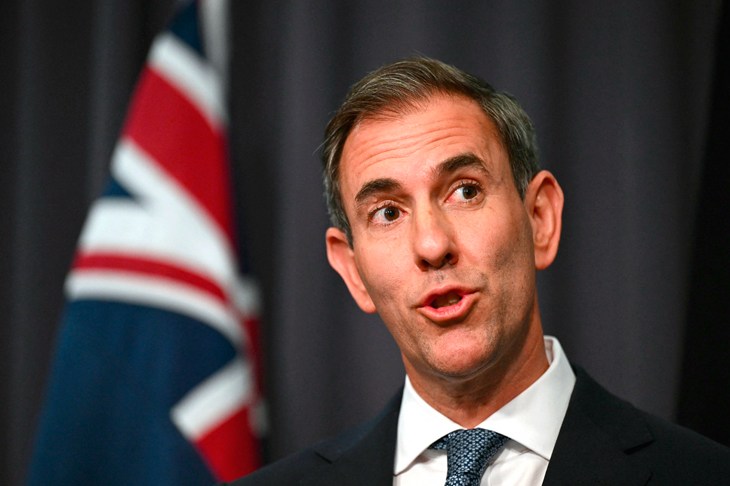
Treasurer Jim Chalmers has spent four and a half years making sure the government lives beyond its means. Australians are now finding it harder to live within their means, with headline inflation jumping from 4.3 to 4.9 per cent.
Chalmers declared the result ‘unwelcome but unsurprising’. Yet despite his gloomy soliloquy on Monday foreshadowing grim economic prospects for the next two years, the results were worse than the market had expected.
Minister for Misinformation Anika Wells, whose financial prowess peaked with her explanation of ‘Ooshie-nomics’, defended Chalmers, saying he was doing a ‘terrific job in difficult circumstances’. To give credit where it’s due, Chalmers has worked hard to make circumstances difficult.
But the Treasurer’s true believers would have been even more surprised than the market. They see Chalmers as a fearless reformer, and those who criticise him ‘are trying to defend an unfair system and insisting it should stay that way at the expense of everyone else’.
Chalmers’ old boss, Wayne Swan, for example, claimed last week that the attacks on his acolyte were driven by ‘the hard right… camouflaging greed as national interest’ because they believe that ‘inequality, unemployment and human suffering are the prerequisites of a strong economy’.
In the real world, unemployment rose to 4.9 per cent in October, its highest level since the dark days of Covid in 2021. If it continues to rise at this rate, Australia could be in recession before the end of the year – a not-so-happy Christmas.
Rising unemployment and rising inflation also raise fears of stagflation.
No one should have been surprised, however, that Chalmers blamed anyone other than himself.
He said, ‘There were two reasons why there is more inflation over the last 12 months… first of all, because the private sector recovery was stronger and quicker than people thought it would be.’
Those doing it tough in the private sector wouldn’t be amused. Every week, another high-profile business either lays off workers or goes bust. If the private sector could just stop recovering, Jim might have a fighting chance.
‘And secondly, because of the war in the Middle East.’ The oil comes from overseas but the excuses are locally manufactured.
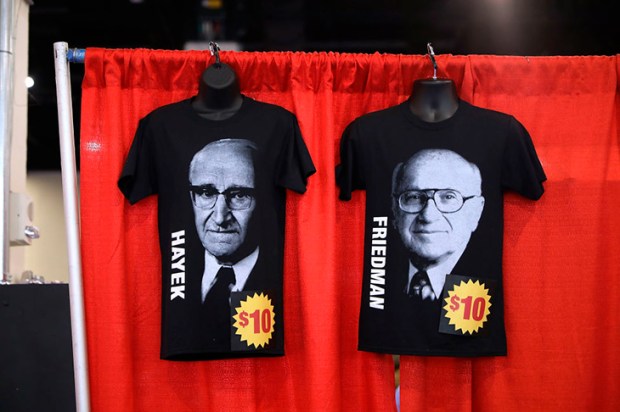
Chalmers’ hero is Paul Keating, but unlike Chalmers, Keating understood, as Milton Friedman put it, that ‘Inflation is always and everywhere a monetary phenomenon in the sense that it is and can be produced only by a more rapid increase in the quantity of money than in output.’
As Friedman explained, ‘a steady rate of monetary growth at a moderate level can provide a framework under which a country can have little inflation and much growth.’
Friedman said that it would not ‘produce heaven on earth’, but it could ‘make an important contribution to a stable economic society.’
In his 1984 budget speech, Keating proudly talked about deploying ‘an effective monetary policy’ to allow for growth ‘without adding to inflationary pressures.’ Indeed, Keating had a whole section in his speech devoted to monetary policy.
These days, we can only dream of a Labor treasurer who is economically literate and recognises that it is excessive government spending that fuels inflation rather than pointing his finger at fuel prices.
If Chalmers had studied the dismal science, he would know that trimmed mean inflation, which had stripped out fuel, also shot up to 3.8 per cent.
Instead, Chalmers whinged about the Brent oil price averaging $US108 per barrel in October, complaining that it was almost 70 per cent higher than in October last year.
It doesn’t occur to him that when the price of a critical commodity such as fuel is high, his job is to put his foot on the brake, not the accelerator.
According to Chalmers, ‘the primary driver of this unwelcome uptick in inflation was the flow-through from global oil prices to petrol bowsers here in Australia.’
He repeated his claim that Michele Bullock, the Governor of the Reserve Bank, had raised rates because of rising petrol prices when what she said was the opposite; the bank was ‘not tightening monetary policy because of the direct impact of oil prices on inflation. Rather, the tightening in monetary policy is to address domestic capacity pressures.’
Most recently, Bullock bluntly said, ‘We have a domestic homegrown inflation problem, that is true.’
And regardless of the cause, Chalmers had to concede, ‘That doesn’t make it any easier for Australians to cop.’
It was an unfortunate choice of verb. Climate Change and Energy Minister Chris Bowen slunk into the country this week after a spectacular failure at the Climate Conference of the Parties (Cop31).
The only memorable thing Bowen said at Cop31 was that he didn’t put his mobile phone in his trouser pocket because he was worried about its proximity to his ‘dick’, which made the PM giggle like a schoolboy.
As Liberal shadow minister Dan Tehan put it, Bowen ‘wasted $150 million of our money on his big Cop flop, including $30 million on a pre-Cop no one went to, $3 million on a documentary, $70,000 on limousine rides, and $220,000 on specialist German climate advisers’ and ‘delivered no agreement and no benefits for Australians who are still waiting for $275 off their power bill.’
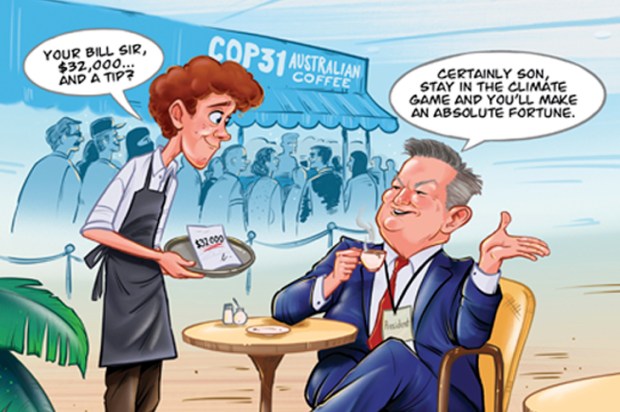
It turns out that spending $32,000 shouting everyone coffee won’t buy consensus.
And $30 million spent on the South Pacific Pre-Cop flop won’t buy gratitude; former Pacific Island leaders warned there was now a ‘trust gap’ between Australia and their island nations.
Russia and Saudi Arabia vetoed any mention of transitioning away from fossil fuels, which, to be fair, still power 80 per cent of the world’s energy.
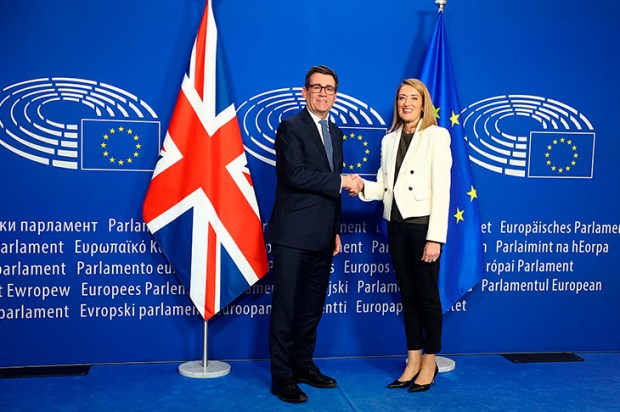
Former US vice president Al Gore called the failure to reach an agreement an ‘outrage’ but G7 leaders, aside from Andy Burnham, gave the conference a wide berth, knowing their populations want cheap, abundant, secure energy, not emission-impossible fantasies.
The Guardian Australia’s climate correspondent punned that the ‘climate’ at the conference ‘was toxic’, snickering at Bowen glowering at the end as if ‘all his Christmases had come at once and every present was a jumper he hates’.
Now Chalmers is considering cutting subsidies for electric cars and home batteries. He says he’s already found $180 billion in savings. With deficits up by more than $100 billion, imagine what the budget would look like if he’d been trying to spend money.
Bowen came home without a deal. Chalmers still gets the bill. And Australians will just have to cop it.
Got something to add? Join the discussion and comment below.
You might disagree with half of it, but you’ll enjoy reading all of it. Try your first month for free, then just $2 a week for the remainder of your first year.