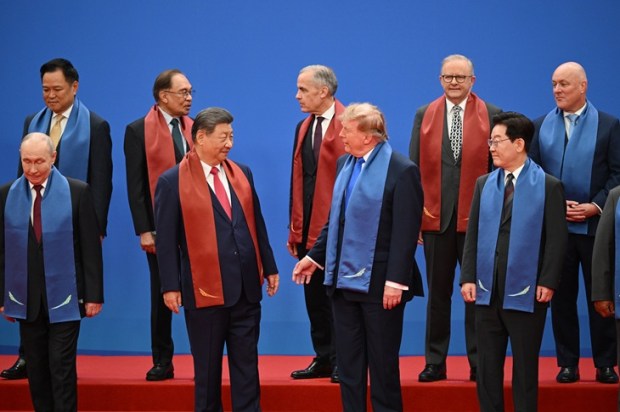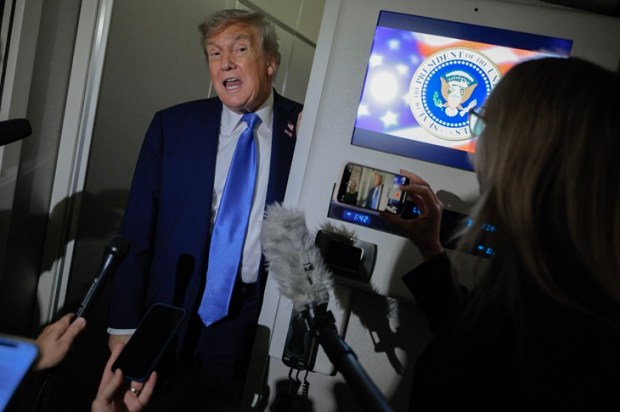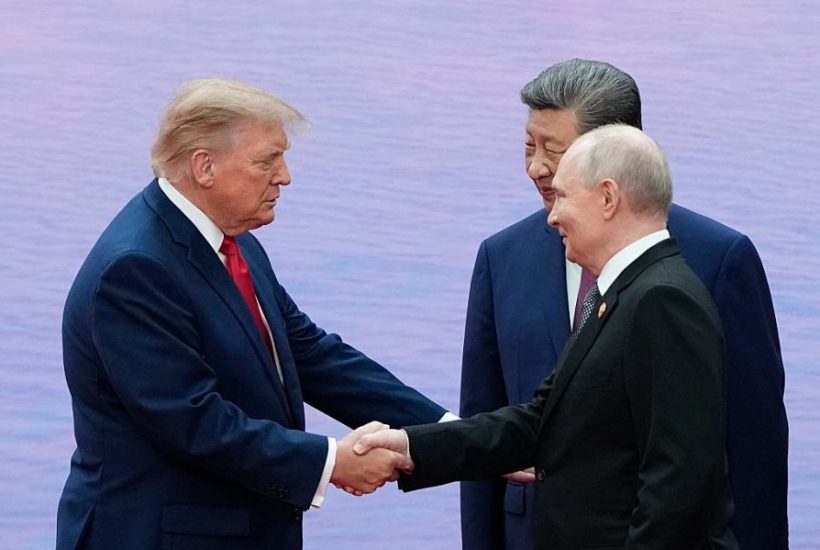
‘Who’s there? It’s my friend. It’s a pleasure to see you again,’ President Trump greets Vladimir Putin in China with a welcome that horrifies people who recognise Putin as a ruthless dictator, as well as the Never Trumpers.
Donald Trump’s major reforms include dismantling DEI; restoring a rational energy policy, including removing subsidies for renewables and focusing on low-cost gas; restoring US border security; and forcing other democracies to carry a fairer share of the necessary increase in defence spending.
Although, at the bottom line, the US has one of the world’s highest growth rates, Trump’s failures include a reckless fiscal policy. Deficits of 6 per cent of GDP have been incurred and are planned to continue at that level (and the Democrats would make this worse with additional spending, including Medicare For All). Debt is 125 per cent of GDP, which though comparable to that of the UK, France and Italy – and much less than that of Japan – cannot be continually added to. (Australia’s debt is 50 per cent of GDP). Were he also able to control US monetary policy, Trump’s statements suggest he would be similarly irresponsible in that regard.
He has also pursued a chaotic trade policy. Paved with good intentions of restoring a fairer system, this has entailed sudden imposition of high tariffs and rapid changes to them.
That said, his critics reserve their strongest censure for his foreign policy. JD Vance named the Iran war as the reason for the Republicans’ mid-term election losses (with an implied criticism of Trump that has led to his removal from foreign policy). It is certainly true that, as Michigan Senator-elect Abdul El-Sayed recognised when confronted by opposition within the Democratic Party on election eve, the only thing driving the result was high prices caused, he maintained, by Trump’s policies.
Internationally, Trump has had successes in forcing his allies to shoulder more of the defence burden, in removing the criminal Venezuelan dictatorship and in ensuring higher security by a de facto American replacement of Denmark in control of Greenland.
The two great disappointments have been Ukraine and Iran. His detractors remind him of his own criticism of other administrations’ ‘endless wars’ and of his blustering about how he would resolve these disputes very quickly – and, indeed, that if he was in power at the time, the Ukraine war would not have started in the first place.
The war with Iran seems to have little chance of ending but do those who criticise Trump’s prosecution of it have an alternative? Does anyone outside of violent jihadism want to see a nuclear-armed Iran under a murderous theocracy that calls for ‘death to America’ (code for death to Western Civilisation) and vows to eliminate Israel, i.e. all Jews in Israel?
In the case of Ukraine, the US has given almost as much military aid as the EU while having a far lower geographic priority. In 1991, Ukraine’s regions – including those with Russian majorities – all voted strongly for its independence, though claimed discrimination against the Russian language may have altered that preference in the eastern part and in Crimea (where 95 per cent of people are Russian speakers).
Trump’s optimism on foreign diplomacy stems from his experience as a businessman. In The Art of the Deal Trump has a blueprint for successfully negotiating mutually beneficial outcomes between parties that are focused on maximising the wealth of the firms they own or are responsible for. A key principle, ‘know your market’, has a different set of metrics in politics.
An early discovery of this was presented to Trump when the Democratic Party declined to sell him, at 5 cents in the dollar, the fireworks they had bought to celebrate the anticipated victory of Hillary Clinton in 2016. A business leader might have cut his or her losses, but no politician could accept such humiliation and continue in a leadership position.
Looking at the position in Ukraine through a transactional or even ‘realpolitik’ lens led Trump to propose a compromise based on the territory Russia and Ukraine held. Neither side could accept this: Had Zelenskyy done so, he would have been impeached; had Putin done so, he would be weakened, perhaps fatally, in view of the costs of winning an area of less than one per cent of Russia itself.
In the case of Iran, Trump has tried to end that rogue state’s relentless pursuit of mayhem and its stated intent to overthrow the established world order. Destroying key installations and its navy and killing a large part of its leadership appear not to have caused a change in direction. Nor have economic sanctions done so, even though they have lowered Iran’s GDP per capita by perhaps 40 per cent (though less than that in local purchasing power parity terms.
We have seen such patterns before. Thus, with rather less of than Iran’s diminution of GDP per capita but a far greater loss of life, Japan’s fanatical leadership surrendered in 1945 only when the prospect of total devastation became real. Nazi Germany had to be totally destroyed.
The Iranian leadership does not use the same metrics that govern businesses or even most governments. Its goals contain an ambition out of all proportion to its capabilities, but this is married to an ability to tolerate extreme damage to subjects that have little influence on decision-making. Thus, although Trump points out that only 3 of the 10,000 to 11,000 drones/missiles Iran has fired have got through the Gulf area defence system, the world’s oil and gas trade remains paralysed.
While the Russia-Ukraine conflict carries risks of a wider conflagration, it is more likely to remain localised. But Iran’s aspirations are global and there are no terms other than a temporary halt in its aggression that the current regime would accept.
Although Trump has said that regime change is not a goal, it is difficult to see how else that nation can be brought into conformity with established international relationships.