Henry Kissinger, Richard Nixon, King Faisal, Leonid Brezhnev, Colonel Gadaffi, Golda Meir, Sheikh Yamani, Carlos the Jackal, Yasser Arafat: these still reverberating names from the past are all present and kicking in Embargo, Philip Delves Broughton’s racy book on the oil crisis of the 1970s. Or if you prefer your history of oil and its demonic powers a little more academically restrained, there is Guy Laron’s account of the oil wars of the past 150 years. Both books are a good read, although the documentary-like oil crisis story is the more vivid, moving like a camera from room to room and city to city over the short but convulsive oil embargo of 1973.
For the whole of the 20th century and on into the 21st, oil has been the predominant industrial commodity. It was the source of all power: economic, military and political. It was the must have. And while oil producers rose and declined – the US, Russia, Austria-Hungary, then Iran, South America and eventually Saudi Arabia – the one constant was oil itself, seeping across every border and every ideology, connecting allies and enemies through the common bond of the thirst for liquid hydrocarbons, the most efficient store of energy ever discovered.
Wherever there has been oil, there has been conflict. It is, as Laron puts it, ‘one of the core instruments of geopolitics’. Control oil, or the chokepoints in the oil trade, and you control everything else. In 1938, when some last-chance prospectors at Well No. 7 in eastern Saudi Arabia defied convention and drilled deeper than usual, they hit what is still the world’s largest onshore oilfield and created a new chokepoint that would later hold the rest of the world to ransom.
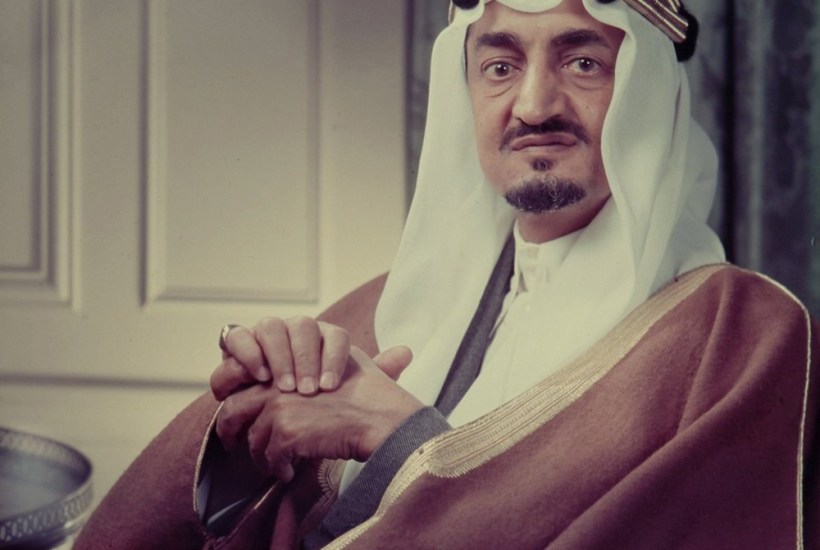
Within living memory Saudi Arabia was one of the poorest places on Earth, a subsistence economy where camels and tents were the currency of power. By the end of the 1973-4 oil embargo, when the country turned on its ally the United States and almost overnight forced the price of oil up from under $4 a barrel to more than $10, King Faisal became the richest man in the world.
Ever since Saudi Arabia got serious about running its economy in the late 1960s the question has always been: what to do with the money. Long before the oil embargo, its leaders had been agonising over how to turn cash wealth into real development without blowing up the economy. And throughout the 1960s the view took hold that neither Europe nor the United States really wanted Saudi Arabia to become an industrial power. When King Faisal told the US that one day his country could use oil as a political weapon and turn the taps off, nobody took him seriously. When his suave, mercurial oil minister Ahmed Zaki Yamani told the world the same thing, nobody took him seriously either. ‘You can drink your oil,’ they were told.
The turning point was the Arab-Israeli war of October 1973. Late that month King Faisal called Yamani to his palace one evening and said: ‘Write this down. In view of the increase of American military aid to Israel, the Kingdom of Saudi Arabia has decided to halt all oil exports to the United States of America.’ Within months, half of the industrialised world was looking at energy rationing, recession and a military-security crisis.
This was a cold war to beat all the hot oil wars that had come before or would follow. It made Saudi Arabia, its leaders and its oil producing machine Saudi Aramco (then the world’s most valuable company) the arbiters of world history.
Yet it was not so simple. Oil has a strange ability to connect opposites, to make friends of enemies and vice versa. The US did not want an oil embargo, or a confrontation with its biggest oil supplier. It did not even want a clear winner in the Yom Kippur war, for all its support of Israel. Neither did Saudi Arabia want a rift with the US. It wanted closer cooperation and, above all, it wanted to be treated with respect. The US had not shown the kingdom respect. The French had been worse, and the British worse still.
Oil has a strange ability to connect opposites – to make friends of enemies and vice versa
Almost as soon as the embargo was imposed, all sides started to find work-arounds. Fearful of a global imbalance of power, the Saudis began supplying the US military with under-the-counter oil, and surreptitiously buying US government debt to keep US interest rates down. European nations began searching for bilateral deals with oil producers – any ones. The short term spot market for oil ballooned (going from 5 per cent to 50 per cent of the market). Traders made fortunes. Contracts were signed and then – unheard of thing – immediately broken. It was the first indication that the pinstriped trust networks that ran the world economy were breaking down, but not the last.
The oil embargo ended because it became too painful for all involved. But the Saudis had made their point: if you have oil, you have the advantage. There were no friends in this post-oil crisis world, no allies. There was just oil.
Nothing makes that point better than the moment described by Delves Broughton when, just as the embargo wound down, Yamani was kidnapped, along with other Opec ministers, by the freelance terrorist Carlos the Jackal. As Yamani awaited what he expected would be his execution, he wondered who had set up this kidnap. The Israelis? The Iranians, the Palestinians, the British, the Iraqis, the Syrians, the Americans, even the Saudis? He concluded that it could have been anyone, because everyone hated him. And then he was released and went back to his chalet in Switzerland.
That was a different world. The energy economy is now tilting slowly but inexorably towards renewables – power sources that cut across every sovereign border. Oil is still the biggest source of the world’s energy, but the direction of travel is clear. Saudi Aramco is no longer the world’s most valuable company. Nvidia, Apple, Alphabet and Microsoft are all at least twice as large by market capitalisation. Computing power fuelled by sunlight is the new oil.
And it is a fair guess that the story of this new power and the struggle to control it will be no less tumultuous than the oil wars that preceded it. A future AI embargo? Not impossible.
Got something to add? Join the discussion and comment below.
You might disagree with half of it, but you’ll enjoy reading all of it. Try your first month for free, then just $2 a week for the remainder of your first year.