
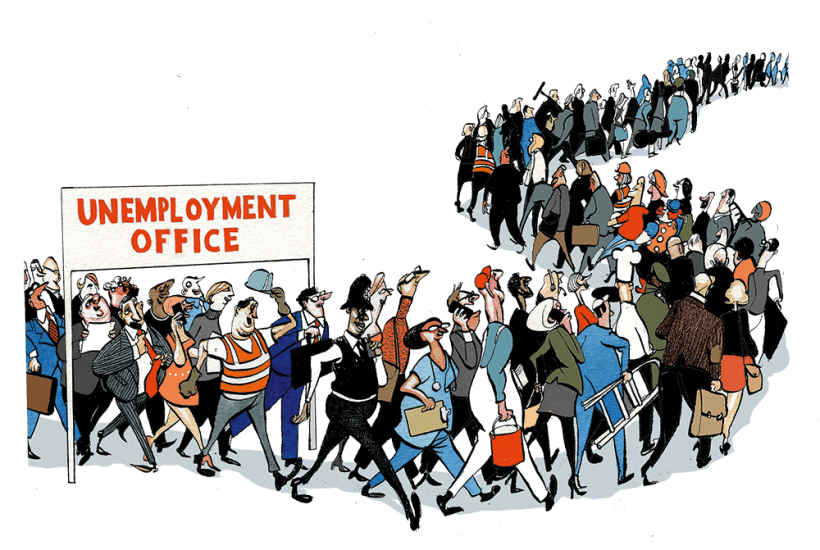
If there is one reframing which could change the way we approach our economic malaise, it would be to replace the phrase ‘the cost of living crisis’ with something else: ‘the cost of working crisis’, perhaps, or, simpler still, ‘the cost of trying crisis’.
Implicit in the phrase ‘the cost of living’ is the idea that the main task of government is to make sure that every-body can exist in a state of barely tolerable subsistence: a wonderful aspiration if you want to parade your moral credentials, but don’t expect it to grow the economy. Growth demands the very opposite of egalitarian subsistence: it emerges from discretionary risk, discretionary effort and discretionary spending.
The effective differential between a high-paid job and a minimum- wage job has narrowed to a bottleneck
There is a new name for this problem. In place of ‘fiscal drag’, the new buzzword is ‘wage compression’. This not only captures the erosion of incentives by an unholy combination of static higher-rate tax thresholds, loss of benefits and student loan repayments, but also recognises that the effective differential between a high-paid job and a minimum-wage job has narrowed to a bottleneck.
Twenty years ago, if someone said ‘Why bother?’ it was a sign that they were lazy; now it merely suggests they have a healthy grasp of economic reality. As someone who would be incredibly idle were it not for the fact that I’m extremely materialistic, I have some sympathy for Neets. But their behaviour is not confined to the lower rungs of society. Indeed, every contemporary of mine who worked in banking or financial services is now a Neet, although they’ve cunningly rebranded it as ‘early retirement’ or ‘going plural’. There are also Neet lawyers and Neet surgeons. If it’s not worth it for these people to work beyond the age of 55, what encouragement is there for everyone else?
The media stereotype of a higher–rate taxpayer depicts someone in banking or law who is highly paid for most of their life. Yet for most people work is a kind of tournament. People work for meagre wages in their youth enticed by the prospect of greater emolument later. A headteacher appointed at the age of 55 sees their salary as a reward for years of hard work. Hit them with a marginal tax rate of 40 per cent for the last years of their working life and you confiscate their prize pot. High taxes on high earners disincentivise everyone.
At the moment, the gap between working 40 hours a week at the minimum wage and the onset of higher–rate tax is barely £20,000 a year. Writing in Conservative Home, John Oxley noted that: ‘Between 2016 and 2025 the National Living Wage rose by 70 per cent. Over the same years the typical full-time salary rose by 38 per cent. The longer view is starker. In the quarter-century to 1999, real pay for someone at the 70th percentile grew by more than four-fifths. In the quarter-century to 2023, it grew by 14 per cent.’
At this point, my inner Marxist must point out that employers have contributed to this problem. In the words of Scott Galloway at NYU: ‘Capital has been kicking the crap out of labour for the last 30 years.’ And it doesn’t help that the non-financial perks of promotion in the workplace have been eradicated by hatchet-faced puritans in HR, Finance, Procurement and Compliance. (I could further add that The Spectator pays meno more for writing this article than when I started in 2008.)
But you could equally counter that there isn’t that much point in paying employees more when so little of the increment ends up in their own pockets. Quite simply, for the purposes of creating incentives, the higher rate of tax kicks in £20,000 too soon. All pay increments are not equally valuable. When you’re young in London, the first £35,000 goes on boring fixed overheads: it’s the next £25,000 which is fun – because you can decide what to do with it. This leads to the very kind of discretionary extravagance which the economy needs. Bernard de Mandeville understood this in 1705; we seem to have forgotten it today. Trickle-down economics may have been a bit of a neoliberal fantasy, but compared with stagnant economics, it has its advantages.
Got something to add? Join the discussion and comment below.
You might disagree with half of it, but you’ll enjoy reading all of it. Try your first month for free, then just $2 a week for the remainder of your first year.