Seventy-seven years on from Passport to Pimlico, life appears to be imitating art in a corner of rural Oxfordshire.
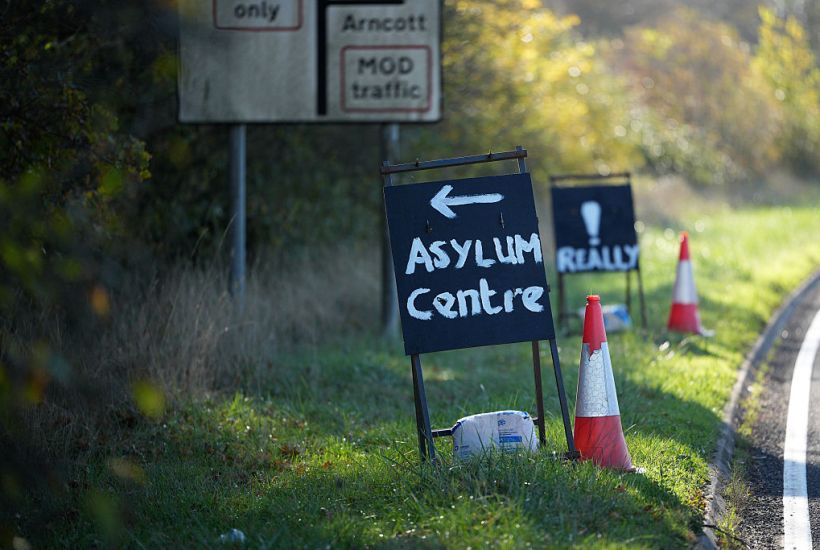
The government’s proposal to house 1,256 asylum seekers near the tiny village of Piddington will more than treble the local population. In September, residents voted to secede from Britain, echoing the 1949 Ealing classic. The parish council chairman proclaimed the Principality of Piddington. There would be charming absurdity here, if it were not so maddening and desperately sad.
There is something troubling about how easily the state can contemplate such changes to a thousand-year-old community
On Thursday, Angela Rayner used special emergency planning powers to approve the asylum centre at a nearby MoD site, over the objections of at least three local councils, as well as the Thames Valley police and crime commissioner.
The government has admitted that the plan will pose a risk to women and girls living nearby. In a planning document, officials said the proposed security measures at the camp ‘cannot eliminate all risk’ to the villagers and acknowledged concerns from local police chiefs about the ‘increased risk of crime’. It now falls to the Home Office to decide whether to give the final go-ahead.
Piddington’s origins stretch back to before the Norman Conquest. It is mentioned in the Domesday Book. Its population has barely changed in two centuries: 359 in 1821, some 350 today.
The village has form when it comes to asserting its independence. In 1428, having secured parish status, villagers were obliged to pay the vicar of neighbouring Ambrosden 20 shillings and a quarter of wheat annually, an imposition still contested into the late nineteenth century. Such were the disputes that used to occupy parish councillors in our ancient English villages. The repair of a lane, the upkeep of a church, the rights of one parish against another.
No longer. Today, the people of Piddington face a more existential question: whether the community their forebears built can survive the arrival of several times its population. Arrivals with no links to Piddington, who know nothing of it and probably struggle to speak its name. The easy familiarity of a place where almost everybody knows everybody else threatens to be ripped asunder. And that is before the questions of public safety.
There is much in Piddington’s story depressingly familiar to rural Britain. The bus service ceased in 2016. In fictional Pimlico the pubs may have stayed open all night, but Piddington’s Seven Stars closed in 2012. A village shop proved unviable. Villagers declined a vending machine, but asked, ever politely, whether a newspaper service might be explored. Their requests have been modest.
No thanks to Whitehall, the village has found a way not merely to continue, but to thrive. St Nicholas’ Church still stands. Short-mat bowlers play at the village hall on Monday mornings. The village fete has been revived. ‘Pidnic in the Park’ continues, though now it serves as an opportunity to peacefully demonstrate against the government’s plans.
Here is a community, in other words, that has acquired that intangible thing: a sense of unity and belonging. Scruton called it oikophilia. And inherent in Scruton’s term is not just love of a shared home, but also the desire to protect it.
It is that which motivates the people of Piddington to question what this plan might mean for the survival of the place they call home. The government says there will be planned security patrols and CCTV in a bid to reassure residents, while simultaneously admitting migrants will be ‘free to enter and leave’. It is surely reasonable for villagers to feel concern. Anger too: Piddington already neighbours Bullingdon prison. One might have thought residents had been asked to accommodate quite enough of the state’s needs.
There is something troubling about how easily the state can contemplate such changes to a thousand-year-old community. In the consultation over the asylum centre, 3,177 individuals and organisations opposed, with just one in favour. That has stopped nothing. And this from a Prime Minister who talks incessantly of devolving power to local people.
The fictional inhabitants of Pimlico – or Burgundy – had a plucky determination not to be pushed around by distant authority. So too the people of Piddington. Their independence declaration was a cry for help. A plea that the quiet continuity of village life is something precious rather than something to be taken for granted. A howl into the abyss from a small English community that feels abandoned by a state that, far from protecting it, seems intent on destroying it.
The ironies of the analogy with the Ealing comedy are many. The residents of Pimlico shredded their ration books and identity cards as they joyfully declared independence, giving up the documents that marked their membership of the British state. Tell that to the asylum seekers throwing their IDs into the Channel to better secure refuge here. As with so much in our present nation, everything is upside down. The Ealing film’s Home Office mandarins debate whether these pesky ‘undesirable aliens’ should be booted out of the country. Oh what we would give for some of that backbone in Sir Humphrey now.
Michael Balcon’s Pimlico, for all its defiance, was genial and hopeful. Today’s secessionists feel far bleaker. There is despondency, even despair. For a thousand years Piddington has endured, quietly carrying on through the tides of history. In Ealing’s satire of British officialdom, common sense eventually prevails, the state rides to the rescue and community spirit is left intact. There is no such guarantee of a happy ending in Oxfordshire.
There will be some who understandably feel little sympathy. This is after all an area that at the last election voted Lib Dem. But ultimately this is about what Piddington represents; and the countless other villages and towns that might come to experience the same fate. Passport to Pimlico was a comedy about a community discovering it had become a foreign country. The story of Piddington is of a community destined to feel like strangers in their own.