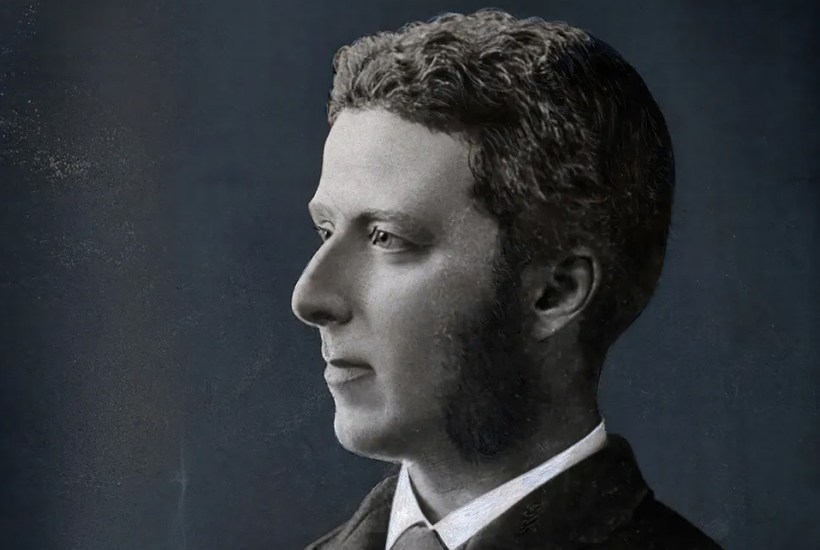
When Sherlock Holmes first stalked across the pages of London periodicals in 1887, journalists eagerly asked Arthur Conan Doyle ‘how on earth he had evolved, apparently out of his own inner consciousness, such an extraordinary person’. But Conan Doyle soon put them right: ‘If you please, he is not evolved out of any one’s inner consciousness. Sherlock Holmes is the literary embodiment… of my memory of a professor of medicine at Edinburgh University.’
As a medical student, Conan Doyle had been taught by the surgeon and professor Joseph Bell, who had pioneered a deductive technique called ‘the Method’, based on the ‘vast importance of little distinctions, the endless significance of trifles’. Bell would study a new patient and then announce to his wide-eyed students that he was a coastal fisherman (from his boots and the shade of his tan), or a bell-ringer in northern Northumbria (from calloused hands and his accent). These lightning deductions would be immortalised by Holmes – and like Dr Watson, once the clues were explained, students would wonder how they had missed them.
Histories of Conan Doyle would fill a library of their own, of course. It’s also well known that Bell inspired Holmes, perhaps more so than the blurb here allows for. But the medical historian Lindsey Fitz-harris’s goal in Sleuth Hound is to place Bell and his Method within the lurid world of Scottish medical forensics.
The Scottish Enlightenment had newly earned Edinburgh the nickname of the Athens of the North, and its medical school was pre-eminent. With the advent of general anaesthesia and antisepsis, Bell, who came from a family of distinguished surgeons, was helping to revolutionise the profession. Edinburgh was also where all serious Scottish crimes were tried, and Bell, along with the police surgeon Henry Duncan Littlejohn, acted as medical adviser to the court. They would apply every branch of forensic science: toxicology, ballistics, fingerprinting, and, of course, the post-mortem, a race against time which Fitzharris excellently narrates. The angle of an injury or a rope could tell them if a death was a suicide or homicide; traces of arsenic could be tied to green-dyed wallpaper; an unusual bullet could show that a burglary had been staged all along.
Conan Doyle, born into a down-at-heel artistic family, enrolled at Edinburgh Medical School, chiefly because Edinburgh was such a famous centre for medical learning. But his own career as a GP and ophthalmologist was rocky and unpromising, and when the short stories he wrote as a pastime began to save his finances, he applied his scientific mind to a new career. Detective fiction was already a flourishing industry in the hands of Edgar Allan Poe and Wilkie Collins, but Conan Doyle felt its mysteries should be solved not by luck but by method. If his old professor had been a detective, ‘he would surely reduce this fascinating but unorganised business to something nearer to an exact science’. And so Holmes was born, coolly announcing in The Sign of Four that ‘detection is, or ought to be, an exact science, and should be treated in the same cold and unemotional manner’.
Joseph Bell hoped that Holmes would inspire readers to think: ‘I also could do this. Life is not so dull after all.’
But after a few years, Conan Doyle, who aspired to be taken seriously as a historical novelist, felt dogged by his creation and killed him off. When he named his teacher as his inspiration in the press, Bell began to be dogged by Holmes, too. Journalists and readers clamoured at him, in letters, by telephone and even on the street. Bell felt that Holmes overshadowed his significant medical achievements, not just in forensics and surgery but in nursing reforms, as well as his warm personality, which was very different from his chilly counterpart. ‘I hope folk that know me see another and better side to me than what Doyle saw,’ he wrote to a friend. ‘I am haunted by my double.’
Bell certainly had a theatrical streak, though, announcing deductions at dinner parties or on trains. Fitzharris’s writing shares this taste for the dramatic. Some of the chapter openings – ‘Joseph Bell entered the operating theatre with his usual steeliness of purpose’; ‘Robert Louis Stevenson couldn’t stop thinking about his friend’ – belie the book’s sophistication. But this is a minor fault. Sleuth Hound is pacy, readable, and thoughtfully pitched in its level of scientific detail.
It is also structured with the suspense of a detective novel, taking us case by case with Bell and Littlejohn, from the wife-killer Eugène Chantrelle to the baby-farmer Jessie King to the high society Ardlamont murder. The anxious process is a reminder of the sheer contingency of solving a crime, how much it depends on giveaway evidence: Fitzharris’s attention to the case of Jack the Ripper shows how dissatisfying real-world criminal justice could be. But it makes the brilliance of forensics all the more attractive. Bell hoped Holmes would inspire readers to think: ‘I also could do this. Life is not so dull after all. I will keep my eyes open and find out things.’ Fitzharris’s lively chronicle of medicine and deduction is an eye-opener throughout.
Got something to add? Join the discussion and comment below.
You might disagree with half of it, but you’ll enjoy reading all of it. Try your first month for free, then just $2 a week for the remainder of your first year.