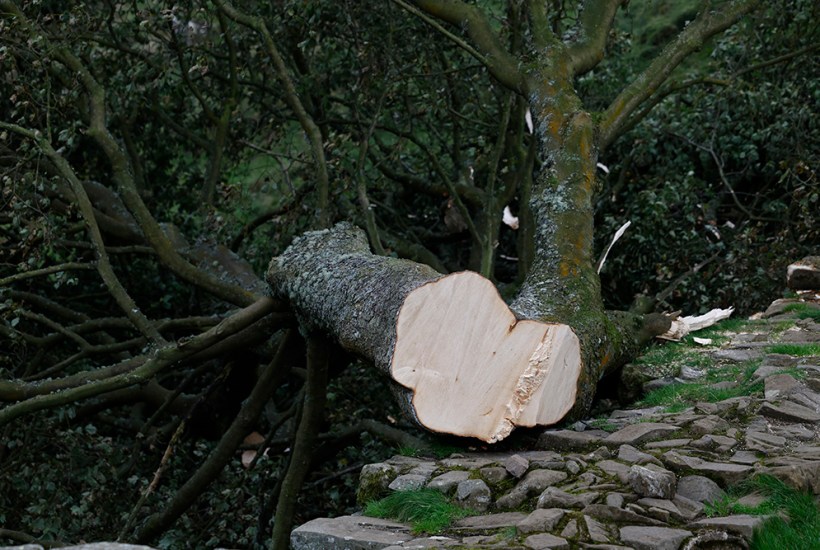
It was just a tree, a beautiful tree, in a strikingly beautiful place. Yet when the two friends Daniel Graham and Adam Carruthers were convicted of felling a much-loved sycamore on Hadrian’s Wall in September 2023, they were sentenced to four years and three months in prison. You can get less for rape.
Andrew Hankinson is best known for his book about the murderer Raoul Moat, written entirely in the second person, a device that can be wearisome. In Felled, he reserves the second person for when he writes about himself. By page 11, he is describing his father’s death. After a few chapters, I made a note: ‘Part of me thinks I’d get on with Hankinson and part of me wants to shake him.’ Not because of the way he writes about his dad, which is very moving; but because he calls himself a shit journalist – his shorthand is poor and he feels sick when he has to do any proper investigation and persuade strangers to talk to him.
This frankness about imperfection is clearly important to him, and it can be charming. But Hankinson is not a shit journalist. He writes cannily, in a way to create friction, because that’s what holds the reader’s attention. Anything but indifference. And there could have been indifference, depending on how you feel about that tree.
I usually throw non-fiction books across the room when I find they contain composite characters, so I cheer for a man who admits that although he could take his laptop into court, he was ‘still not a quick enough typer to get it all down accurately, to be able to rely on it’. He writes:
I’m telling you because I need to be clear about what you’re reading. The conversation below is snapshot, pieces of paraphrasing, incomplete. It’s a depiction of what was said. It’s like a true crime television drama.
The case was given two weeks in a crown court, a top KC and a judge who had previously presided over the awful murders of the toddler Star Hobson and the seven-year-old Nikki Allen. But if this was a true crime drama, it didn’t hold much mystery. Graham, the older of the perpetrators, kept a video on his phone of the tree being felled. There were messages and voice notes exulting and expressing surprise at the ensuing uproar. On trial, the men’s defences were ridiculous. Graham had rung the police line 101 to denounce Carruthers, but denied having done so, despite a record of the call being on his phone. On the night that Graham’s Land Rover was spotted in the nearest car park to the tree, Carruthers claimed to have driven his partner and their week-old baby in his mate’s car from Carlisle to Newcastle for dinner, then changed his mind and turned back. The cross examination is pure comedy:
So you were going about 65 miles with a newborn?
Yes.
This was its first week home?
Yep.
So, a first meal out and you decided to go to Newcastle?
Yes.
And just turned around at about four miles from Sycamore Gap?
Possibly.
Did the culprits know what they would unleash? ‘I woke up in the morning,’ said Carruthers in the dock, ‘and had a quick look on me phone, and every other article was about the tree. I couldn’t understand why there was such a major outbreak. It was almost as if someone had been murdered.’ On the other hand, there was glee. ‘Adam sent Daniel a voice note: “Someone there has tagged like ITV News, BBC News, Sky News, like news, news, news. I think it’s gonna go wild.”’
Hankinson self-denigrates a lot – he wrote an article about the tree that was ‘snarky’, he says – but don’t believe him. Apart from a few missteps where the book’s tone slips, he is masterfully in charge of his narrative. An impact statement from the National Trust was read out before sentencing. The tree was iconic, totemic, of course. It cost the National Trust £30,000 to remove it properly and care for the site. Comments from the public were included, such as ‘my heart actually hurts’; and someone thought that losing the tree must feel to the National Trust like ‘losing a family friend’. ‘It finished, eventually,’ writes Hankinson.
After the trial, he received emails from strangers. One wrote:
I’m a Canadian; I live in Canada. I live in a country of trees. People have been cutting down trees in Canada for God knows how long, and for God knows how many reasons. How in gawd’s name does the UK arrive at the point of losing its collective mind over the loss of a tree?
Hankinson doesn’t answer that question. Nor does he have an explanation for the deed in the first place – although Carruthers, once he had admitted guilt to the probation officer, claimed it was the result of drunken stupidity. Hankinson creates a more nuanced portrait of Graham, whose father had hanged himself two years earlier. But I still don’t quite arrive at the opinion of the writer Will Storr, who calls Felled ‘an unforgettable book about what failure does to men’. There are many failed men who don’t cut down trees for the craic.
Whether Felled is a book about a tree, or men, or men who cut down a tree, by the end of it I no longer wanted to shake Hankinson – but I would shake his hand.
Got something to add? Join the discussion and comment below.
You might disagree with half of it, but you’ll enjoy reading all of it. Try your first month for free, then just $2 a week for the remainder of your first year.