Three incidents over the past fortnight have highlighted a disturbing trend in the UK: a tendency by some activists to downplay the violent and disruptive behaviour of certain pro-Palestinian groups. Two of these cases are linked to Palestine Action and its proscription. The first relates to the Irish author Sally Rooney and the decision (made jointly between the author and her publisher) to stop selling books in the United Kingdom after she promised to donate the proceeds to Palestine Action.
This has been described in some quarters as a ‘ban’. Yet the British government has no interest in outlawing her books; no one is precluding Rooney from supporting the Palestinian cause; and she could donate her royalties to any number of charities supporting Palestinians.
Whether this is a publicity stunt or a matter of principle, the real question is what Rooney’s stance says about her attitude to the law. She appears to regard her views on Palestine Action as a justification for saying that UK law should not apply to her, and that if it does, she will take her ball and go home.
Palestine Action is a group which plots in cells to attack national security infrastructure
One wonders what information Rooney has that she feels able to disregard the assessments made by the Home Secretary and subsequently upheld by the Court of Appeal that Palestine Action was engaged in activities against key national infrastructure and defence firms that provide services and supplies to support Ukraine, Nato, our ‘Five Eyes’ allies and the UK defence. Perhaps she simply doesn’t care?
Following the Rooney episode, it was revealed that the author Sarah Helm, who is also the wife of Britain’s national security adviser Jonathan Powell, had published a series of astonishing messages on the social media website X. The furore began when it emerged that she had published, in response to the Rooney book saga:
God help us authors who support Palestine and Palestine Action.
The Spectator subsequently revealed a trove of anti-Israel posts that had been written or reposted by Helm. Once again, without commenting on the legality of her posts (the Metropolitan Police determined the first post did not meet the criminal threshold), it is surprising how the criminal activities of Palestine Action are simply ignored.
Palestine Action is sometimes referred to as a ‘direct action group’, as though its members were merely guilty of causing inconvenience or throwing some paint around. But this is a group which plots in cells to attack national security infrastructure and has done so, including a factory which manufactured submarine parts and an RAF base. Members have deployed violence, including attacking a female police officer with a sledgehammer.
At a time when the UK has major security concerns around Iranian and Russian attacks, it should hardly be surprising that a group which engages in such activities has been proscribed. The investigations into RAF Fairford and the abrupt departure of US warplanes from UK soil this month demonstrate that these are not seen as idle threats.
In practice, how would one expect a guard at a UK airbase to distinguish between a Palestine Action saboteur and an Iranian-backed terrorist? How do we even know that the group has not been infiltrated by such individuals? The moment Palestine Action attacked British national security targets it crossed a line. This should be recognised by the likes of Rooney and Helm.
The third incident affected me directly. Last week, I attended a lecture at City Law School by Adam Wagner KC. Wagner, who is a visiting professor, was there to talk about his experience representing the British families of ten Gaza hostages. The lecture was not political in nature and did not seek to address the merits of the Gaza conflict or the conduct of the Israeli Government. Rather, Wagner explained his role as a human rights lawyer and what he had sought to achieve by acting for the hostage families.
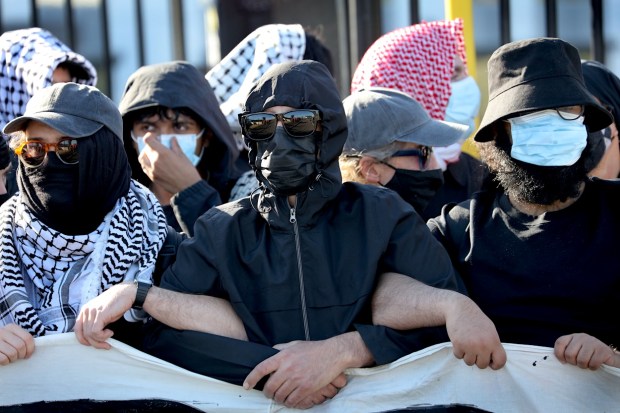
Almost inevitably, partway through his speech, a group of activists stormed into the lecture theatre. Their faces were hidden with keffiyehs and their clear aim was to disrupt the lecture and intimidate the audience and the speaker. Shouts of ‘war criminal’ (whether aimed at Wagner, the audience or the hostages, it was not clear) and ‘settlers go home’ echoed around the room for ten minutes. Rather more threateningly, they also chanted, ‘Israel, Israel, watch your back; Palestine is coming back.’ The intruders were not there for a debate and it was only once both security and the police had been called that they were eventually ejected.
This week, Baroness Hayter of Kentish Town tabled a written question in the House of Lords asking the government what action it intends to take to ‘protect academic freedom of speech and ensure students are able to attend lectures without experiencing threats or intimidation’ in light of the incident. It is good to see that it is being taken seriously in parliament. But it is hard to know what can be done in circumstances where some people seem to believe that the rules of civilised society do not apply to them.
Taken together, these episodes point to a wider problem: the apparent belief that a sufficiently worthy cause confers a licence to disregard the rules that govern everyone else. The rule of law cannot operate on that basis, and democracy cannot work if people believe they are entitled to intimidate others, disrupt legitimate events or dismiss legal restrictions whenever they disagree with them. The Palestinian cause is no exception to that principle.