Many years ago, I was on an appointments committee to select between two candidates for a lecturing position in the Politics department. (Yes, seeing you ask, I did have my time greatly wasted when I was a full-time academic.)
Candidate one was a nutty woman who believed that Cuba was some sort of paradise on earth. Candidate two was a post-structuralist specialist who wrote papers that were so impenetrable that it was hard to appreciate that they were written in English. He was a devotee of Michel Foucault.
I opted for candidate one in the belief that the students would be able to figure it out: what she believed was basically bonkers. By contrast, candidate two would have simply left them bamboozled. The complete mangling of language really did my head in.
I was thinking about this the other day when considering the importance of language when it comes to sensible discussion of economics and economic policy. For a long time, the progressive side of politics – note here the adjective ‘progressive’ – has captured the language of economics to slant the discussion in certain ways.
An early inclusion was the term ‘social justice’ to defend virtually all forms of government spending and intervention. More spending on education – to promote ‘social justice’. More spending on health – to promote ‘social justice’. The massive allocation of taxpayer funds to the National Disability Insurance Scheme – the quintessential example of promoting ‘social justice’.
The beauty of the term ‘social justice’ is its vagueness and the difficulty of opposing it. Hands up all those in favour of ‘social injustice’. Right, no one: proceed as planned. Even querying whether more government spending does promote social justice as defined, for instance, as lower measured income inequality is seen as a heartless act. Well-intentioned objectives are regarded as sufficient.
(The use of the term ‘economic rationalism’ to attack conventional economics always seemed very strange. ‘Economic rationalism’ was meant as a term of derision and was first widely used by the super-wet sociology professor, Robert Manne. He was bitterly opposed to the opening up of the Australian economy through the dismantling of import protection measures and the deregulation of the financial sector.
The trouble with the term ‘economic rationalism’ is the obverse is ‘economic irrationalism’. Hands up those in favour of ‘economic irrationalism’. I can’t see any hands.)
‘Austerity’ is another word used by the left to describe any attempt to cut government spending in a particular area. It’s worse than that: ‘austerity’ is used to denounce any attempt to cut the rate of growth of spending. The dollars are still rising, but by not quite as much as may have been planned.
This reached a ridiculous point after the Abbott government was elected and Tanya Plibersek – she became the deputy leader of the opposition and shadow minister of education in 2013 – took the misuse of language to new heights. Either by design or being thwarted by an uncooperative Senate, Abbott could not reduce government spending in any meaningful way. But Plibbers wasn’t having a bar of it: cuts, she cried, for the lower rate of increase in government spending on education than Labor had planned. Give me a break.
Swanny – Wayne Swan, Labor’s treasurer between 2007 and 2013, was a master of the distortion of words. ‘Saves’ he called them, when outlining the final budget outcomes. It turned out that saves didn’t just mean lower growth in spending but also included tax increases. Saves just had a better ring than lifting taxes.
Recall here his announcement in the 2012 budget of four surpluses. As it turned out, there were no budget surpluses but, hey, he had good intentions. (I can still have a good chuckle even thinking of him rising in the House and making that promise.)
Talking about the mangling of language in a parliamentary context, the naming of annual budgets is an example of marketing-driven falsehoods. In 2024, it was ‘Cost of living help and a future made in Australia’. In 2025, it was ‘Building Australia’s future’. This year it was ‘Resilience and reform: building an economy that works for all Australians’. Again, give me a break.
The budget papers should be serious, analytical documents in which future risks are given considerable objective weight. They are not the place to play politics. But as time goes by, they increasingly read like some lengthy advertisement to be assessed in the context of providing the greatest political advantage to the government.
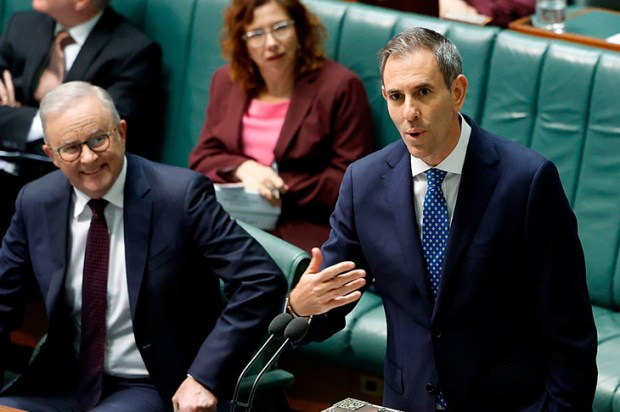
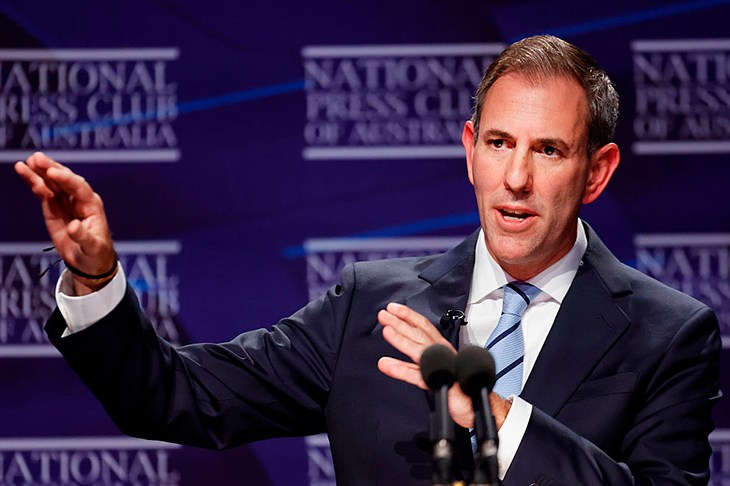
The fact that Jim Chalmers, the current Treasurer, could, in all seriousness, call his budgets examples of ‘responsible economic management’ tells you what a joke the whole process has become. Recall here that this year, ten deficits in a row are predicted as well as burgeoning government debt.
For a time, Jimbo was committed to introducing a Wellbeing Budget, whatever that means. Following the example of Jacinda over the Ditch, the intention was to measure what matters. ‘It’s about tracking our progress so we can better align our economic and social goals in our communities and right across our country.’
A feeble effort was made in putting together a Wellbeing Budget before it was quietly shelved, having been punted to some other department. It was a complete crock, but it is still surprising that Jimbo had the good sense to kill it before it developed a complete life of its own. After all, the Women’s Budget Statement appears every year: no one reads it, no one takes any notice.
Free trade agreement is another term that gets my goat. It is used by both the left and the right. The supposed free trade agreements are nothing of the sort. They are just a mangled group of concessions and special deals between the parties to the agreement. There is nothing ‘free’ about them. They are also not binding. When it came to changed circumstances, both China and the US violated important terms of the free trade agreements they have with us.
The proposed Australia-EU free trade agreement has been in the news lately. The highly pampered and protected farmers of the EU are basically unaffected by the agreement – there are some minimal, long-term increases in quotas for certain agricultural products. But here’s the real kicker: the agreement attempts to lock Australia into the terms of the Paris climate accord. What does this have to do with free trade?
Enough is enough, I say. It’s time to recapture the language from the left and start to use accurate objective terms to describe economic outcomes and budgets. Make the case for living within our means, for budget surpluses and repaying government debt.
Don’t pretend that inputs are the same as outputs, that targeted government spending can achieve outcomes without throwing off unintended consequences and at potentially vast cost.
Treating economics as the basis for misleading marketing campaigns needs to end. Promising the unattainable is ultimately a low act. Sensible politicians take note.
Got something to add? Join the discussion and comment below.
You might disagree with half of it, but you’ll enjoy reading all of it. Try your first month for free, then just $2 a week for the remainder of your first year.