On September 8, British Foreign Secretary Ed Miliband announced an import ban on goods from Israeli communities beyond the 1967 lines, sanctions against companies providing construction, infrastructure, financing, or real-estate services there, and a ban on British advertising of property in those communities. He insisted that the measures target settlements rather than Israel and declared his opposition to BDS. The distinction is sententious reassurance. Commercial restrictions rarely respect the political line drawn for them, particularly when banks, insurers and importers must guess where liability begins.
Supporters call the policy a historic shift. They are right. JNS reports that the targeted areas account for about $250 million of Israel’s $159 billion in exports. The immediate loss may be modest; the precedent established by the machinery is not. Geographic prohibitions, corporate designations, and financial penalties create a chilling effect as firms avoid transactions whose provenance may later be questioned. Mark Goldfeder has noted that Britain’s postcode logic may even classify the United States embassy in Jerusalem as situated in a settlement. A supposedly narrow boycott can become a compliance wall around Israel.
Britain is not acting alone. France, Canada, and nine other countries joined the initiative. London is furnishing them with a sanctions template. Once one government defines prohibited territory, companies, services, and financial relationships, another may copy and enlarge the categories. Elliott Abrams observed that the rules may change during the six to nine months before they take effect. Every cautious corporate lawyer will assume that they can expand again.
The policy first raises a question of moral proportion. Britain condemns the Hamas massacre of October 7, yet directs its coercive measures principally against Israel. Hamas began the war, Iran sustained its machinery of aggression, and Israel receives the commercial penalties. The atrocity remains in the preamble while the defending state becomes the defendant. Britain does not formally absolve Hamas; it performs something politically more useful by redistributing the consequences.
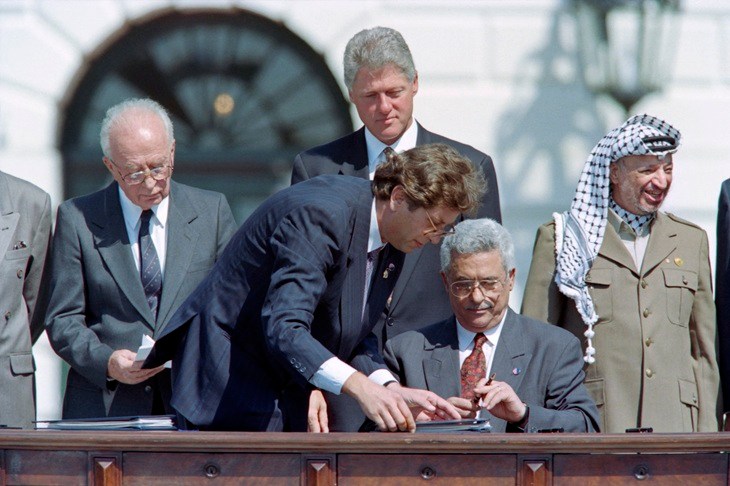
The legal contradiction is equally serious. The 1995 Interim Agreement placed Area C, including its Israeli communities, under interim Israeli civil and security control. Settlements were reserved for permanent-status negotiations. Oslo neither granted Israel final sovereignty nor conclusively decided the legality of the communities. It contained no express construction freeze, although opponents invoke its prohibition against unilateral changes in status. Britain is no longer encouraging negotiation over that unresolved question. It is deciding the question in advance and punishing one party accordingly.
Why, then, does Britain remember only the clauses that restrain Israel? Article XV required both sides to prevent terrorism and prosecute offenders; Article XXII required them to suppress incitement. Palestinian security cooperation has sometimes saved lives, yet the broader record includes recurring terrorism, official incitement and financial benefits connected to attackers. A 2026 State Department report concluded that the Palestinian Authority provided $156 million in payments and benefits to terrorists and their families during 2025 despite its announced reform. Where are Britain’s sanctions upon the Palestinian institutions that violate these obligations? Where is its prohibition upon businesses linked to terrorist financing or official incitement? An agreement cannot remain binding wherever it restrains Israel and become aspirational wherever it binds Palestinian institutions.
Miliband’s moral posture becomes still less defensible when tested against Britain’s own territorial disputes. Gibraltar is a self-governing British Overseas Territory whose defence and foreign affairs remain Britain’s responsibility. Spain continues to contest British sovereignty and has even characterised British Gibraltarians as colonial settlers. The territory was captured by British and Dutch forces in 1704 and ceded to Britain under the Treaty of Utrecht, yet Madrid disputes the extent and consequence of that settlement. National Geographic records that more than 98 per cent of Gibraltarians rejected shared sovereignty with Spain in the 2002 referendum. Britain therefore regards history, treaty, local government and the wishes of the inhabitants as facts that cannot be erased by Madrid’s assertion of sovereignty. London would not accept Spanish sanctions upon Gibraltarian construction companies, banks or property advertisements. It would not describe every British family living there as an illegal settler merely because another government disputes the territory.
The Falkland Islands now provide an even more exacting comparison. Argentina claims the islands and describes British-authorised resource development in their surrounding waters as unlawful. The Sea Lion oilfield is being developed under Falkland licences by Britain’s Rockhopper Exploration and Israel’s Navitas Petroleum. President Javier Milei has announced sanctions against participating companies, sent warnings to entities in numerous countries and given Britain two weeks to halt the project or face proceedings before the International Tribunal for the Law of the Sea. Sky News reports that Argentina calls the activity illegal exploitation of its resources and denies that the islanders’ right of self-determination applies because, in its view, Britain implanted the population in disputed territory.
Britain’s response is illuminating. The government says Argentina is attempting to deny the islanders the right to pursue their own economic development and decide their own future. It maintains that the local government issued valid licences and invokes the 2013 referendum in which 99.8 per cent of participating voters chose to remain a British Overseas Territory. TIME records London’s promise that its support for the islanders’ self-determination is unwavering and that Britain will always defend it.
That defence is understandable. Its principles are also fatal to Miliband’s conceit. Argentina says the territory is disputed, the population lacks an applicable right of self-determination, and commercial licences issued by the local authority are illegal. Britain replies that a claimant cannot settle sovereignty by assertion, extinguish the inhabitants’ agency, or criminalise their economic life. Miliband then turns toward Judea and Samaria and adopts the method Britain rejects in the South Atlantic: disputed status becomes predetermined guilt, locally authorised commerce becomes illicit and the people living there become proper objects of collective economic punishment.
No comparison among Gibraltar, the Falklands, and Judea and Samaria is exact. Exact equivalence is unnecessary. The relevant question is whether Britain applies its stated principles consistently. Why may British security, historical claims, local consent, and negotiated arrangements qualify international demands, while Israel’s corresponding interests disappear? Why does a Falkland licence deserve legal respect while an Israeli permit becomes evidence of criminality? Why is economic development a right when asserted by British islanders, yet a provocation when undertaken by Jewish families? Why must Argentina await negotiation while Israel is sentenced before negotiations conclude?
Britain may answer that the legal histories differ. Of course they do. Every territorial dispute possesses a distinct history. That truth is precisely why Miliband’s categorical language is dishonest. Gibraltar is governed through a treaty Spain contests in part; the Falklands are administered by Britain under a sovereignty claim Argentina rejects; Britain’s Antarctic claim overlaps those of Argentina and Chile while all such claims remain in abeyance under the Antarctic Treaty; its sovereign bases at Akrotiri and Dhekelia were retained under the 1960 settlement establishing independent Cyprus; and the waters surrounding Rockall remain entangled in competing fisheries and seabed interests. Judea and Samaria likewise remain subject to competing claims and agreements that deliberately postponed final status. Britain inhabits a world of treaties, strategic necessities, overlapping claims, local consent and unfinished negotiations. Only when Israel is judged does complexity mysteriously disappear and accusation become adjudication.
The hypocrisy becomes more pronounced because the Falklands controversy now involves an Israeli company. Navitas may be sanctioned by Argentina for operating under British-supported licences while other Israeli companies are sanctioned by Britain for operating under Israeli-supported authorisations. London asks the world to reject Buenos Aires’s coercion against commerce in disputed territory even as it perfects its own machinery for coercing Jewish commerce elsewhere. The principle is not territorial consistency. The operative distinction is whose territory, whose licences and whose people are being judged.
Chagos exposes another version of the same selective flexibility. In 2019, the International Court of Justice concluded that Britain’s separation of the Chagos Archipelago from Mauritius had prevented the lawful completion of decolonisation and that the United Kingdom should end its administration as rapidly as possible. Britain did not respond to that adverse judgment by declaring every British activity on Chagos illegitimate or sacrificing the strategically indispensable base on Diego Garcia. It negotiated. In 2025, Britain and Mauritius signed an agreement intended to restore Mauritian sovereignty while preserving the operation of the base. Whatever one thinks of that settlement, Britain asserted its right to reconcile international law, defence, existing arrangements, and strategic necessity through negotiation. Miliband denies Israel the same latitude even though Oslo itself reserved the contested questions for negotiation.
Britain’s treatment of Northern Ireland offers the same lesson in another form. Its status rests upon consent, negotiation and the disarmament of paramilitaries, not rewards conferred by violence. London would never have argued that terrorism relieved one party of its obligations while converting the other party’s disputed civilian presence into the sole obstacle to peace. The peace process survived because obligations ran in both directions and because violence was not permitted to acquire a moral veto.
Israel should answer with an Equal Standard Initiative. It should publish a comparative legal record covering Gibraltar, the Falklands, Northern Cyprus, Western Sahara, and other territorial disputes; demand a statutory firewall protecting lawful commerce with Israel; challenge unsupported designations in British courts; and require London to state the policy’s ultimate boundary. Every demand upon Israel should be paired with measurable obligations concerning Hamas’s disarmament, Palestinian incitement, terrorist financing and security cooperation. Retaliation should remain graduated and directed at responsible institutions rather than Britain indiscriminately.
Israel’s initial response has already imposed diplomatic costs by closing the British consulate and limiting London’s role. Deterrence, however, requires more than pain. It requires a rule. Any government claiming to distinguish disputed communities from Israel must write that distinction into law, accept the same rule in its own territorial controversies and enforce both halves of the agreements it invokes.
Miliband is entitled to criticise Israeli policy. He is not entitled to transform Britain’s preferences into settled international law while Britain invokes history, consent and self-determination for itself. A country that tells Argentina it may not punish Falkland Islanders for living and trading under British authority cannot punish Israelis for living and trading under Israeli authority without first confronting its own argument. Britain cannot demand negotiation in the South Atlantic, pre-emption in Judea and Samaria, enforcement of Israel’s half of Oslo and indulgence toward the Palestinian half. That is not a rules-based order. It is one rule for Britain, another for Israel, and a sanction regime constructed to conceal the difference.
Aaron J. Shuster is a Jewish-American writer, philosopher, cinematist and producer whose work examines politics, culture, history and the Middle East. His political commentary has appeared in The Spectator Australia, FrontPage Magazine, Middle East Quarterly and The Observer.