When I moved from Germany to Britain more than 15 years ago, I soon realised how large the two world wars still loomed in the public imagination. My new friends, neighbours and colleagues quipped ‘Don’t mention the war’ and gave me boxes of tissues on VE Day. It was all done in good spirit, but sprang from a cultural backdrop I struggled to understand – until I’d caught up with enough episodes of Fawlty Towers, Blackadder and Dad’s Army to get a sense of what the British-German journalist Matt Frei once called ‘the British obsession with the Krauts’.
While often concerned with the second world war, that preoccupation is actually much older; and it is mutual. In the 19th century, the exiles Karl Marx and Friedrich Engels simultaneously admired the political freedom they enjoyed in Britain while criticising the excesses of commercial freedom, as evident in ‘Manchester capitalism’. Both conditions struck them as compellingly different from German-speaking Europe. During the 2008 financial crisis, Chancellor Angela Merkel tapped into similar ideas when she lamented that ‘we still have a strongly Anglo-Saxon-dominated system’, while a few years later expressing deep regret over Brexit.
So Germans, too, have a special obsession with the British. And no wonder. Over the centuries, the two nations have been friends, rivals, partners and mortal enemies. Now a new history, Great Powers, re-examines that complex relationship, arguing that there was nothing inevitable about how it unfolded. At each stage, specific decisions determined war and peace, argues Jan Rüger, a professor of history at Birkbeck College, University of London. Therefore, he says, it is also in our hands today what happens next.
The author of previous British-German histories, Rüger now sets out to explain what he calls the ‘Anglo-German paradox: that two nations so closely enmeshed could simultaneously be each other’s most formidable enemies’. Great Powers is extremely ambitious in scope, aiming to tell a story that spans more than three centuries, beginning with the assumption of the throne of Great Britain and Ireland in 1714 by George I, Prince-Elector of Hanover, and ending with Keir Starmer, Friedrich Merz and the geopolitical challenges of the mid-2020s. Rüger pulls off this remarkable feat with panache, somehow squeezing a wealth of masterful research into an eminently readable book.
I found the first third particularly enjoyable, which covers a phase in the German-British relationship that receives significantly less attention than the wars of the 20th century. Here Rüger outlines the fruitful, if ambiguous, connection between Britain and Germany in the 18th and 19th centuries through many fascinating vignettes.
We learn, for instance, that George I was ridiculed almost continually by his British subjects. His ‘Germanness did wonders for the work of the satirists’, Rüger notes dryly. They lampooned him for his accent, dress, looks and entourage. They called him the ‘turnip king’, round, pale and purple, and there was also intense sexual mockery of his philandering wife. But there was a serious dimension to all this – namely the question of royal legitimacy, for which the foreignness of the new monarch provided a convenient vehicle. ‘King George has no more right to the Crowne than my Arse,’ one attorney pronounced in public.
From the lofty heights of court politics, Rüger frequently descends to street level, where interactions shaped how the two nations regarded one another. Well into the 19th century, he tells us, this relationship was asymmetrical. Plenty of Germans came to Britain, drawn by the opportunities of empire, the scale of London and by what they saw as a specifically English form of artistic and commercial freedom, soon dubbed Englische Freiheit.
‘England is, and remains, the world market,’ Wilhelm Siemens told his brother Werner in 1860. While Werner launched what was to become Europe’s largest engineering conglomerate from Berlin, his brother followed a similar path in Britain. Both Siemens companies co-operated, laying submarine cables that connected Britain with the world, including the first transatlantic line to the US and Canada as well as the first cable from Britain to India. But Britain’s commercial Freiheit was also often seen as machine-like coldness by German observers. This stereotype runs through the relationship on both sides.
Take the writer Heinrich Heine, who moved to Britain in 1827. He enjoyed the absence of the tight censorship he had experienced in the German lands. But London both awed and appalled him: ‘This stone forest of houses and, in between, the stream of living human faces, with all their colourful passions, with all their horrendous haste caused by love, hunger and hatred.’ The dizzying haste, Heine thought, came from the need to fund the city’s lavish excesses: ‘That is why John Bull has to work day and night; he has to accumulate the money that will cover these expenses.’ Germany seemed provincial, backward, bucolic and innocent by comparison.
How could two nations so closely enmeshed be simultaneously such formidable enemies?
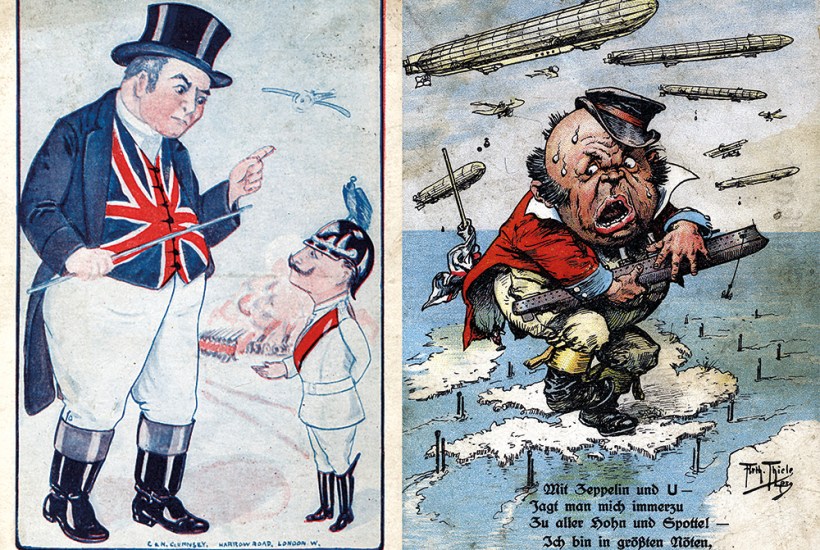
That image flipped in the 20th century. After German unification in 1871 and the subsequent economic boom, Kaiser Wilhelm II’s country began to overtake Britain in some industrial sectors. Suddenly British critics were inclined to use very similar language to the earlier tropes about machine-like Britain to describe the German empire as a nation of ruthlessly efficient, servile subjects. Rüger quotes from the Daily Mail’s article ‘Our German Cousins’, published in 1909, which claimed that the population of Germany was a ‘machine’ in which every person was, ‘by upbringing and by conviction, but a unit of the great whole… exactly defined by the State’. Britain, by contrast, began to cultivate a sort of Hugh Grant-esque image of a nation of amateurish, gentlemanly charmers.
The horrendous conflicts of the past century between the two countries compounded this idea. So kudos to Rüger for covering these complex and highly contested areas of research with restrained clarity – from the causes of the first world war to the Treaty of Versailles and the debates around appeasement. Where Great Powers is particularly compelling and original is on the longue durée. Rüger emphasises that Adolf Hitler’s long-held conviction that Britain and Germany were destined to enter into an alliance, which would allow the former to pursue a global empire and the latter continental hegemony, came on the back of Germans arguing similar things for centuries. The problem was that the notion never appealed to Britain, which sought a balance of power on the continent. Neither Kaiser nor Führer understood that.
In the second world war section, a well-trodden field in both academic and popular history, Rüger delivers fresh material and perspectives. These notably discuss what it was like for British-German families to live through the conflict and the surprising extent of prewar collaboration between MI5 and the Nazi authorities to identify communists.
Despite the book’s length, it’s worth reading from cover to cover. There is something rewarding to discover in every chapter, as Rüger moves between high politics, battlefield action and the daily lives of citizens. The final third, which focuses on British-German reconciliation in the postwar era and how both nations moved into the present century, is potentially controversial. As he shifts from history to current affairs, Rüger occasionally abandons his carefully neutral stance and lets his views on ‘the strategic folly of Brexit’ show.
This is where the book’s thesis – that the destruction of the British-German relationship was ‘the result of decisions taken by specific politicians in specific circumstances’ rather than the logical outcome of the rise and fall of great powers – turns into a call to action. Rüger argues that if war was a choice, it follows that peace and reconciliation are too. To him, the ‘crises of recent years are a reminder of how foolish it would be to take any of that for granted’. It’s a compelling note on which to end an important book. Great Powers should be read far and wide – on both sides of the North Sea.
Got something to add? Join the discussion and comment below.
You might disagree with half of it, but you’ll enjoy reading all of it. Try your first month for free, then just $2 a week for the remainder of your first year.