Early in Butch Cassidy and the Sundance Kid, Butch finds himself facing the intimidating Harvey Logan, who has decided that leadership of the Hole-in-the-Wall Gang will be settled in the traditional manner. What follows is one of the film’s comic masterpieces. Butch does not freeze, and he certainly doesn’t telegraph fear. Rather than deliver a lecture on the rules of fair combat, he starts discussing the fight with the air of a bureaucrat organising a committee meeting. Are kicks permitted? Should they strip to the waist? Is there a referee? The spectacle of two outlaws attempting to establish Queensberry rules in a dusty canyon is absurd enough, and that is precisely the point. While Harvey is still trying to work out when frontier violence acquired a standing orders manual, Butch kicks him squarely in the groin. Civilisation has done its work. The contest is over before it has properly begun.
The key takeaway from the scene is that Butch knows when to talk and when to make the decision to fight. The scene is funny precisely because the gap between the language of rules and the reality of power is so wide. It is also instructive. When fate dictates you must negotiate with an adversary you fundamentally do not trust, and when the alternative to action is paralysis through analysis, the only rational course is to engage in conversation while preparing to strike at the most vulnerable point.
That is roughly the position the United States now occupies with respect to China and advanced artificial intelligence. Both powers are racing toward systems that may cross the threshold into something closer to superintelligence. Both understand that the first to achieve decisive advantage may inherit a form of technological dominance that is difficult to reverse. And both have begun, at least in public, to speak the conciliatory language of limitation. The question is whether genuine negotiation is possible between parties who regard each other with deep strategic distrust – or whether one side is simply performing the Butch Cassidy manoeuvre while the other is still discussing the rules.
In the poem Beowulf, negotiations belong to the civilised order. Anglo-Saxon society managed conflict through diplomacy, truces and Wergild, the death price that substituted compensation for endless feud. Grendel stands outside that order. He will not parley. He recognises no human law of settlement. Against such a creature, the only remaining language is force.
China is not Grendel. Beijing has not rejected the idea of rules in principle. In July 2026, it hosted the founding of the World AI Cooperation Organisation in Shanghai, drawing in twenty-nine countries, many from the Global South. The United Nations has held its Global Dialogue on AI Governance and the US State Department has convened successive Pax Silica Summits. These are not the actions of a power that has entirely abandoned diplomacy. Yet the suspicion in Washington and among its allies remains sharp – that China’s preferred ‘governance’ constrains American progress while leaving Chinese programs free to continue. In short, negotiation on terms that amount to unilateral restraint. A classic ‘rules for thee, but not for me’ scenario.
Taking arms control negotiation history as a template offers limited comfort. The Strategic Arms Limitation Talks in the 1970s and 1980s rested on a rough parity of destructive power and on the shared recognition that a full nuclear exchange would leave both sides devastated. Superintelligence is different. The advantage may be ‘winner takes considerably more’ rather than mutually assured destruction. The process of verification is far harder. You can’t count algorithms as they do not leave the same physical signatures as missile silos. And the technology is dual-use in ways nuclear weapons are not. A system that can accelerate scientific discovery can equally accelerate military innovation and social control. Negotiating limits under those conditions means knowing exactly what you cannot concede, while assuming the other side will exploit every ambiguity you leave them.
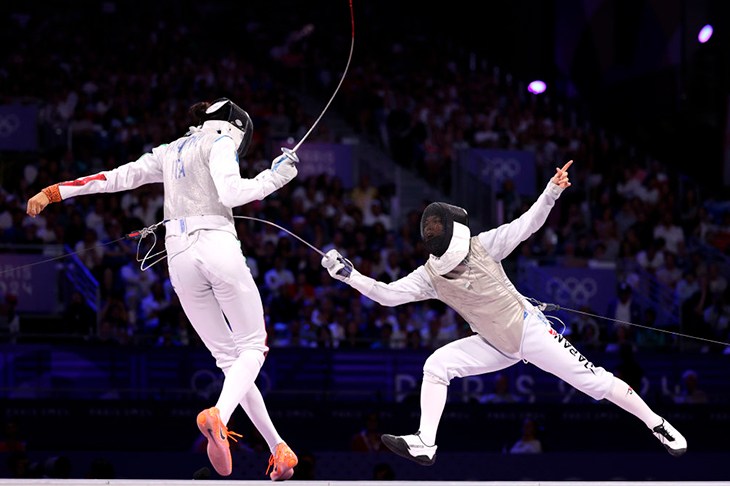
This makes the problem less like disarmament between friends than a contest in which both sides must cooperate just enough to keep competing. Fencing offers an oddly useful analogy. It is that delightfully absurd pastime in which two otherwise sensible adults strap on masks, seize long, sharp pieces of metal, and proceed to try to stab each other while simultaneously agreeing, with the utmost sincerity, that nobody must actually get hurt. An injured opponent is, after all, an opponent who might sensibly decide never to show up again. The contest therefore depends upon a peculiar kind of cooperation – each fencer needs the other intact, motivated and willing to return tomorrow. It is a symbiotic relationship conducted at sword-point.
Around 1900, the French and Italian schools of fencing fought a parallel contest over the soul of their sport as it moved from lethal duels towards the Olympic stage. The French tradition prized elegance, precision and deception – fencing as a light, finger-controlled ‘game of chess’. The Italian school emphasised force, speed and athleticism, rooted more obviously in combat – deep lunges, powerful blade actions and aggressive attempts to dominate the opponent’s weapon. National pride was fully engaged. Yet the emerging international sport required both traditions to accept rules that constrained what either side could do.
That is the more useful analogy for AI. The US and China are competitors, but competition does not necessarily eliminate interdependence. Each has an interest in preventing the contest from producing consequences so destructive that there is no worthwhile contest left to win. Unconstrained American techno-optimism will not reassure partners or restrain rivals. Chinese preference for state-directed development wrapped in the language of international cooperation will not, by itself, calm those who fear concentrated power. Any workable regime will therefore need both competition and restraint – enough freedom to preserve technological dynamism, but enough agreed limitation to ensure that tomorrow’s bout can still take place.
Australia’s interest is direct. We live in the region where Chinese power is most immediately felt. We are bound by alliance to the US. We have our own research base and critical minerals. A world in which advanced AI becomes another arena of unconstrained great-power rivalry is a more dangerous world for a middle power. A world in which the leading states manage to establish even limited rules of the road is one in which smaller players retain more room to manoeuvre.
Butch Cassidy did not win by pretending Harvey Logan was a reasonable man open to prolonged procedural discussion. He recognised the necessity of action and the comic futility of establishing perfect rules in the middle of a brawl. Beowulf’s world distinguished between those who would parley and those who would not. The French and Italian fencing masters eventually subordinated pure doctrine to the requirements of the shared order.
None of these lessons maps perfectly onto silicon. Together they suggest that the time for paralysis through analysis has passed. The question is whether Washington and Beijing can still find a language in which to negotiate with an adversary each fundamentally distrusts – before one side decides that the only remaining option is a kick to the groin.
Got something to add? Join the discussion and comment below.
You might disagree with half of it, but you’ll enjoy reading all of it. Try your first month for free, then just $2 a week for the remainder of your first year.