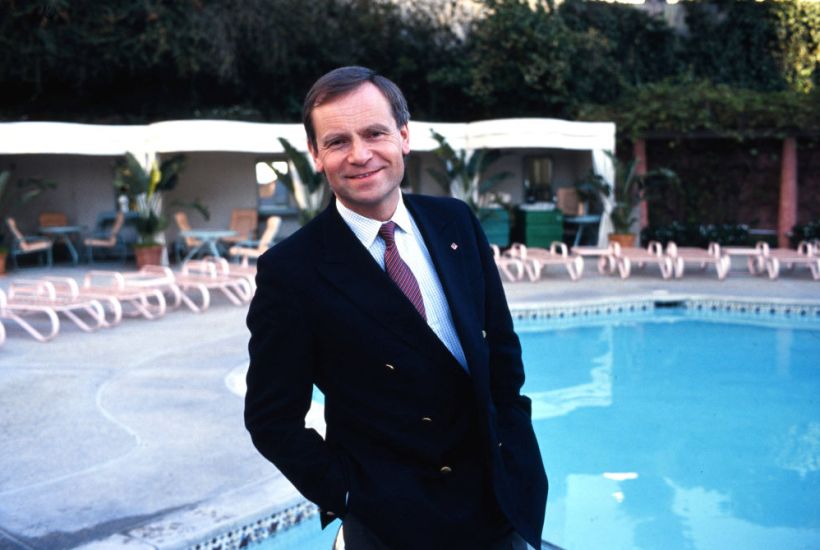
The news of the death of Jeffrey Archer at 86 came in somehow typical circumstances. The bestselling novelist, Conservative peer and all-round reprobate was hard on the publicity trail for Adam and Eve, which he was calling his final book, although, typically, he was leaving the door ajar for future literary endeavours. Apparently his ‘sudden and peaceful’ death came between writing sessions at his Westminster penthouse. A home where he liked to show guests at his famous Krug and shepherd’s pie parties the views over the Thames that Monet had once painted.
Lord Archer somehow lived larger than everyone else in his orbit, or indeed any comparable figure in public life
Lord Archer somehow lived larger than everyone else in his orbit, or indeed any comparable figure in public life. He made Jeremy Thorpe look somehow timid. His political career was ultimately undistinguished. His much sought-for berth as Mayor of London never happened, despite a great deal of comparison, put about by himself, as being the Dick Whittington of our times, and he surprised many, while he was a Conservative MP, for continually backing causes that were usually the preserve of the left, such as free admission to museums, the lowering of the age of homosexual consent and the removal of VAT from theatre tickets (perhaps because he so frequently invested in productions).
Yet to describe Jeffrey Archer as merely a politician was rather like calling Charles Dickens a fireside storyteller. What made Archer such a compelling character, whether for sketchwriters, biographers and now obituarists was that he refused to live by the conventional dictates of society, and become hugely wealthy and a household name in the process. Through a combination of boldness, chutzpah and wiliness, he usually managed to come out on top of the situation, even if it had been his own folly that got him into the mess in the first place.
Perhaps only Archer, for instance, could have written his first bestseller, Not a Penny More, Not a Penny Less, as a successful means of evading bankruptcy. But only Archer, by the same token, would have invested all the money he had, plus a huge amount more, in a fraudulent company known as Aquablast, leading to the threat of bankruptcy in the first place. And, to round matters off, only Archer, summoned as the chief prosecution witness against the company, could have derailed the case by being caught up in his own spot of legal bother, when he was accused of stealing suits from a Canadian department store.
Archer was involved in countless scandals – financial, sexual, literary – that would have finished off a lesser man, and indeed his four-year criminal sentence would have sent most of his peers into obscurity. It was typical of Archer that he took the opportunity for reflection offered by his incarceration to write a (rather good) trilogy of books chronicling his experiences in prison, and, after he had served his sentence, to return to public life with just as much brio as before. The shepherd’s pie parties continued, and many of those who had loudly denounced his lack of moral probity when he was convicted once again attended them. It was typical of their host that he did not bear a grudge but instead saw all such things as part of the great game of politics and life that he had been so immersed in for decades.
I only ever met Archer once, shortly after he was released from prison, and he was doing a talk at Trinity College, Oxford about penal reform. Somehow, the evening summed the old malefactor up in miniature. I was given a front-row seat in a packed auditorium because Archer spotted my (attractive, blonde) companion and winked at her. He then delivered a barnstorming, essentially meaningless speech in which he compared himself to the Count of Monte Cristo, Papillon and, for some reason, Ronnie Barker in Porridge. Then at the afterparty – because, obviously, there had to be an afterparty whenever Jeffrey Archer was involved – I asked him if he would be interested in giving me an interview for the student newspaper I was involved in. His reaction was practiced. Another wink, a hand on the arm, a look at my companion – a lingering look – and then ‘I’m not supposed to be giving any interviews. Terms of my probation.’ A perfectly timed pause. ‘But if you bring her along, I’ll see what I can do.’
The encounter never came to pass. But I have always remembered him with great fondness, as a rogue who contributed to the gaiety of nations, and as a man who knew how to charm, amuse and appall in equal measure. Like Hamlet reminiscing about his father, I can only express my sorrow that I shall not look upon his like again.
Listen to one of his final interviews here: