It makes for a good pub quiz question: what has 632 people, 202 horses, 55 dogs, 41 ships and only six women? Along with the UK’s heatwaves came Bayeux Tapestry fever as the Canterbury Embroidery returned to England for ten months after something approaching a millennial sojourn in France. The British Museum was barely able to cope with the demands on its website for the first tranche of tickets to visit the exhibition.
It is easy to see why. The Tapestry depicts, in an abundance of endlessly fascinating detail, that most famous date in English history: 1066. In popular perception, the doughty Anglo-Saxons narrowly lost to that bastard Duke William and his land-grabbing Normans at the Battle of Hastings, consequently being forced to submit to the Norman yoke. It was a true revolution in politics, religion and society. William all but swept away the upper echelons of magnates to reward his followers; Norman saints vaulted over English ones in newly erected stone churches; and a vast castle-building programme stamped the authority of the new power across the land. Eadwig and his missus Hildgyth among the peasants would also have noted the changes.
All this stemmed from William’s success at Hastings in October of that fateful year. But had the duke, born illegitimate, now, by force, become a legitimate king? He could point to his victory on the battlefield as a God-given judgment on his claim to the English throne. However, he and others clearly felt this was insufficient proof – hence the Tapestry. The magnificent, 225ft- long monument of shameless propaganda is lucidly explicated in a superb accompanying book from the British Museum, in which a host of distinguished medievalists re-examine this most iconic relic from the past.
For all that it has been studied, there remain uncertainties. We know that, technically, the Tapestry is an embroidered textile (don’t ask me to explain its stem-, laid-and-couched- and satin-stitch techniques: the book does that). On other matters, we rely on speculative, if often challenged, consensus. Displaying ‘strong affiliations to both sides of the English Channel’, it was ‘likely designed in Canterbury’ (the English were renowned for their needlework), its creation dating to somewhere between 1067 and the 1070s. The earlier date is gathering favour, being ‘a time when the newly crowned William the Conqueror still hoped to rally the English to his cause and forge a united Anglo-Norman kingdom’. If so, it did not prevent widespread rebellion in 1069.
Readers of this impressive book and visitors to the exhibition will have their attention drawn to key scenes. An early one shows Earl Harold swearing a pledge before William, almost certainly in acknowledgement of the duke’s ‘rightful’ succession to the throne of England, ‘despite Prince Edgar [Ǣtheling] by now being prepared to succeed’ Edward the Confessor. William liked to present – or even fabricate – such oath-taking ceremonies to vindicate his landgrabs. The appearance of Halley’s Comet soon afterwards is a ‘disquieting’ omen, underlining Harold’s subsequent sacrilegious oath-breaking.
And, in the most famous depiction of an English royal death in history, is King Harold really killed by an arrow in the eye? Written sources claim he was hacked to pieces. The two figures under the inscription ‘Here Harold is killed’ – one struck by an arrow, the other by a sword – are totally different, but we ‘cannot rule out the possibility that they represent the same person’.
Never backward in coming forward, Odo is all over the narrative
The book, interestingly, suggests that in addition to its overt propaganda purposes, the Tapestry may have been a transportable artwork, unfolded at gatherings ‘as the basis of a spoken performance’, with a narrator expanding on the story. One can easily envisage an actor hamming it up, embellishing the scenes with dramatic flair. After all, ‘history’ was a form of entertainment at the time.
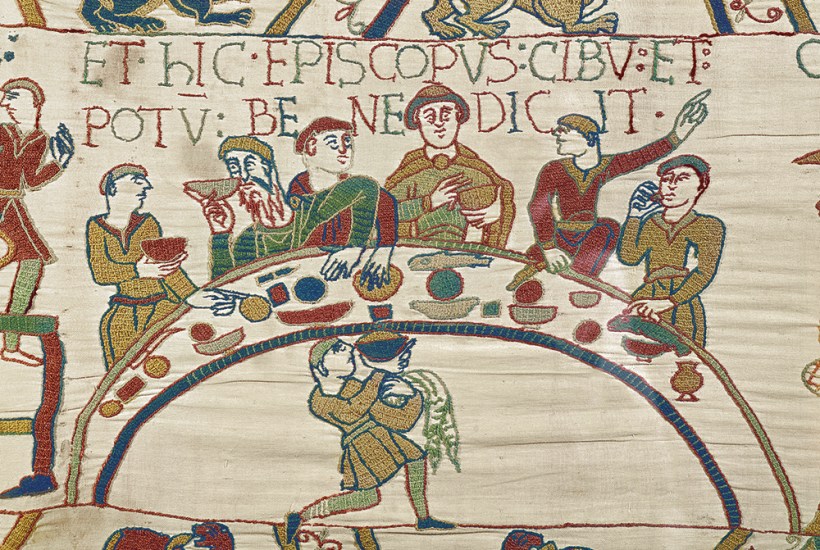
William’s half-brother Bishop Odo of Bayeux is considered the Tapestry’s probable patron. Never backward in coming forward, he is all over the narrative, most notably presiding over a pre-battle feast, administering a Christ-like benediction, and rallying the troops at a critical juncture of the combat, wielding his club (or is it a baton of command?), reminding William of his debt to him.
Splendid as the book is, at its hefty price one might have hoped for glossier paper. Still, the large-scale reproductions of the whole Tapestry allow for endless perusal of the fascinating details which reward constant revisits with new discoveries each time. The undisputed importance of the Tapestry explains the spate of new and revised books devoted to it. Especially worthy of mention is the update of David Musgrove and Michael Lewis’s The Story of the Bayeux Tapestry (Thames & Hudson, £12.99).
The temporary return of the Tapestry deserves all the hype surrounding it, and the accompanying exhibition book adds further to the excitement.
Got something to add? Join the discussion and comment below.
You might disagree with half of it, but you’ll enjoy reading all of it. Try your first month for free, then just $2 a week for the remainder of your first year.