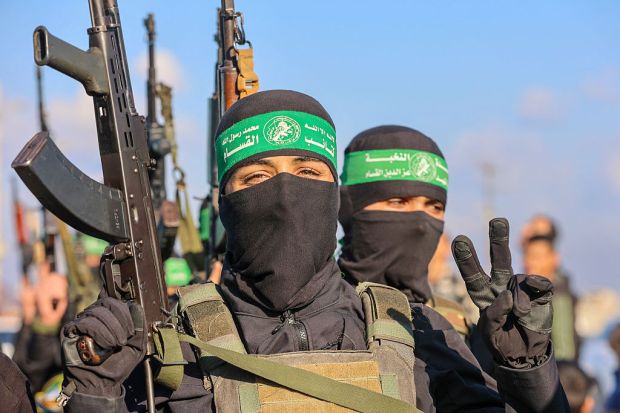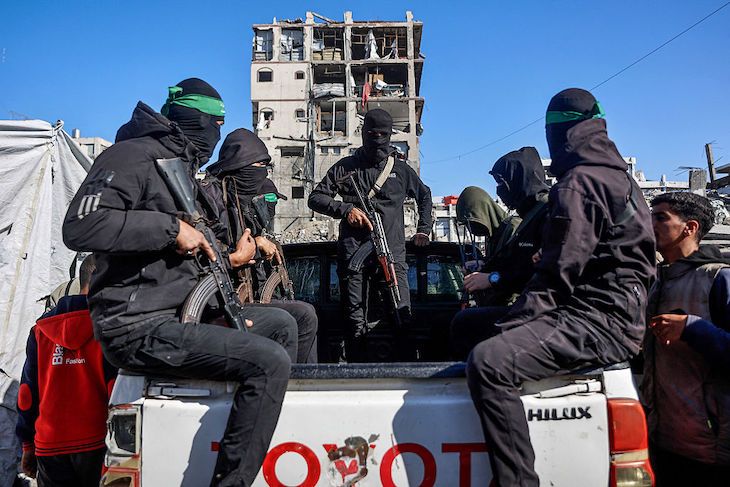
The failure of the British state is long-term and corrosive. It emerged this weekend that Mr. X, a former bodyguard of Hamas leader Ismail Haniyeh, was allowed to settle in the UK and given British citizenship – before going on to allegedly coordinate a Hamas terror plot in Germany. He also faces separate terror charges in this country.
The case of Mr. X was quickly followed by the news yesterday that Britain’s Home Secretary plans to launch a new resettlement scheme which prioritizes Afghan women and girls, and Palestinians of both sexes.
By the time Mr. X arrived, a succession of Hamas exiles had already made England their home
The chronology as it has emerged so far is well worth examining. From 2006, Mr. X had a clear public presence in Gaza as part of the security detail for the Hamas leadership. His identity would be known to any security agency who cared to look. In 2015, we granted him leave to remain and later, citizenship. Following the murderous October 2023 Hamas attacks, X attended demonstrations outside the Israeli embassy, and by 2025 was traveling widely including to Egypt, Qatar and Turkey. That same year he was allegedly handling weaponry in Austria and Germany. He was arrested in London in November 2025 – on information supplied to the British authorities by Germany and Israel.
In the specific case of Mr. X, it is unclear what his grounds for claiming asylum were, or what due diligence (if any) was conducted into his background. Some significance may be attached to 2012 being his apparent year of arrival. That was at the peak of the Arab Spring, the year the Muslim Brotherhood’s Mohamed Morsi won the Egyptian elections. Some rather naively considered a democratic Islamism could progress in a region long characterized by autocracy and political failure. Hamas was, of course, founded as the Palestinian wing of the Muslim Brotherhood. Nor would Hamas membership per se have barred someone from Britain. Hamas’ military wing, the Al-Qassam Brigades, had been proscribed in 2001, but the group was not banned in its entirety until 2021, including its political wing. By the time Mr. X arrived, a succession of Hamas exiles had already made England their home.
It is not just the Islamists who understand that the UK serves as a safe haven for Middle Eastern activists. The United States has also noticed. In January 2026, it sanctioned long-term British resident, Zaher Birawi, in an attempt to disrupt what it referred to as Hamas’ “covert support network.” Birawi strongly denies any wrongdoing.
Are there more cases like that of Mr. X in the pipeline? The Labour government in Britain is now committed to bring in bigger numbers of Palestinians. While counter-terrorism databases may be examined, what social media analysis is being conducted of those who seek to live here? Across the Channel, in 2025 the French government suffered a major scandal when a female Palestinian student it had supported, Nour Attaalah, was exposed as having shared social media content which praised Hitler, and that called for the televising of the execution of Israeli hostages held by Hamas.
We live in age where the Home Office issues leaflets to asylum seekers on “Understanding behaviors and expectations in the UK” – widely viewed as leaflets telling migrant men not to rape or harass women. What new materials will now be needed as a result of the push to admit more Palestinians? Who, exactly, has lobbied for greater numbers of Palestinians to come here? Can we now be shown how this significant government decision came to be made?
In a country experiencing a crisis of antisemitism, including a lethal terrorist attack on a Manchester synagogue last year, is it wise to bring in greater numbers of Palestinians from a conflict zone – a conflict where many of them consider Britain to have been on the wrong side? Has the government conducted an Equality Impact Assessment into how increasing the number of Palestinians in the UK will impact upon British Jews?
Finally, the British public, long restive on the issue of immigration, might expect the Muslim majority nations of the Organization of Islamic Co-operation (OIC) to be the first port of call for Afghans and Palestinians seeking refuge. Why Britain?
What then needs to be done? Firstly, we need to establish what went wrong in the case of Mr. X – and others. The migration of Hamas and Muslim Brotherhood supporters to the UK now needs to be focus of a proper independent inquiry, dated from the time of the Labour governments of Blair and Brown, and including all subsequent Coalition and Conservative Ministries. Here the guiding principle is provided by Senator Howard Bakers’s immortal formula during the Watergate hearings – “What did the President know, and when did he know it?” What did the British know, and when did it know it?
Did the Home Office’s Homeland Security Group or the MI5 know Mr. X had been one of the heavies guarding the leader of Hamas? And if it did, what action did they take? How high is the threshold before such decisions are referred to Ministers? If the Home Office or MI5 did not know, why not? It should establish clear guidance to ensure that the UK’s new Palestinian migration policies do not replicate past mistakes on a much larger scale.
Dr Paul Stott is the Head of Security and Extremism at Policy Exchange