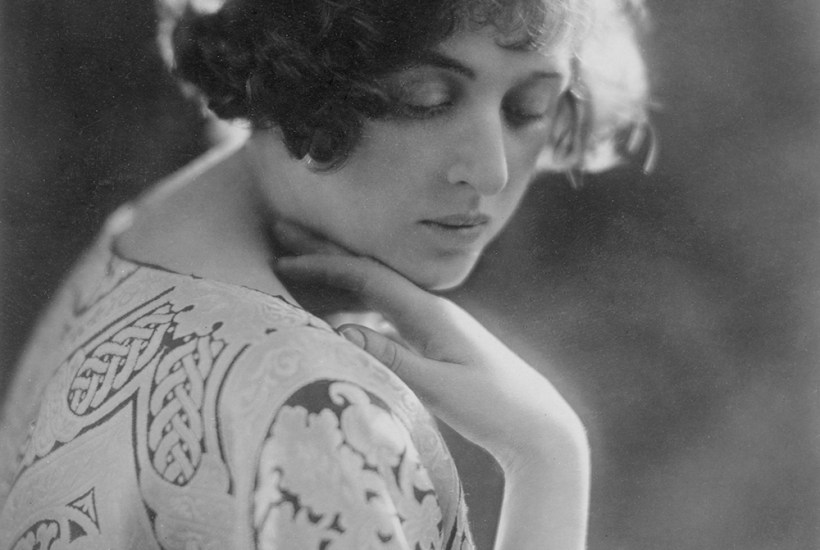
Tall, blonde, beautiful, ruthless, brave and amoral to her fingertips (many of this biography’s paragraphs end with ‘The two became lovers’), Clare Consuelo Sheridan was extraordinary – especially for the era in which she lived. Her mother, Clara, was the eldest and fluffiest of the three Jerome sisters who arrived in England in the first wave of American heiresses aiming to marry into the peerage. Her father, Moreton Frewen, was a man so mesmerically gifted with the power of persuading his friends to invest in his catastrophic schemes that he was nicknamed ‘Mortal Ruin’. Winston Churchill was her first cousin (his mother, Jennie, was the youngest Jerome sister), Consuelo (née Vanderbilt), Duchess of Marlborough, was Clare’s godmother, and most of the beau monde were family friends.
At her debut in society, Clare (born in 1885) was under strict instructions from her father to marry a rich (and presumably gullible) man. She failed, and was sent in disgrace to stay in Ireland with the third Jerome sister, Leonie. By now, so indebted had the family become that Moreton pressured his children into transferring their Jerome inheritance to him (inevitably, it disappeared). Soon even the oak panelling from the bedrooms in the family home, Brede Place, had been stripped and sold. Clare later wrote how, aged 23, sitting at a smart dinner party she ‘looked around the table at the brilliant, bejewelled company, all laughing and lighthearted and I wanted to cry… I returned home with my soul in rebellion’.
In 1910, aged 25, Clare married the handsome, charming Wilfred Sheridan. The couple had two daughters. When one of them, Elizabeth, died at 14 months, the grief-stricken Clare went to a nearby pottery to commission a memorial. While there, she thought she would try her own hand at modelling. She succeeded so well that, as she wrote: ‘It was the dawn of a new life.’
When Wilfred was killed in 1915, a few days after the birth of their son Dick, it was expected that Clare, as a war widow, would devote her life to her children. Instead, she saw widowhood as an opportunity to live the life she’d have chosen – above all, one of independence. When a besotted and very rich young man (who, to the fury of her father, she refused to marry) bought her a studio, she launched herself into a career as a sculptor.
Her talent for catching a likeness made her portrait busts sell immediately. Dumping her children with their grand-parents, she now led an unfettered life. Her lovers included H.G. Wells and Lord Birkenhead, through whom she was commissioned to sculpt the former prime minister H.H. Asquith for the Oxford Union. Its unveiling brought much welcome publicity and gave her a certain taste for the limelight.
Then came the event that changed her life. Three years after the Russian revolution, followed by the murder of the Tsar and his family that had so appalled Britain, Clare’s affair with the head of a Russian trade delegation resulted in an invitation to sculpt the leading Bolsheviks. Refused a visa to Moscow by the government, she reached the Russian capital via Sweden and Estonia and sculpted both Lenin and Trotsky (leading to an affair with the latter). She returned to England deeply sympathetic to the revolutionary ideology and loaded with sables from Trotsky.
She had now become notorious and though the Times printed her ‘Russian Diary’, fashionable society turned its back. So it seemed a good time to visit New York, where Clare arrived in 1921 for a lecture tour and the publication of her book Mayfair to Moscow. There were reporters, a glittering exhibition and scores of invitations. She sculpted Charlie Chaplin (another notch on the bedpost) and a wealthy, married admirer, the financier Bernard Baruch, who paid for almost everything and took her every-where. ‘She has that utterly indefinable and unknowable “something” which makes every-one she comes in contact with give to her,’ said her brother Oswald admiringly.
Along the way there was an affair with Kemal Ataturk, a pregnancy by Mussolini and other liaisons
But women were shunning her. Whether or not an admirer was married made no difference to Clare, and even Baruch was embarrassed when she declared at a smart dinner party that it was a woman’s privilege to bear a child to the lover of her choice and that the state should support them both.
With commissions drying up, Clare turned to journalism, a profession in which a few women were now succeeding. She had a gift for vivid description, and when offered a contract as a roving reporter by the Pulitzer family, the owners of the World, she quickly achieved her first big scoop – an interview with Rudyard Kipling, then at the peak of his celebrity and known for never giving interviews. Calling on him as an old family friend, Clare skilfully guided the conversation to intimate channels – he had lost his only son in the war, she her husband – and printed the result, a deception that led him to end his friendship with the entire Frewen family. Another scoop came her way when, travelling by train in Ireland, she slipped into a carriage reserved for Michael Collins, the young hero of the Irish Revolution, and spent the four-hour journey with him.
Touring Germany in 1927 with her brother in the sidecar of his motorbike – she packed two evening dresses, he his collapsible opera hat – she met the British ambassador, whose clever and beautiful wife was a friend of her aunt Leonie. This, however, did not prevent the 42-year-old Clare from having a fling with the ambassador, who obligingly arranged interviews for her with key figures at the League of Nations Conference in Geneva. By now she was a celebrity – albeit under the watchful eye of MI5, suspicious of her pro-Russian stance.
Her life continued in a dizzy swirl, writing travel books, articles and novels, settling first near Danzig, then on the European side of the Bosphorus, then in Algeria on the edge of the Sahara, sometimes with her children, sometimes leaving them at Brede. Along the way there was an affair with Kemal Ataturk, a pregnancy by Mussolini (followed by an abortion) and other liaisons. Her novels, usually thinly disguised versions of her life, were popular, and a highly sanitised memoir, Nuda Veritas, became a bestseller. Fortunately she also left 50 volumes of explicit diaries (diligently trawled through by Elizabeth Kehoe). It was a life lived to the hilt. As Clare’s obituary in the Times in 1970 put it: ‘As a human being she must rank as unique.’
Got something to add? Join the discussion and comment below.
You might disagree with half of it, but you’ll enjoy reading all of it. Try your first month for free, then just $2 a week for the remainder of your first year.