There is only one problem with this beautiful, elegiac novel, a glorious hodgepodge mash-up of time travelling and apocalyptic eco-fiction: it is out of order.
It would be very hard to follow such a beloved monster as The Time Traveler’s Wife (2003),which has been turned into a film, a TV show, a musical and a play and has influenced Doctor Who and Richard Curtis as well as numerous inferior copycats. The novel is near perfect, heart-tugging, totally original but still fundamentally a simple love story of Clare and Henry, with its own superb internal logic. After all, other people’s marriages are innately mysterious, so someone occasionally disappearing into a time loop is as good an explanation as any.
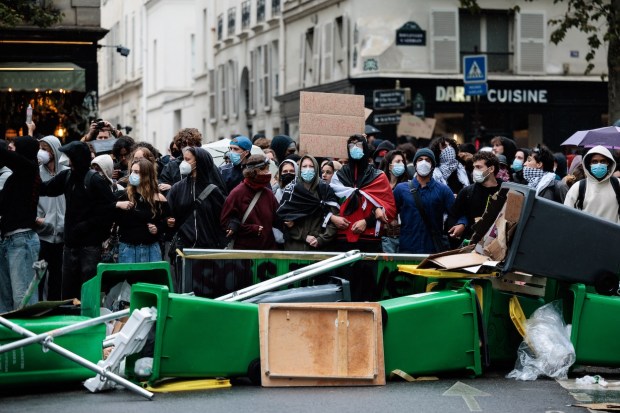
Audrey Niffenegger’s latest book is the story of the couple’s daughter, Alba, and her exceptionally complicated life hopping between the 1960s and 2098. The rather bewildering opening dumps us in America under curfew and martial law in 2022, at a party where we meet a huge number of characters, not all of whom quite earn their introductions. Presented heroically is Antifa – which might come as a bit of a surprise if your view of this political group is that its members told your aged American auntie that they were going to defund the police, scaring her enough to vote for the Monstrosity again. These people also live very nice lives, thanks to stock tips from the future.
At the party Alba meets Zack, her future husband, a handsome, mild, forgiving character who is ‘no contact’ with his parents (very 2020s) and extremely tolerant of the way Alba tells him everything that’s going to happen to him for the rest of his life.
Something happens at the party. Various people escape (without spoiling anything, I beg you not to get too attached to these characters) and we are hurled into a near-future world that includes bio robots, evil, sentient robots (different ones), climate catastrophe, ghosts, civil war and a closed border between the US and Canada. There are also differently gendered identical twins, the Beethoven bootstrap paradox, an odd meta-apology for how Clare and Henry met in the first book (you may recall he was a naked adult man, she a child), virtual reality museums and a lot of people cooking eggs. It is quite full on.
Then Part Two begins. We meet Oliver, the novel’s most sensitively drawn character, and spend a lot of time in the 2010s learning how lives are affected by chrono-displacement disorder. There are beautiful meditations on death and grief; we meet Henry again, the original time traveller, in a terrible state; and Clare, trying to build a new life; and there is a fine story about a young Chinese boy learning to play the piano. There is also some funny stuff on the difficulties of trying to raise an AI child, as well as a sensational scene set in a diner where Niffenegger is at her best – funny, endearing and heartbreaking all at once.
It’s possible that this novel would have worked just as well as a collection of short stories – fragments of lives interrupted by time travel. The third section continues sweet and sentimental, with occasional messy touches, ricocheting between a ghostly underwater London and a mildly coercive-sounding threesome.
When so many books nowadays are mulched, over-chewed, over-thought retreads or patently dumbed down, Niffenegger’s make the case for being triumphantly individual; for loving the messy and the imperfect; for worshipping art and love. Life Out of Order is the antithesis of an AI novel. It is chock-full of ideas, red herrings and ambition. To be human is to be loved for all your flaws is the message.
Got something to add? Join the discussion and comment below.
You might disagree with half of it, but you’ll enjoy reading all of it. Try your first month for free, then just $2 a week for the remainder of your first year.