Canada and the US were once great friends, allies and trading partners. They had disagreements on various domestic and international matters, wars and military conflicts. They didn’t always see eye-to-eye on trade negotiations related to the auto sector, acid rain, softwood lumber and more. Nevertheless, the two countries always found a way to return to the same page.
Yet this historic and economic relationship has now been torn apart. Canada and the US are engulfed in a full-fledged trade war, and there’s no end in sight.
Canada and the US are engulfed in a full-fledged trade war, and there’s no end in sight
There have been tensions between the two countries since Donald Trump was elected US President. Trump engaged in a tariff war over steel and aluminium products with the then-Canadian prime minister Justin Trudeau in 2018. Things escalated once more in 2024 when Trump announced 25 per cent tariffs on all goods from Canada and Mexico just before he returned to the White House.
The latest tariff battle has been the worst by far. Trump has announced 50 per cent tariffs on an assortment of Canadian goods – including down jackets, wine, agriculture products and, of all things, hockey sticks. Most of these items had been previously exempt from tariffs because they were traded under the umbrella of the United States-Canada-Mexico Agreement. Trump had other ideas (or whims, as the case may be). A last-ditch attempt by American and Canadian negotiators to avoid Trump’s tariff wrath collapsed on August 21.
The details that led to the collapse in negotiations have only been discussed in general terms by the Canadian side. Conversely, the Americans released an explosive document on Tuesday that accused Canada of choosing ‘unreasonable demands, walk-backs, and flat-out rejection’ over partnership and suggested the US was going to end ‘Canada’s free ride.’ And, much like Trump’s executive order to rename the Gulf of Mexico to the Gulf of America, he’s now threatening to change the name of Lake Ontario to ‘Lake America’.
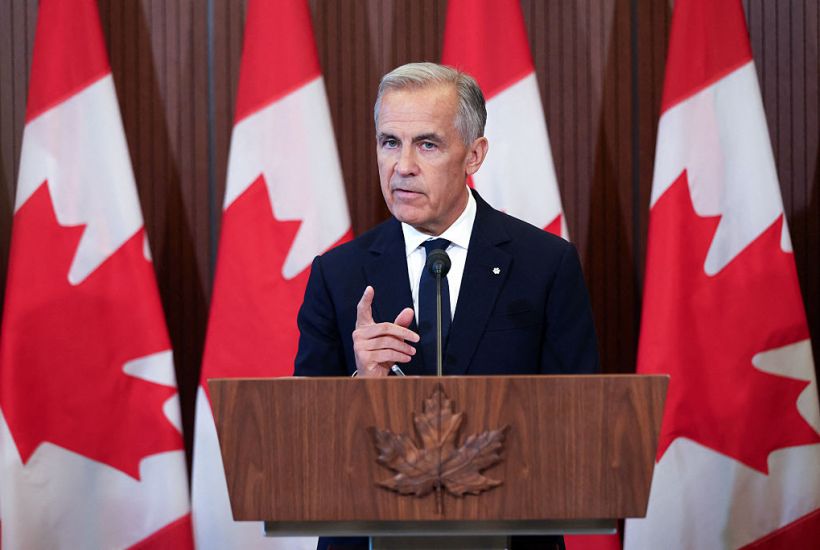
In retaliation, Canadian Prime Minister Mark Carney has launched a new political strategy: total defiance of Trump.
Carney and his Liberal government have announced an extensive series of counter tariffs that will commence on 8 September. ‘Canada’s counter tariffs will apply to products covering $27.6 billion in imports from the US,’ according to the Department of Finance, ‘and will focus on sectors such as steel, dairy, appliances, agricultural equipment, pulp and paper, and electronics, that are most impacted by US tariffs.’
The PM, who has occasionally been critical of Trump the past few months, is also using more direct and somewhat forceful language in public. He suggested Washington’s terms and conditions would ‘destroy’ Canada’s auto, steel and aluminium sectors, for instance. He demanded the Trump administration stop treating Canada as a ‘subsidy’ at a press conference in Lévis, Quebec on Monday, and said that Canada will only return to the negotiating table when America has ‘the right attitude towards our industries and in a true partnership.’
In fairness, Carney’s remarks pale in comparison to what Ontario premier Doug Ford said about Trump during talk radio interview this week. Ford called the President a ‘bully,’ ‘arrogant and cocky’ and actually said ‘he can kiss my ass as far as I’m concerned.’ (Trump retaliated on Truth Social, calling Ford a ‘Flunky’ as well as a ‘less charismatic, intelligent, and overall unimpressive brother of the late, great, Rob Ford.’)
Carney’s decision to defy Trump may succeed in the short term due to the recent surge in anti-American sentiment in Canada over the tariff war. But it’s a preposterous long-term strategy that could potentially crush Canada’s economy for future generations. ‘Nearly $3.6 billion (US $2.6 billion) worth of goods and services crossed the border each day in 2024,’ according to the government of Canada. Moreover, the US is ‘Canada’s largest trading partner in goods and services, while Canada is the US’ second-largest trading partner.’
No matter how many trade deals the Carney government attempts to arrange – including a highly controversial decision to increase trade with China in January – the loss of access to the US economy will be devastating for Canada.
Moreover, these acts of defiance will only serve to drive the existing wedge between Carney and Trump even further open. The chances of repairing the damage during Trump’s remaining time in the White House are pretty slim. It may not even be doable after he’s gone, irrespective of whether American voters elect a Republican or Democratic president in 2028.