The economic storm clouds continue to gather over Britain. A reckoning of some sort is on its way, possibly a spectacular one. How will we react?
Perhaps there are clues to be found in ‘I’m Backing Britain’, the short-lived campaign to gee up the nation back in early 1968. I was born a few months after its brief but memorable moment in the sun; I picked up on the slogan as a child, as one of those things adults said with a wry grin that I didn’t quite understand.
But what Britain had in 1968 was a dynamic mass popular culture offering multiple pleasant distractions and more functional institutions. It had a sense of identity
The decision by Harold Wilson’s Labour government to devalue the pound in November 1967 was an unavoidable sign that something was very wrong with the British economy. A few weeks later, inspired by a letter to the Times by a Tory MP, five female secretaries at the firm Colt Ventilation in Surbiton decided to start work half an hour early once a week and without being paid, hoping that their example would spark a nationwide effort to increase productivity and get Britain out of trouble. ‘What about starting this scheme of a five-and-a-half-day week? Let us be the first company to start the ball rolling,’ one wrote in a memo. After a miserable Christmas, this was seized on as an exemplar of civic pluck. The Duke of Edinburgh sent the women at Colt an enthusiastic telegram. All three party leaders leapt on the idea. The press were widely supportive, the FT describing the idea as ‘a beacon of light in an otherwise dismal economic and industrial prospect’.
Understandable objections came from the unions, who were not so keen at the idea of unpaid overtime. Neither was Enoch Powell, then shadow defence secretary – ‘I am not accusing the government of having suborned those Surrey typists, but they could not have wished for a better reinforcement for their campaign to instil into the people of Britain the conviction that it is all their own fault.’
In an eerie pre-echo of today’s world that clashes with our sunny nostalgia for the 60s, the secretaries received death threats and needed security.
But their campaign blasted off with the dizzying speed of the late twentieth century, when big fads and fancies often blazed and burnt out in days. Just a week after the Surbiton memo, Bruce Forsyth recorded a single ‘I’m Backing Britain’ with its frenetic oompah chorus telling us, ‘The feeling is growing, so let’s keep it going, the good times are blowing our way.’ But the verse couldn’t hide the bitter pill – ‘In offices and factories up and down the country, an extra half an hour is all we need each day, in shops and supermarkets everybody’s starting to work a little more without the pay.’ Poet laureate Cecil Day Lewis knocked off some doggerel on the subject even quicker: ‘To work then, islanders, as men and women/ Members one of another, looking beyond/Mean rules and rivalries towards the dream you could /Make real, of glory, commonwealth, and home.’
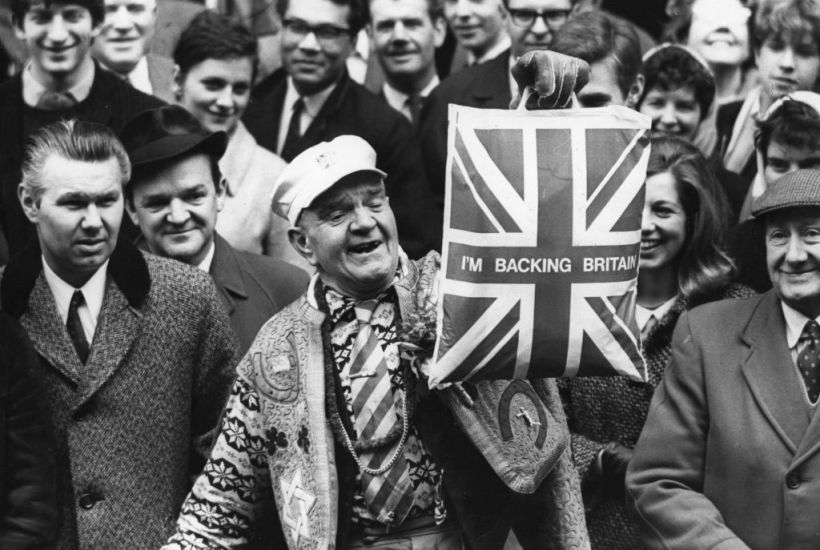
Merchandise – posters, badges, T-shirts, all emblazoned with the slogan on a Union flag -–became highly visible by mid-January. Philip French in the New Statesman described being ‘constantly confronted’ by this ‘jingoistic’ symbol as ‘painful’. Ironic amusement came when it was discovered that the patriotic T-shirts extolling British business had been made in Portugal – it would have been too expensive to produce them here.
By February ‘I’m Backing Britain’ was already fizzling out. Brucie’s single flopped. Economists pointed out that, even if workers across the land took up the practice of half an hour unpaid work, it would make no difference.
Later in the year, the slogan had become a punchline, used as the final shot of
Carry On Up the Khyber. Nobody in Britain likes an eager beaver, and there was resentment at being asked to pull together by politicians who had engendered the mess in the first place.
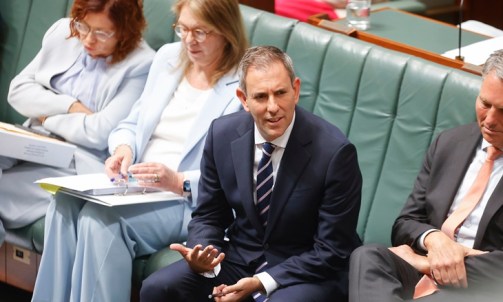
Today, the economic outlook is far worse than in 1968. It is fascinating that many politicians, particularly in Labour, simply do not seem to comprehend this. The gloomy faces of Starmer and Reeves on their accession back in 2024 spooked the markets, so the thinking of Team Burnham (if they are thinking at all) seems to be to look breezy and unbothered.
At least back in 1968 politicians, press and public acknowledged the hole they were in. Today, the likely imminent collapse of the economy seems just one problem among many, with little heed paid to the glaring fact that everybody’s big dreams are impossible.
Surely nobody in 1968 would have stated, as Labour MP (and former teacher!) Jonathan Brash did on X last week, that ‘Public sector workers use their income to pay FOR the private sector. The state is one of the biggest procurers of the private sector. It wouldn’t exist without taxpayers.’ As if this wasn’t deluded enough, he added the coup de grace – ‘People creating the divide between public and private genuinely don’t understand how an economy works’. You have to wonder what other eccentric views he holds – that wheels are square? That cats are small dogs? Where does he imagine the income of public sector workers comes from: magic beans?
One thing remains the same 58 years on. We the British are just not culturally civic-minded. The hive-like work ethic of the Germans or Scandinavians is not in our blood. We live to clock off and knock off. The few weeks of ‘I’m Backing Britain’ were the best we could ever muster.
But what Britain had in 1968 was a dynamic mass popular culture offering multiple pleasant distractions and more functional institutions. It had a sense of identity. In 2026 we’ve had so many new arrivals that we no longer even know who we are, quite literally. All that unites us is frustration and helplessness.
The final scenes of Carry On Up the Khyber depict the British ruling class in India, continuing with their meal as their palace is smashed to smithereens around them by angry natives. A character turns to camera and says to the audience ‘They’re all raving mad, you know’, and up goes the ‘I’m Backing Britain’ flag. The modern progressive establishment may look very different, but its ostrich-style denial of catastrophe is exactly the same.