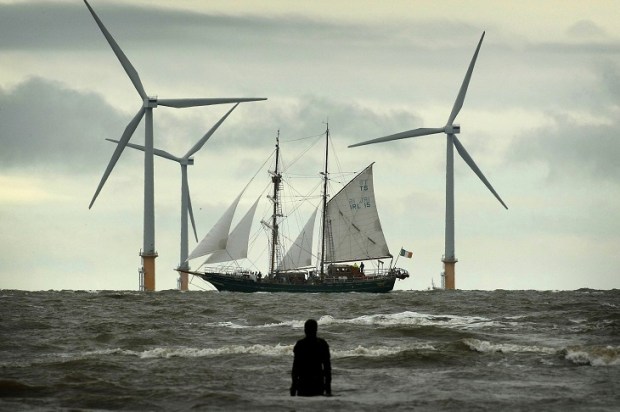
Reading in The Australian Financial Review that data centres will have to get 40 per cent of their power from wind, I was not surprised.
Once again, Labor is intervening in the market to force an outcome that its own policies have failed to deliver, this time developing national rules requiring new data centres to supply or underwrite at least as much electricity as they consume.
Data centres consume enormous quantities of electricity and water, so they should pay for their connections and fund the additional infrastructure they require; with that, I agree.
But directing what they must buy is entirely different.
If wind is already the cheapest source of new electricity, as the government repeatedly tells us, why must data centres be pushed into long-term contracts to support it?
Australia has been supporting wind for more than two decades. The Renewable Energy Target was introduced in 2001. Eligible generators receive a large-scale generation certificate for each megawatt-hour they produce. Electricity retailers are required to purchase and surrender those certificates, and the cost is recovered from consumers.
The legislated target is 33 million megawatt-hours each year and continues until 2030. An Institute of Public Affairs analysis estimated that certificates created by Australia’s 50 largest wind farms could have been worth about $1.04 billion in 2024. It classified 35 of those wind farms as wholly or partly foreign-owned.
And certificates are only the beginning. The federal Capacity Investment Scheme now provides long-term revenue underwriting for renewable generation and storage. It has been expanded to 40 gigawatts and is expected to support about $73 billion of investment.
Rewiring the Nation is a $20 billion program. Its $19 billion CEFC fund uses low-cost and, in some cases, concessional finance for the transmission and other infrastructure needed to connect much of this new generation. Then there are renewable energy zones, state auctions, government-backed contracts, accelerated approvals, new roads and community benefit packages.
All of this shows that wind is not succeeding through ordinary market competition; wind is intermittent, but its government support is not.
Despite all this support, wind supplied only 14 per cent of Australia’s electricity in 2025.
More importantly, investment in new wind and solar is going backwards. The Clean Energy Council reported that only 2.3 gigawatts of new utility-scale wind and solar reached financial close in 2025, down 46 per cent in a year and one of the weakest results in a decade. Financial commitments to onshore wind fell 59 per cent.
Projects announced with great enthusiasm have been abandoned when confronted with actual costs.
During 2025, developers abandoned three proposed offshore wind projects in Victoria’s Gippsland zone: Gippsland Dawn, Kent, and Gippsland Skies. Together they represented about 6.5 gigawatts of proposed capacity.
The proposed 900-megawatt Proserpine wind farm in Queensland was put on hold and its federal environmental referral withdrawn after its developer said it was no longer ‘economically viable in its current form’. Genex has now dropped the wind component of its Kidston energy hub after failing to make the commercial numbers work.
Across the sector, developers face higher equipment, construction and financing costs. Grid connections can be slow and uncertain. Major transmission projects are delayed, and contract economics have become more difficult. Offshore wind costs have risen sharply around the world.
Communities are also pushing back. The concerns raised include effects on farming, biodiversity, landscapes, property values and the cumulative impact of several projects in the same district.
Social licence cannot be manufactured in Canberra or purchased with a community fund after the major decisions have already been made. Nor can the problem be solved by forcing data centres to become wind customers.
AEMO forecasts that data centres in the National Electricity Market could consume about 12 terawatt-hours of electricity by 2030, around 6 per cent of grid-supplied demand. This is one of the largest new sources of electricity demand Australia has seen for decades.
Globally, data-centre electricity consumption is expected to more than double to approximately 945 terawatt-hours by 2030, according to the International Energy Agency.
They have done their maths and concluded they will need much more than just wind and solar. Microsoft has entered a 20-year agreement supporting the restart of the 835-megawatt Crane Clean Energy Center in Pennsylvania. Google has agreed to support up to 500 megawatts of advanced nuclear power from Kairos and has contracted 115 megawatts of round-the-clock geothermal generation in Nevada. Amazon has also invested in nuclear projects.
Australia should also be asking what industry its enormous support for wind has actually created.
Who owns the wind farms, and where are the turbines, towers, blades and generators manufactured? How much taxable profit remains in Australia and how many permanent jobs exist after construction is completed?
Research by the Centre for Future Work found that all wind towers installed in Australia are imported, mostly from China. Australia also depends overwhelmingly on international companies for turbines, blades, nacelles, and specialist equipment.
We provide the land, transmission, certificates, revenue guarantees, and customers. Other countries supply much of the technology and capture much of the manufacturing value.
Labor has tried to create markets through urgency and subsidies before. More recently, governments have committed billions to creating a renewable hydrogen industry while major projects have been cancelled or delayed.
The pattern is familiar: announce the industry, set the target, provide subsidies, and then intervene again when the commercial demand fails to appear.
Labor should avoid repeating the pattern.
Let data-centre operators choose the combination that works, whether that is wind, solar, storage, hydro, geothermal, gas with credible emissions abatement, or nuclear if Australia eventually removes its prohibition.
If wind is genuinely the cheapest and best option, hyperscalers will buy it without being forced to.
If, after 25 years of certificates, subsidies, revenue guarantees and publicly financed transmission, the government must still manufacture customers for it, Australians are entitled to ask why.