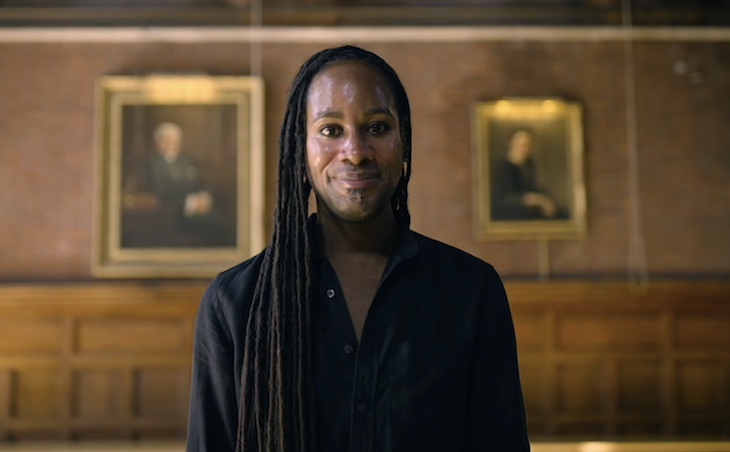
One of the unfortunate consequences of the Jason Arday debacle is that it has thrown the entire discipline of sociology into disrepute. In the minds of many, his shoddy scholarship, lazy methods and recourse to obfuscating jargon are not an aberration, but reflect the dubious standing of a social science which has always had unjust pretensions to an actual science.
Sociology is not alone in having succumbed to gobbledygook and hard-left propagandising
There’s been a chorus this week of those repeating this familiar accusation on social media. ‘I have yet to be convinced that sociology is an academic discipline at all never mind that it is important. It seems to be just a vehicle for advancing left-wing policies with a veneer of academic respectability.’ That’s a typical example. In Unherd, we have Richard Dawkins adding his voice to this chorus. He observes of this disgraced Professor of Sociology and Education that ‘the gobbledygook of his writing style’ was to be expected, because ‘practitioners of a subject that any fool can understand may suffer from what has been called “physics-envy”.’
While the soft science of sociology has often been regarded with condescension or scorn by practitioners of the hard variety, what its latest critics fail to acknowledge is that sociology is not alone in having succumbed to gobbledygook and hard-left propagandising. All the humanities, including and especially and English and History, haven been infected by outlandish and invasive theories related race and gender. And as Dawkins knows well, not least because he has fought against it himself in New Zealand, biology has also been compromised, by those who would teach Maori creation myths alongside ‘Eurocentric’ science in schools. Even maths is being ‘decolonised’ across universities. No-one’s suggesting now that mathematics is inherently worthless.
Sociology has for years suffered an image problem, seen as a soft subject for soft minds. That perception was reinforced in this country the 1980s, firstly by the cult television comedy The Young Ones, whose infantile radical poseur Rick was a sociology student, and then by a British Telecom advert featuring Maureen Lipman consoling her dim grandson who has failed his exams – except sociology. ‘He gets an ology and he says he’s failed,’ she reassures him. ‘You get an ology, you’re a scientist!’
Of course, studying sociology doesn’t make you a scientist in the everyday meaning of the word. But the discipline has always sought to follow a scientific approach, in that it seeks objectivity, tries to assess and balance data, note trends, and generally aspire to understand how people function in context of a collective. It’s worth keeping in mind that two of the greatest critics of hyperliberalism today, Eric Kaufmann and Frank Furedi, are both sociologists.
In this respect, perhaps our terminology, and the English language, is the problem. In German they have a better word to describe the enterprise of seeking to comprehend the world through scientific methods: Wissenschaft, literally ‘knowledge-ship’, an academic practice which encompasses the hard sciences and the humanities.
Before the advent of hyperliberalism, and predating even the stereotype of the sociology student from Scumbag College, sociology had a noble pedigree, beginning in a 19th century. Auguste Comte is regarded by many as its first practitioner, the first who sought to study society and humanity using rigorous methods. Better known still today are Émile Durkheim, remembered for his thoughts on the malaise of anomie among free-floating individuals in a rootless, modern society, and Max Weber, who connected Protestantism with the work ethic that begat and motored capitalism.
Durkheim and Weber, great thinkers in their own right, are worth recalling today in these fragmented times. In their tangential way they both addressed pressing issues that haven’t gone away: the collapse of meaning in a convulsive and confusing world. While Weber thought that the ‘rationalisation and intellectualisation’ of modernity in a society without God was bringing about a ‘disenchantment of the world’, Durkheim also felt industrialisation and modernisation had left a spiritual void, that, ‘There can be no society that does not experience the need at regular intervals to maintain and strengthen the collective feelings that provide its coherence.’
Durkheim’s works might have much to teach us about our decentred multicultural society, and also about the cult of hyperliberalism that pervades our society and universities. He was not entirely down on modernity, believing it was a positive step up from the rigid conformity typical of primitive cultures. Weber, believing this spirit of passive obedience was still too prevalent in his times, advocated as an antidote a philosophy of individual self-discipline and self-overcoming.
One of the causes for the entire Jason Arday affair, and for the spread of the hyperliberal creed of which it is the latest symptom, is a lack of critical, individual thinking. Wokery is predicated on conformity and fear. People have gone along with it because they have been scared not to. We would be better off studying the great sociologists of the past rather than deploring its imposters of the present.