As a writer, I need to stop tripping into curiosity black holes while doomscrolling podcasts. Seeing as I’m already face-down in this particular dark pit, you, dear reader, may as well benefit from my folly.
This excursion started with the Jevons Paradox and how it pertains to AI, energy, civilisation, and the offensive amount of money Labor has wasted on the topic.
Billions and billions.
Skipping to the end, commentators who drag the Jevons Paradox up observe that the more advanced a civilisation is, the more energy it consumes. So far, so true.
Then they work this backwards and assume that if you build a bigger energy grid, your civilisation will expand to fit. That is … debatable, at best, and not precisely what Jevons implied.
And then finally, the fantastical stretch: AI requires an enormous upscaling of energy resources therefore the more AI data centres you build, the more energy your civilisation consumes, and the more advanced your society will automatically become.
The clever sales pitch to politicians?
Spend all your public treasure on data centres and it will make your nation shiny and advanced. People will vote for you! More AI equals more economy!!!
This sort of logic gives me an uncomfortable eye-twitch.
Not only because it’s wrong, but like so many loose and superficial readings of statistical relationships, it fundamentally misunderstands the consequence of breaking points.
Commentators are good at spinning mathematical relationships into prophetic claims and philosophical narratives. They assign higher meaning where it doesn’t exist and read way beyond what the original author stated, usually to prop-up some failed theory they’re trying to sell to their audience.
Chaotic, real-world models rarely oblige such hubris.
It is why policy based on computer modelling (Covid, Climate Change, mass migration, birth rates, taxation, etc.) remain some of the most damaging ever written.
They are just wrong.
Human minds are better at extrapolating real-world outcomes than machines because unpredictable environments require creativity to solve. We understand patterns that escape explanation and observe obstacles outside an algorithm’s parametres. Or put another way, it is a similar reason why humans, even children, instinctively understand a joke while AI stares back at us, dead and unmoved.
This article is not a philosophical discussion about AI, rather I have a warning regarding the next waste of taxpayer money that no one else seems to be talking about.
AI is the new Climate Change.
Both in its doomsday rhetoric and parasitical relationship with the Treasury.
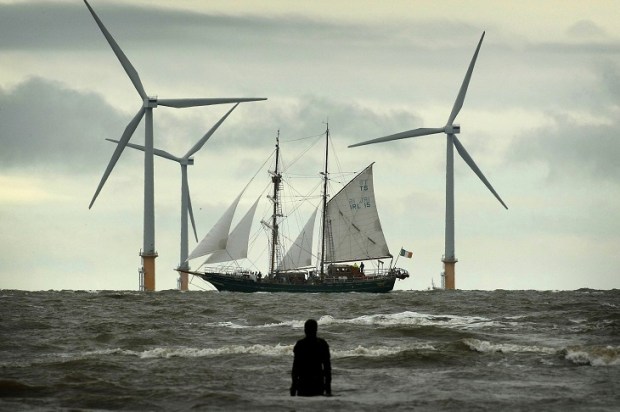
Politicians are too intellectually clumsy to see the flaw in the AI-energy argument, let alone ask the right questions and make sensible policy adjustments. For government, the economic promises of AI – whispered in their ears by Big Tech lobbyists seeking public grants and open-ended contracts – have given Energy Ministers concerned about the imminent demise of Climate Change ideology the perfect excuse to keep funding solar, wind, and batteries.
Well, in Australia. The rest of the world is building nuclear plants to power their AI data centres.
AI has rapidly become the barely understood replacement for Climate Change. Instead of, ‘We need to invest all this money to control the weather!’ The narrative is closer to, ‘We need to invest all this money to increase productivity and become advanced and rich.’
Don’t be surprised if you hear endless moaning about a productivity crisis that comes with a magic, publicly-funded AI solution. This is the new theatre, or as our Editor-in-Chief likes to describe it, the Canberra circus.
We have already seen this march begin. AI databases require enormous sources of power, and the government has been more than happy to green-light accompanying renewable energy projects. In some cases, it appears government is hoping to use these AI installations to help underwrite the renewable energy grid.
Even when viewed purely from the perspective of the AI data centres, temperamental and unreliable energy is the last thing you want, especially if AI is to be written into our critical services.
It’s all such a bad idea that it hurts even thinking about the many ways this could go tits up.
The point I am making is that the rise of AI databases will probably be used as a justification for continuing the renewable energy transition, and this is a bigger hurdle to clear than Climate Change.
Catastrophic human-induced climate change was always a false and ludicrous premise which was easy to expose and routinely murdered its own credibility through apocalyptic due dates that kept being moved around. It was assumed by most voters that defeating the Malthusian ideology of Climate Change would kill off renewable energy, decarbonisation projects, and the whole wasteful Net Zero bureaucracy.
One Nation may very well win a few elections on this promise.
Victory against renewable energy is so close we can almost see the soft, comforting glow of uranium.
This victory is about to be dashed on the rocks of AI.
The merits and faults of AI form a different conversation. Understanding ‘AI for the sake of renewables’ is an equally important concept if we, as conservatives, are to salvage our grid and lower power prices.
Returning to the cornerstone of this AI-energy relationship, the Jevons Paradox began as a contrary position to an early false assumption toward the beginning of the fossil fuel revolution. Namely, that as a civilisation improves its technological efficiency, the total consumption of resources should fall. Use water more efficiently? Reduce water consumption. Purchase smart devices etc? Reduce energy consumption.
William Stanley Jevons, in his 1865 The Coal Question as part of An Inquiry Concerning the Progress of the Nation and the Probable Exhaustion of our Coal-Mines, observed something else.
His actual words were:
‘It is wholly a confusion of ideas to suppose that the economical use of fuel is equivalent to a diminished consumption. The very opposite is true. As a rule, new modes of economy will lead to an increase of consumption, according to a principle recognised in many parallel instances.’
He goes on to explain the relationship more exactly by comparing it to the increase of labour and jobs created by machinery designed to replace labour. A counter-intuitive reality made possible thanks to the magic of market forces and demand. Something the socialists amongst us never quite grasped.
It is even added, and Jim Chalmers might like to bookmark this:
‘So it is a familiar rule of finance that the reduction of taxes and tolls leads to increased gross and sometimes even nett revenue.’
The necessary caveat about Jevons’ comments relate to, and he makes this clear himself, the specific mechanics of coal.
These are not observations strictly about any form of energy.
If I have read and understood his requirements correctly, they could be generally applied to the non-fossil fuels of nuclear and hydro, but not to renewables generally. Any observations made about civilisation and its energy grid using Jevons Paradox would be flawed for a mixed grid like ours and yet I have rarely, perhaps never, heard this distinction made. Perhaps because few read the source material surrounding the famous quote.
If you are wondering why I am labouring the point about coal in a discussion pertaining to AI, some of it is pure indulgence. The writings of this age provide respite from the dry, dull, and tedious speculation common in economic journals … and certainly to the raving insanities present in the pages of energy publications.
‘Even our superior capital will not avail us against dear fuel, because nothing more readily flows abroad in search of profitable employment than capital. And if we are to uphold worldwide freedom of intercourse, let us not deceive ourselves as to its natural results upon the material basis of our prosperity.’
He could be describing the folly of allowing China to control our energy resources, and our upcoming mistake of gifting India uranium to fire their nation while we sit in the dim light of Bowen’s batteries. And yet the turn of these expressions somehow fixes the seriousness of the issue more gravely than a headline.
(For those who intend to read the document, he dismisses both wind and solar directly as being ‘wholly inapplicable to a system of machine labour’ and that ‘no possible concentration of windmills … would supply the force required in large factories or iron works’.)
The other reason for the reversion to these old texts is that one can often find clarity about today’s problems in the predictions of the past.
It is fascinating to understand that, even for Jevons’ predictions, he is writing at a time before the first and second world wars and could not have known population growth, for example, would fluctuate far more heavily based upon war conditions rather than energy. This is no different to Medieval kings planning their population without foreknowledge of the Black Death.
The statistical truth of civilisational systems is that there is always something outside the model. For us, it may be an asteroid, an ice age, a volcanic eruption, or simply the collapse of culture. This is where buffers and redundancy come into play, and unfortunately present conditions have been forcing civilisation to drop these protections, many of which were stretched to breaking during Covid lockdowns.
In any case, we find ourselves living in a reality where Australia grew its wealth on the abundance of cheap and reliable domestic energy that we controlled independent of geopolitical instability and the tyranny of distance. It was ours. During this period, we followed the general rule, growing as if energy itself were feeding our offspring.
And then, toward the end of the 90s and through into this millennium, the narrative of energy shifted. Climate politics attempted to make us feel guilty about the use of this resource and attempts were made to artificially constrain demand. Our appliances were given energy ratings. Legislation created a raft of restrictions and requirements that fuelled an appliance and technology market where climate guilt was essentially used as a marketing prop to drive profit above organic consumer interest.
Our personal efforts and investment in a low-energy future raised a lot of money for businesses and the energy industry, but it did not shrink energy consumption.
And then, with the roll-out of green energy, consumers were called on to flip their ideology and submit, wholesale, to an energy rich existence where gas and mechanical appliances were transitioned into carbon-slogan-something-about-saving-the-world. Even our cars. Even our bikes. Even our homes. Even our human minds with the rise of AI.
Instead of consume less, we are told to grow rapidly.
Energy began this century as the great evil of Western Enlightenment, with cities switching off their lights as a communal virtue signal to green energy dependence (and profit for those companies and bureaucracies) and now it is somehow saving the world through their open-cut mines, slave labour, and excessive waste.
And yet what these architects of our misery could not control was exactly what Jevons warned about – economics.
Abundant energy is pointless if no one can afford to use it. The power point can be on, but the air-conditioners remain off for fear of the bill and so there may as well be no energy at all.
These are the subtleties missed by the light-weight minds in Parliament.
How resentful does the government think the Australian public will be of a renewable energy grid built with public money for foreign AI companies designed to replace the labour and income of taxpayers who cannot afford to turn the lights on?
Jevons feared the natural exhaustion of coal. He would have been greatly comforted by the later developments of nuclear energy.
What he did not, and dared not, predict was the singular desire of politicians to destroy our energy grid, flog-off our natural resources to our economic competitors, and dupe people into thinking the energy bill is some sort of sacrifice to the climate gods.
Such self-sabotage is alien to our ancestors.
‘It is true that, at best, we see dimly into the future…’
Indeed, he could not see us well at all.
Now that you have been warned, I shall leave you with the last paragraph of his book on the topic of coal and energy.
‘The alternatives before us are simple. Our empire and race already comprise one-fifth of the world’s population, and by our plantation of new states, by our guardianship of the seas, by our penetrating commerce, by the example of our just laws and firm constitution, and above all, by the dissemination of our new arts, we stimulate the progress of mankind in a degree not to be measured. If we lavishly and boldly push forward in the creation and distribution of our riches, it is hard to over-estimate the pitch of beneficial influence to which we may attain in the present. But the maintenance of such a position is physically impossible. We have to make the momentous choice between brief greatness and longer continued mediocrity.’
Alexandra Marshall is an independent writer. If you would like to support her work, shout her a coffee over at donor-box.