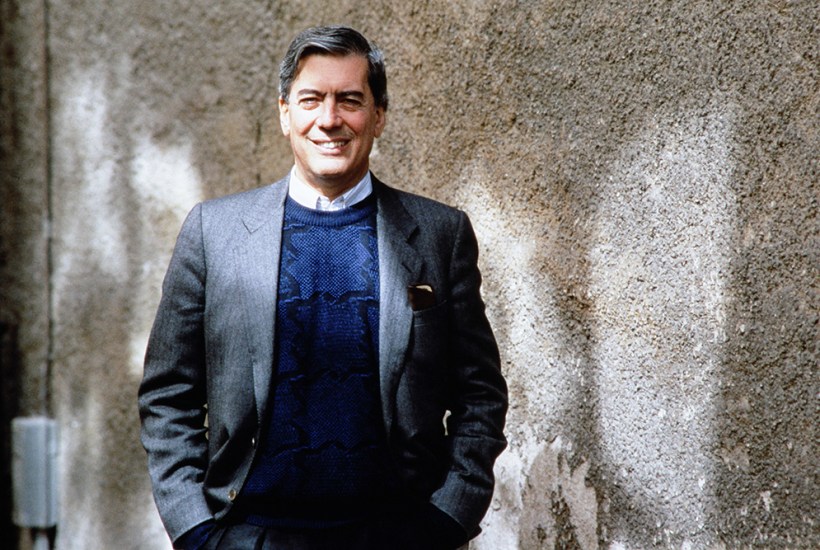
In October 2010, when Gabriel García Márquez, by then suffering from dementia, was told that his former friend and rival had won the Nobel Prize for Literature, he enquired: ‘Who is Mario Vargas Llosa?’ This tottering, always compulsive biography of the writer who died last year and which has taken 15 years to write (‘I completely miscalculated its complications’) is Gerald Martin’s valiant answer. ‘Is there a life quite like this one anywhere in the western world in the second half of the 20th century?’ In Martin’s breathless judgment ‘this literary adventurer, politician, diplomat and warrior all rolled into one’ was a single-minded workhorse whose sheer intensity, quality and variety of life was ‘almost literally incredible’.
Listeners to Vargas Llosa’s Nobel lecture in 2010 knew his reputation as ‘the Julio Iglesias of contemporary fiction’, who had defined headlines for 60 years, winning numerous literary prizes for a novel or an essay (‘or for mere “famousness”’, in one critic’s phrase); who had veered politically from left to right – from the plebeian communist student ‘Comrade Alberto’, championing the Cuban revolution, to the aristocratic ‘Marquis de Vargas Llosa’, confidant of the disgraced King of Spain, plus reverential supporter of Mrs Thatcher and Ronald Reagan, who in 1990 had come within touching distance of being elected Peru’s president.
As well, his Stockholm audience was aware that Vargas Llosa’s cool, amiable, belligerently frank demeanour camouflaged a turbulent private life. In 1955, he’d scandalised his family by marrying his aunt Julia, when he was 19 and she 29, later commemorating this precocious declaration of independence in his best-loved novel, Aunt Julia and the Scriptwriter. In 1965, he’d repeated the outrage by getting married again – this time to his first cousin Patricia, when she was 19 and he 29. And, most scandalous of all, in 1976, in a cinema in Mexico City, he’d encountered his open-armed ‘blood brother’ García Márquez, only to fell him to the ground with ‘the most famous punch in literary history’. Offering no explanation other than shouting ‘That’s for what you did to Patricia!’, Vargas Llosa fled Mexico, never spoke again to García Márquez and withdrew from circulation his 667-page critical study of his ‘official best friend – and unofficial nemesis’.
Martin – pertinently, also García Márquez’s biographer – is keen to see this unexplained but universally discussed punch as the key to the ‘vast parable’ of Vargas Llosa’s ‘fabulous life’, the reason behind the unsuspected right hook potentially unlocking the further mystery of how a great realist novelist transformed into a passionate neoliberal crusader.
I was a friend of Vargas Llosa for 40 years – made documentaries on him, wrote a novel that sprang from one of our conversations and liked him enormously – but reading Martin’s extraordinary portrait I realise how little I knew him. Mario’s cousin Freddy Cooper Llosa told me:
Mario didn’t have the depth to deal with his emotions, the maturity. He grew up with no father. His mother was an unsophisticated, nice woman, who’d fallen madly in love with a Pan American radio operator on a flight from Arequipa; and his grandfather taught him to read 19th-century novels by authors who had affairs that Mario later wanted to emulate.
Martin locates ‘the first primal scene’ in Peru’s coastal city of Piura. Mario, who for his initial ten years had shared his mother’s bed, every night kissing a photograph of the inexplicably deceased Ernesto Llosa, was suddenly told that his handsome father was alive; furthermore, he intended to re-enter their lives. Mario’s usurpation by a paunchy, bald-headed tyrant, who regarded his poetry-loving son as ‘a cissy’, was to be the tormenting source of his literary success. ‘Much of who I am and what I have written I owe to him.’
In Martin’s reading, Vargas Llosa dedicated himself to literature precisely to avoid examining his foundational narrative. Betrayed by those he most loved, he never outgrew the ten-year-old ‘hope of the tribe’ who had been lied to. Both in his life and books, reckons Martin, he was motivated by revenge and resentment; not merely against his violent father (‘I hated him’), but also against: Peru (at one moment calling for sanctions against his country); the ‘cheap intellectuals’ who’d been his left-wing friends; and ultimately anyone who swam too close, including his two wives, his two half-brothers and even his cousin Freddy. ‘He cut off anyone who argued with his politics,’ said Freddy. ‘He never sorted out the immaturity of his upbringing.’
From the late 1950s, Vargas Llosa lived his life away from Peru, in Paris, Barcelona and London, in order to create his prize-winning novels about it. He argued for the ‘divine freedom’ to write and behave as he wished. Yet in satisfying his transgressive appetite for ever more independence, he tied himself in gaslighting knots. According to Patricia, he was like Oedipus, ‘inveterately self-blinded’ about himself and his relationships to other people in the real world; insightful and visionary only in his imagination.
‘Why, why so many lies, so many deceptions, so much disloyalty?’ lamented his first wife Julia, who behaved with exemplary dignity when she discussed Mario with me in La Paz. ‘He was such a selfish and ignoble person.’ With mounting disillusionment, Martin catalogues his subject’s habit of sinking his notable teeth – the fangs of ‘a lone wolf’ – into any hand that fed him: ‘Selflessness would never be his thing… “denial” and “Vargas Llosa” are also words that go together.’ Juiciest of countless ironies is Julio Iglesias’s chastisement, following Mario’s elopement, aged 79, with the crooner’s first wife, the 63-year-old socialite Isabel Preysler, shortly after Mario and Patricia celebrated their 50th wedding anniversary: ‘Senor Vargas Llosa’s behaviour leaves much to be desired.’
He had a habit of sinking his notable teeth – the fangs of a lone wolf – into any hand that fed him
‘At what moment did Peru get fucked?’ was the primordial quote of his 1969 novel Conversation in the Cathedral. In Vargas Llosa’s case, Martin argues: ‘Uchuraccay was surely the moment he “fucked up”.’ His superficial investigation into the 1983 deaths of eight journalists in the Andean village of Uchuraccay suggested the terrible possibility that ‘Vargas Llosa really did not know Peru’ – or, indeed, himself – a suspicion which his subsequent presidency campaign, enlivened by his affair with Roxana, the wife of a cousin, served only to deepen. Ten days before the election, Mario had not heard of the Japanese agronomist who would defeat him in a landslide by 57 per cent to 34 per cent. It was a personal disaster.
‘If he couldn’t have Peru, he would have Spain.’ He moved to Madrid, the seat of political power, became the principal protagonist in the quincentenary celebrations for Columbus’s discovery of his continent, and turned himself into ‘a fictional character from which he could never escape’. His novels took a downward path, ‘more limited and low key’, with their author ending up as a propagandist for right-wing populists such as Javier Milei and Jai Bolsonaro, promoting the sort of utopian ideology that his fiction had excoriated. ‘It is not hard to see this as a tragedy.’
In Aunt Julia, a writer of radio soap operas goes mad as his daily scripts for ten different soaps become more and more entangled in a single story. At times when watching Martin scale Vargas Llosa’s various peaks, I had the image of an overloaded pack mule negotiating a pass in the Andes and trembling lest he plunge off-piste, like Norman Sherry in his Graham Greene biography. Martin appears endearingly conscious of his unwieldy burden, ‘with slightly different styles blurring the full thematic focus’. But puffing hard, he gets there.
Inevitably, it falls to the biographer of ‘unquestionably the two leading writers in Latin America’ to adjudicate in the prize fight between these heavyweights. While Martin judges Vargas Llosa’s life as the more epic, he manifestly considers García Márquez more integrated as a human being and writer, even if Vargas Llosa, that ‘immense conundrum’, was ‘much more politically influential’. Martin’s assessment: ‘Technically and even historically, he could have been Tolstoy, or even Hugo; spiritually, he could not.’
As for that ‘infamous punch’, I heard the same story from Carlos Fuentes, kick-starter of the Boom, and Guillermo Cabrera Infante, Mario’s best friend in London. Abandoned once again during another of Mario’s humid romances, Patricia fled to Barcelona and dined with García Márquez, who drove her to her hotel, where he advised: ‘If you want to get Mario back, you must have an affair – or pretend to have an affair – with someone he’s jealous of. And there’s only one person he’s jealous of. Me.’ Once returned to his embrace, Patricia later made the error of telling her errant husband. Never someone to brook competition, Mario suffered a catatonic eruption when he next saw García Márquez in that cinema foyer.
Got something to add? Join the discussion and comment below.
You might disagree with half of it, but you’ll enjoy reading all of it. Try your first month for free, then just $2 a week for the remainder of your first year.