For as long as I can remember, I have been at odds with myself. I am disabled, yet I do not seek membership within ‘disability culture’. I am of Irish heritage but was born in Australia. I am a Catholic who has strayed from the Church. I value family, community, solidarity, and national identity. As a student of Western Civilisation and someone living with a disability, I have often found myself caught between competing understandings of identity, community, and belonging.
The contemporary ‘culture wars’ encourage us to define ourselves through categories such as race, disability, religion, and sexuality. I have always felt uneasy about reducing people to a single aspect of his or her identity. These concerns have emerged alongside broader considerations, such as the changing world order brought about by globalisation and the rapid development of artificial intelligence (AI), which have challenged our understanding of work, community, and human identity. These considerations have shaped my intellectual journey, and I have been drawn towards communitarian and civic traditions that emphasise shared obligations alongside individual rights.
The result is a political paradox I call ‘crimson conservatism’. Crimson combines the red inheritance of labour, trade unionism, and economic solidarity with the classical-liberal and conservative inheritance of liberty, duty, and ordered belonging.
It is both radical and traditional.
It rejects the Neoliberal free-market absolutism of the ‘Right’ and the Social Progressivism of the ‘Left’.
It is the philosophy of lowercase letters, melding together small ‘c’ conservatism and its reverence for home, inheritance, and belonging, joined to small ‘s’ socialist economics, including trade unionism, public services, and prudent intervention in markets. Crimson conservatives do not seek revolution. They seek the restoration of obligations to family, community, and nation.
Crimson conservatives are neither revolutionaries nor reactionaries.
Revolution is bloody, chaotic, and often descends into the very tyranny it seeks to overthrow. Yet crimson conservatism is radical because it pushes beyond the exhausted categories of ‘Left’ and ‘Right’. It looks to the traditions and customs of the past, whilst confronting the issues of the future. It is moderately Cavalier than fanatically Roundhead. More Feuillant than Jacobin.
Its central purpose is civic restoration – the renewal of mutual obligation, intermediary institutions, and participation in local and national life. My attraction to this vision is partly biographical. I grew up in a close-knit family and received a Christian Brothers education, where duty and service were taught alongside individual achievement. At university, I have increasingly encountered perspectives that prioritise autonomy and self-definition. They have forced me to ask whether meaningful freedom is possible without strong social institutions.
The Anglo-Irish politician Edmund Burke understood politics as a partnership between the living, the dead, and those yet to be born. That insight lies near the heart of crimson conservatism. A society is not merely a collection of individuals making transactions in the present. It is an inheritance received, maintained and passed on.
Economic globalisation has weakened that inheritance. Deindustrialisation transferred jobs and production overseas in search of cheaper labour. Communities that once offered people networks of family, work, worship and association became less capable of holding them. The result was not simply an economic transformation but a civic one. A view of human beings as relational – and of freedom as a balance between autonomy and restraint – gave way to the idea that individual desire should prevail over duty to the common good.
Crimson conservatism seeks to recover the local community as an anchor of life. This does not mean forcing people to remain where they were born. It means making it possible for them to stay by rebuilding local industries, institutions and networks. Political and legislative authority should be devolved wherever practical, particularly to shires and regional communities. Such a model is conservative because it trusts parish, place and inherited bonds. It is also a form of decentralised socialism because it empowers local government and public institutions while taking power away from a distant central state.
The renewal of civic life cannot be directed entirely from Canberra. Local governments, churches, schools, unions, sporting clubs, charities, and voluntary associations must be able to lead it. These institutions teach people how to belong, how to serve, and how to disagree without ceasing to be neighbours. They are not decorative additions to democracy. They are where democratic character is formed.
I am deeply suspicious of the political embrace of neoliberal capitalism and unfettered globalisation, which has consumed both the Left and the Right. Since the 1990s, political economy has too often been reduced to market whims and free-trade orthodoxies that offshore jobs in search of cheap labour. The costs have fallen disproportionately upon the working class.
The deindustrialisation of the West was accompanied by an erosion of respect for vocational education. The ‘knowledge economy’ promised that ever more young people would prosper through university, while apprenticeships and practical skills were treated as second-class choices. This created an oversupply of graduates for some forms of work while leaving shortages in the trades that actually build, repair, and sustain the country.
This question is personal to me. I have pursued a university education while my sister completed a diesel-fitting apprenticeship. Her work has reinforced my belief that vocational education deserves far greater recognition. The culture wars often construct a false choice between intellectual and practical labour. A flourishing society requires both.
AI has made this argument more urgent. For the first time in decades, many white-collar workers are confronting the possibility that their occupations may be automated, devalued, or radically transformed. We are being forced to reconsider which forms of labour matter and what obligations we owe to those displaced by technological change.
Pope Leo XIII wrote during the Industrial Revolution of a spirit of revolutionary change disturbing the nations of the world. Our own technological revolution is different, but the social question remains. Economic transformation cannot be judged only by efficiency. It must also be judged by what it does to human dignity, family stability, community life, and the ability of ordinary people to contribute meaningfully to the common good.
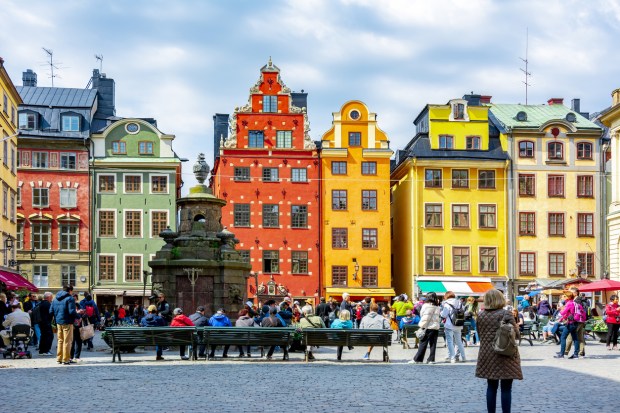
And what of blue-collar work? It may be regaining value. Some will mourn the declining prestige of the office as a symptom of cultural crisis. History suggests another possibility. Organic societies have long honoured the tradesman as an artisan whose skill contributes to the common good. Medieval and Renaissance guilds produced objects of beauty and utility. Piazza San Marco stands as a monument to a civilisation in which skilled labour, commerce, worship, and civic pride were not separate worlds.
Crimson conservative economics therefore sees the possibility of a renaissance – both of intellectual culture and of the trades. But that renewal will occur only if we abandon our post-historical disdain for manual work. We should encourage apprenticeships, strengthen technical education and provide genuine pathways into a vocation. As Phillip Blond has argued in developing the idea of Red Toryism, an economic ethos must once again be rooted in the dignity of work rather than in consumption alone.
Australia must also move away from the assumption that offshoring is an inevitable feature of prosperity. We should reindustrialise by drawing upon our natural resources and revitalising mining, energy, manufacturing, and regional production. Resource wealth should support national renewal rather than deepen our dependence upon foreign supply chains. This is what renewal looks like. Not dependence, but production. Not abstraction, but work.
A small-s socialist economic outlook can therefore serve a small-c conservative purpose. Strong public institutions, productive industry, organised labour and strategic market intervention can preserve the communities and traditions that a purely market-driven economy dissolves. The purpose is not to nationalise everything or smother enterprise. It is to conserve what is valuable while reforming what must change so that society can endure for future generations.
This is where I have experienced my greatest intellectual struggle. I value freedom of speech, religious liberty, and individual dignity, and I remain deeply indebted to the liberal tradition. Yet I do not believe that individuals can flourish independently of the communities and traditions that shape them. My engagement with the culture wars has therefore been an attempt to reconcile liberty and belonging rather than simply choosing one against the other.
Modern political discourse is infatuated with the individual. Personal desire is frequently placed above the sacred bonds that hold communities together. Crimson conservatism arose, in part, as an answer to an atomistic understanding of freedom without responsibility or accountability. This is not an argument against civil liberties. I believe in freedom of speech, expression, the press, and religion. But rights cannot sustain a society when detached from duties.
I also recognise why universal rights matter. Groups that have lacked political representation or legal protection have often depended upon them as safeguards against exclusion. My concern is not with protecting human dignity, but with treating rights as though they emerged from nowhere and require no sustaining culture. In practice, liberties survive because institutions, customs and habits teach citizens to respect them.
Roger Scruton used the term oikophilia to describe the love of home and spoke of putting the oikos back into the economy. That is the spirit of crimson conservatism. Public policy should draw upon local and national customs rather than regarding people as interchangeable units in an abstract market. This must never be confused with ethnic nationalism, which demonises minorities and the vulnerable. What I propose is civic patriotism: loyalty to a shared political home and to the duties that membership entails.
Danny Kruger has argued that families, communities, nations and the virtues sustaining them are the conditions of social life. Crimson conservatism begins from the same conviction. The modern progressive Left and the neoliberal or neoconservative Right appear opposed, but both can become hostile to inherited obligations. One champions social autonomy, the other economic autonomy. Both risk separating people from family, community and the national common good.
Civic patriotism offers another path. It invites working people to participate in democratic life not merely as consumers or members of identity groups, but as citizens. It treats liberty as part of a covenant between the individual, the community, its institutions, and the nation-state. Such a covenant seeks equality without erasing difference, solidarity without coercion, and national belonging without ethnic exclusion.
Theologically, the crimson conservative’s love of tradition rests upon the belief that a nation should defend the God-given dignity of its citizens. Abstract rights are vulnerable to constant reinterpretation, but natural rights embedded in custom and sustained by institutions can provide a firmer balance between liberty and obligation. Tradition is not infallible, and inherited practices can be unjust. Yet reform succeeds best when it appeals to a society’s moral memory rather than pretending that political order can be designed from first principles.
My engagement with the culture wars is therefore both intellectual and personal. I remain disabled without wishing to be reduced to disability; Irish by inheritance and Australian by birth, Catholic in formation, even when distant from the Church, committed to freedom, yet sceptical of a freedom emptied of duty. These are not contradictions to be resolved by selecting one identity and discarding the rest. They are parts of a life held together by belonging.
Crimson conservatism is my attempt to describe the politics that follows from that experience. It is a politics of home, work, obligation and inheritance. It asks the Right to remember solidarity and the Left to remember tradition. It asks the market to serve society, the state to respect local institutions and the individual to recognise that freedom is sustained by duties we did not invent. In an age of culture wars, technological upheaval and economic insecurity, such a politics may appear paradoxical.
That is precisely why it is necessary.