Ann Widdecombe’s father, James Murray Widdecombe CB OBE, was born in Saltash, the small Cornish town where I grew up, looking across the Tamar to Plymouth.
Ann knew this geography in her bones. ‘My mother was born in Plymouth, my father in Saltash, and my Westcountry connections go back to 1715,’ she once said.
Those connections were not merely ancestral.
When the war commemoration committee created a memorial of 141 hand-painted pebbles for the Saltash soldiers who fell in the Great War, it was Widdecombe who came to lay them.
Those same connections ultimately drew her back to the region, to a cottage on the edge of Dartmoor where, on July 9, she was found dead with serious head injuries. She was 78.
Devon and Cornwall Police have launched a murder investigation. A 26-year-old man initially arrested on Friday was released without charge; on Saturday evening, a 28-year-old suspect was arrested at an address in South Yorkshire, with the support of Counter Terrorism Policing, and taken into custody.
The emerging timeline is bleak: police believe Widdecombe was attacked at around 12.30pm on Wednesday, the same morning she had appeared live on TalkTV at 8 o’clock and was not found until an ambulance crew was called to her home the following day. She lay undiscovered for nearly 24 hours.
Whatever the motive, and we should resist speculation while the investigation proceeds, the fact remains that a woman who spent four decades in British public life died violently, alone, in the landscape she loved.
That demands something more than a news cycle.
It demands reflection.
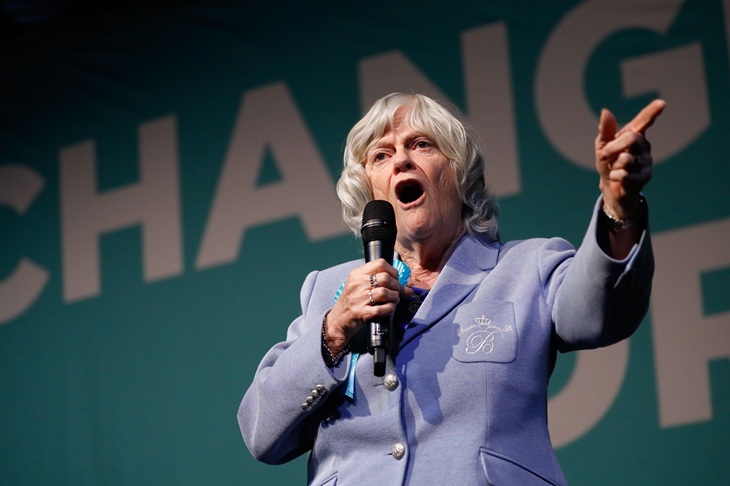
Widdecombe was, by any measure, one of the most formidable figures in post-war British politics. Conservative MP for Maidstone from 1987 to 2010, Minister of State for Prisons under John Major, Shadow Home Secretary under William Hague, Brexit Party MEP for South West England at 71, and finally immigration and justice spokesperson for Reform UK.
Still campaigning, still appearing on television, still writing her weekly column, right up to the morning of the attack.
Her management company captured her philosophy in words she had used herself: ‘We get one go this side of eternity, one go. Life is not a dress rehearsal.’
She took that seriously. Whether you agreed with her or not (and plenty didn’t), she never trimmed. Her conversion from Anglicanism to Roman Catholicism in 1993, prompted by the Church of England’s decision to ordain women, was characteristic: a public stand on private conviction, taken when it would cost her politically and gain her nothing. Her opposition to abortion, to the equalisation of the age of consent, to same-sex marriage: these were positions that made her a target for ridicule long before social media industrialised the process. She absorbed the abuse with something close to relish.
‘I am toothy, dumpy, ugly, overweight, a spinster: what the hell,’ she told one interviewer. It was disarming precisely because it was unapologetic.
And then came the second act. Strictly Come Dancing in 2010, dragged across the floor by a heroically patient Anton du Beke, surviving ten weeks on pure audience affection while the judges winced. Celebrity Big Brother in 2018, finishing runner-up at 70. Pantomime villainy at Christmas.
Britain does this with its most polarising figures: it metabolises political danger through entertainment, converting conviction into camp and controversy into a kind of affection.
Widdecombe understood the transaction and accepted it on her own terms. Du Beke, in his tribute, called her, ‘…a real friend. She was fun. She was upbeat. She was positive.’
The gap between that description and the caricature of the fire-breathing reactionary tells you how poorly our public discourse captures the people who inhabit it, and how easily ridicule substitutes for engagement with what they actually believe.
Australian readers will recognise the type, if not the individual. B. A. Santamaria, the Catholic anti-communist polemicist whom scholars have called the most significant unelected figure in Australian political history, occupied an analogous space: socially conservative, devoutly Catholic, reviled by the left, satirised on screen by Max Gillies, yet impossible to ignore because his willingness to say unfashionable things aloud forced opponents to articulate why they disagreed rather than simply assuming consensus. Santamaria’s Point of View broadcasts ran for nearly 30 years on Nine; Widdecombe’s weekly columns and television appearances ran for 16 years after she left Parliament. Both understood that conviction politics serves a structural function in democracy. The system does not run on agreement. It runs on structured disagreement conducted within boundaries of civility and physical safety.
It is that second boundary, physical safety, that her death brings into sharp focus, regardless of motive.
In the United Kingdom, two serving MPs have been murdered in the past decade: Jo Cox in 2016, David Amess in 2021. Reported crimes against parliamentarians have more than doubled since the 2019 general election.
In Australia, the Director-General of ASIO warned only last month that politically motivated violence is becoming more likely than the current threat level of ‘probable’ suggests, describing ‘concurrent, cascading and compounding threats’ to national security. Protections for Australian politicians were formally enhanced earlier this year.
In the days following Widdecombe’s death, Reform UK’s MPs were given 24-hour security protection funded by the party. Both countries, Westminster democracies built on the premise that elected representatives remain accessible to the people they serve, now confront the same question: how to preserve that accessibility without making public life a wager against the worst-case outcome. Widdecombe, who lived alone in a remote Dartmoor cottage with no apparent security, and who lay undiscovered for a full day after the attack, embodied the old assumption that a retired politician could simply go home. That assumption now looks like a fat tail nobody priced.
She stood as the Brexit Party candidate for Plymouth Sutton and Devonport in 2019. Plymouth, where her mother was born, looking back across the Tamar to Saltash, where her father was born, and where I once walked the same streets.
In February last year she was at the Reform UK Cornwall Conference in Redruth, still barnstorming, still unrepentant.
The Westcountry bred her, reclaimed her, and in the end took her. Conan Doyle chose Dartmoor for The Hound of the Baskervilles because the landscape could swallow someone whole. They called her Widdy, and the folk ballad that shares her name, ‘Widdecombe Fair’ in its original spelling, ends with Old Uncle Tom Cobley and all haunting the moor as ghosts.
The moor is very quiet now.