The Western Australian government recently announced its trial of ‘Overt Live Facial Recognition Technology’. In fact, by the time you’re reading this, the trial will have already completed its first ‘planned deployments’.
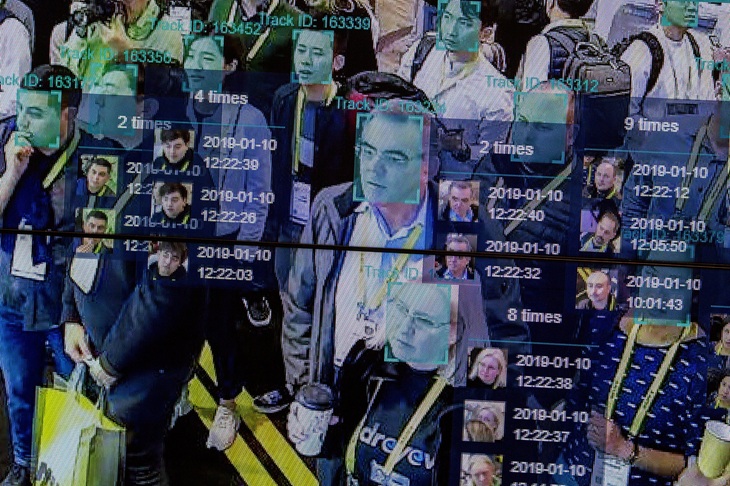
The technology can adjust what categories of people are included in the ‘alert list’ that triggers an initial alert to law enforcement officers who are monitoring the live screens scanning the crowds walking past them.
WA government’s website outlines that this technology will assist in preventing and detecting crime, finding missing persons, tracking down registered sex offenders, and the general protection of the public.
Reassuring, right?
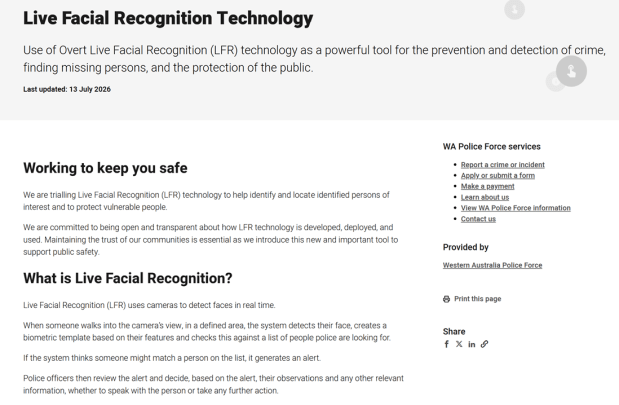
What is most concerning is the ambiguous language used when describing this ‘alert list’ – as it has the capability of including more categories of potential criminals within its scope of detection under the guise of ‘public safety’ and ‘preventing crime’.
Who’s to say that this technology could be adapted as methods to surveil protests, or other live events, and create a list of alleged dissidents that become criminals for exercising their democratic rights? It wasn’t that long ago where we saw the restriction on protests in the name of ‘public safety’ during the Covid pandemic.
This may be a worst-case-scenario approach, but what would be the hurdle to stop this from occurring? A piece of legislation in each State/Territory around Australia after a series of violent crime sprees or organised gang activity perhaps? Mass CCTV networks already exist to plug this technology into.
What is glaringly obvious about the deployment of this technology is the lack of scrutiny by Parliament or civic involvement in deciding on whether such technology would be beneficial for the community.
The key language used throughout the governments public service announcement reassures you that this is in the best interest of the people and endeavours to disarm the harsh reality of what the technology is capable of doing. For example, the terms ‘public safety’, ‘keep you safe’, and ‘vulnerable people’ are used in reflecting on why the technology could be the next logical step in supporting public safety.
It is important to note that I am not against implementing measures to protect public safety. However, these measures must be proportionate and have the primary objective of protecting people’s core rights like privacy and the presumption of innocence.
Mass public surveillance that runs on AI algorithms and predictive programming is not a pro-fundamental rights approach.
How does it work?
The technology uses cameras to detect faces in real time. In order to find yourself on the ‘alert list’ and trigger an alert, you would need to walk past the camera’s view, have your face scanned and a biometric template will be created from it, and it will finally check to see if your biometric data matches anyone within its system before issuing an alert if you match.
Before taking any action, police officers will review the alert and decide, based on the alert and their general observations, whether they will approach the person and look to take any further action. The facial recognition technology will provide a ‘similarity score’ and determine, based on a pre-defined threshold, whether an ‘alert’ will occur.
So, in practice, it could be that anyone who achieves an 80 per cent or higher similarity score to someone on the alert list will be approached and questioned by the police. It is important to note that the actual threshold to trigger an alert is not provided by the WA government.
Privacy: ‘I don’t care about surveillance because I have nothing to hide’
What is most concerning is the mass-collection of your biometric facial data that form core components of your privacy rights. If compromised, biometric data poses a significant risk to your privacy as it cannot be changed or altered (unless you opt to surgically change your face).
The Office of the Information Commissioner in WA published a media release on July 9, 2026, a mere day before the facial recognition technology trial ensued, acknowledging the risks associated with the mishandling of biometric data if it were to occur.
The way privacy legislation and other laws related to recording in public places are defined, the live facial recognition technology meets all the requirements under the law that facilitates its mass-adoption – assuming the trial will be successful in WA.
There are three main concerns I hold regarding mass-adoption of this technology:
- People will inevitably have to change their behaviour if they believe they are constantly being surveilled as a potential criminal.
- The adoption of this technology may be plugged into existing systems, like CCTV, which will facilitate an instantaneous surveillance grid around the entire country.
- Automated decision-making by AI that will begin to make law enforcement decisions without human input.
Although law enforcement officers cannot act on an alert until it has been validated by them – how long until we see this aspect change in the name of ‘public safety’?
You may think, ‘I don’t care about surveillance because I have nothing to hide’, and you may be right. CCTV has been monitoring all of our movements for decades, and private companies have already adopted AI surveillance and monitoring.
Fair enough.
However, the law is changing and adapting constantly, and what you perceive as normal today could be criminalised in the future. In fact, laws change so frequently that you may be committing a crime without even realising it.
Without privacy rights and protections, you no longer control the potential evidence that may ultimately be used against you at a later date to incriminate you.
Even in their current, least restrictive form, these technologies can determine whether you will be subject to police questioning or framed as a potential ‘criminal’ due to a biometric analysis of your facial data’s similarity score.
Mass-surveillance changes the way humans behave – as fear of constant monitoring promotes conformity and is a timely reminder that they are always being watched.
As George Orwell’s fictional novel (although it is becoming less fictional every year) 1984 declares: ‘Big Brother is watching you.’
Dr Alexander Hatzikalimnios is a legal academic and commentator. He writes on digital regulation & technology, free speech & expression, and fundamental rights.