In the French city of Nantes, the ribbon-cutting ceremony for the city’s long-anticipated railway station was a big event.
The socialist mayor, Johanna Rolland, presided over the unveiling of the eco-friendly station, which had been hailed as a marvel of architecture and engineering. The town’s councillors applauded its ‘natural ventilation’ system, which was supposed to make air conditioning unnecessary in hot summer months. Also present at the inauguration was celebrated French architect Rudy Ricciotti, the recipient of France’s highest distinctions, including the Légion d’honneur. He designed the station’s thermally self-regulating mezzanine. Its price tag was €37.5 million (£32 million).
That was six years ago. Today, the thermal ventilation system does not work. In hot weather, the Nantes railway station becomes an inferno. In last week’s heatwave, the shops in the glass mezzanine – including Starbucks – were forced to close. Local authorities hastily installed fans, but rail passengers preferred to sit outside to wait for their train.
The failure of Nantes’s eco-efficient train station is a case study of the catastrophic consequences when urban planning is driven by fashionable ideology instead of sound engineering. It’s one of many structural failures in France that have failed to protect the population from the effects of scorching heatwaves (‘canicules’ in French).
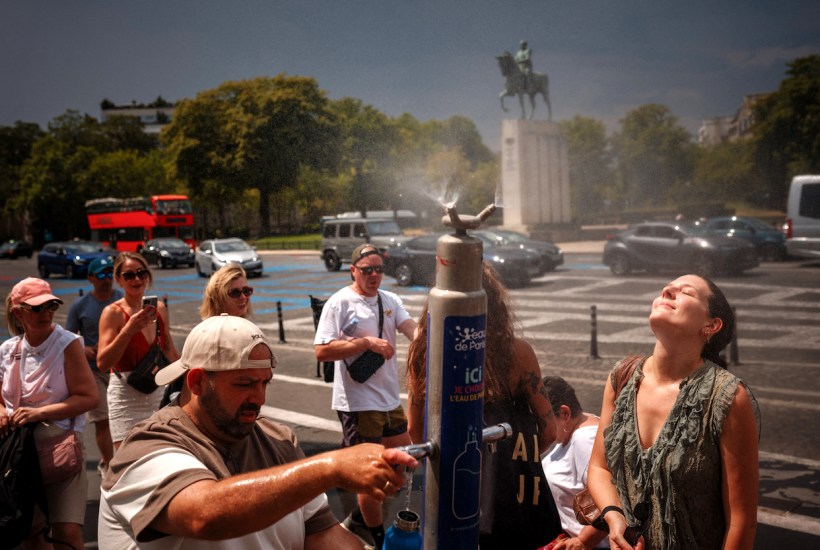
In last week’s canicule, elderly patients in French care homes and hospitals suffered and died in temperatures above 40 degrees. Schoolchildren stifled in classrooms equipped only with fans and misting water bottles. In the Paris transport system, commuters were jammed into crowded buses and Métro trains with no ventilation. In the poor suburbs, residents in cement tower blocks without air conditioning sweltered in the searing heat. Only 25 per cent of households in France have air conditioning – half the rate of households in Spain and Italy.
French opposition to air conditioning has a long history. The country’s old buildings, it is claimed, make retrofitting cooling systems difficult. Some blame a raft of energy-consummation regulations which followed the oil shocks in the 1970s. Others argue that the French are simply resistant to change. But with thousands perishing in heatwaves every year – France’s health ministry says that last week’s canicule caused more than 1,000 excess deaths – most agree that it’s time for action.
But France is not a nation renowned for pragmatism. Unlike Anglo-Saxon culture with its practical approach to problem-solving, the French are conceptual and abstract. The French approach to heatwaves has been heavily bureaucratic. The government’s usual response is to set up ‘crisis cells’ to manage the impact of extreme heat.
Though air-con penetration in French households is low, it’s still higher than the European average of 20 per cent, and the UK rate of as little as 5 per cent. (Ninety per cent of households in the US use air-con.) In Britain, air conditioning has not been regarded as needed in a climate known more for drizzle than for extreme heat. The urgent problem in France is the absence of air conditioning in hospitals and schools (only 7 per cent of French schools are equipped with air-con, while 65 per cent of commercial offices are). While many enjoy air conditioning in French shopping centres and at work, hospital patients and schoolchildren suffer.
Failure to commit substantial public investments to installing cooling systems in France can be explained by simple politics. The country is divided over air conditioning along ideological lines.
The French right are generally in favour of air conditioning. For conservatives, air-con saves lives and avoids productivity losses in the economy. Marine Le Pen’s Rassemblement National has promised to ‘turn the page on punitive environmentalism’ with a strategy that would massively roll out air-con in schools, hospitals and care homes. Eric Ciotti, a hard right MP who is also mayor of Nice, the Riviera city, has drafted a law that would make air conditioning compulsory in schools and hospitals.
The French left are overwhelmingly hostile to air conditioning. They say it contributes to global warming. For French politicians from the left-wing Ecologist party, who control several city councils, opposition to air conditioning is an inflexible doctrine asserted with quasi-religious fervour. In Paris, the Ecologists pushed for the purchase of new buses without air conditioning. The consequences for commuters were disastrous, but supporters believe that suffering is regarded as a necessary ordeal to awaken citizens to the coming apocalypse of climate change. Enduring the cruel afflictions of extreme heat is an expiatory ritual that expunges the sins of over-consumption in a society addicted to fossil fuels and nuclear power.
In the aftermath of the most recent heatwaves, however, these traditional distinctions are blurring. Fearing voter backlash, Ecologists are adopting more nuanced positions. Ecology leader Marine Tondelier conceded last week that air conditioning is perhaps needed in schools and hospitals.
Air conditioning will be a burning issue in the run-up to France’s presidential elections next year
The French government, meanwhile, is deeply permeated by eco-ideology. Official policy is opposed to air conditioning. Government reports, brochures and public-service videos discourage French citizens from installing air conditioning, and suggest alternatives such as home insulation. True, France has poorly insulated housing stock, especially in bleak suburban areas covered with bleak tower blocks. Yet little has been done to tackle the problem.
Emmanuel Macron may well be a pragmatic centrist, but he has appointed strident activists to key ministerial positions in charge of the environment. His current ‘minister of ecological transition’, Monique Barbut, is a climate change activist from the UN system with no political experience. Last week, Barbut blurted to the media that she was ‘horrified’ by suggestions that air-con is needed in heatwaves. Her ill-advised outburst came while hundreds of patients were dying in furnace-like hospital rooms. Barbut’s boss, Prime Minister Sébastien Lecornu, disavowed her publicly by ordering 30,000 air-con units for French hospitals.
Lecornu displayed some admirable pragmatism. But it was too little, too late. Ordering air-con units for hospitals should have been done before the summer – indeed 20 years ago by previous governments following the deadly heatwave of 2003, which some estimate caused the deaths of 15,000 French people.
Air conditioning will be a burning issue in the run-up to France’s presidential elections next year. Every presidential candidate will have to have to formulate a concrete action plan for adapting to heatwaves. The final-round presidential vote takes place next May, likely followed by a general election in June. Given that heatwaves struck in May and June this year, French voters could well be going to polling stations in 2027 in scorching hot weather.
In Nantes, architect Rudy Ricciotti has been unapologetic about his eco-friendly railway station that turned into a blazing oven. He insisted that, if he had to go back to the drawing board, he would do everything exactly the same.