In 1791, Jeremy Bentham described in his book Panopticon: The Inspection House how a panopticon could allow a single guard to observe all prison inmates, remaining invisible to them.
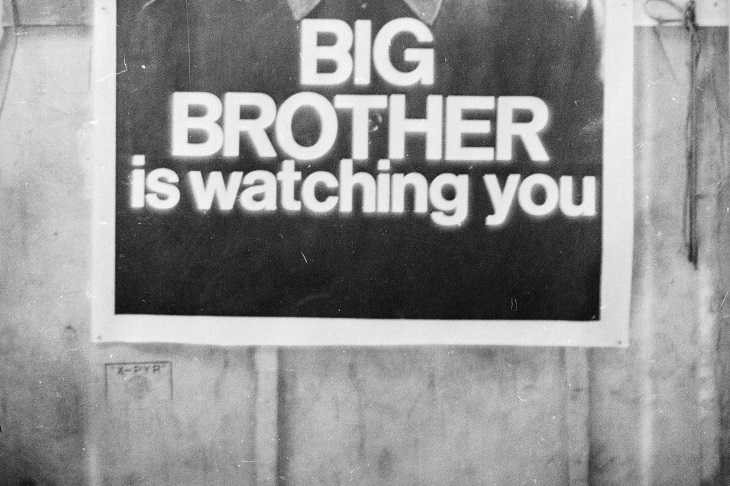
While Bentham’s prison architectural design was surveillance made for the late 18th Century, spyglasses, telescopes, and radios were used in the 19th and 20th centuries to control people and to suppress dissent. In the 20th Century, although power plants defined industrial might, there still existed a modicum of privacy and George Orwell’s iconic book, 1984, merely fantasised about a world without privacy; it was not yet a reality at the time of writing his classic tale.
Since then, the surveillance industry has seen major developments, always at the expense of people’s privacy.
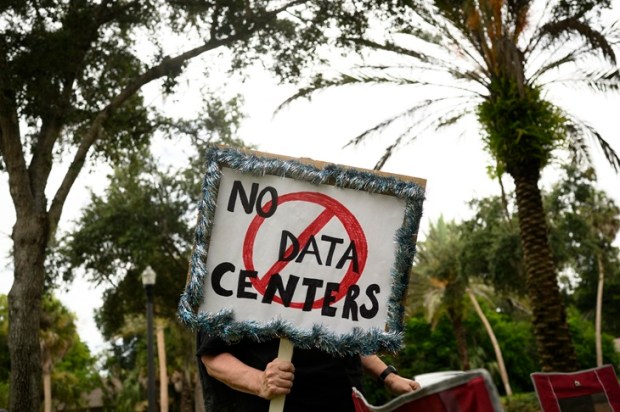
In the 21st Century, governments enthusiastically endorse newly developed surveillance methods to control the population and to pursue the elusive goal of ‘social cohesion’. However, these developments have typically eroded people’s privacy which is fast becoming an endangered and untenable ideal. Specifically, in our time, data centres that store massive amounts of information at an immeasurable cost threaten the fabric of society.
A new mega data centre in the United States provides an instructive tale.
It is slated to be the world’s largest, occupying 40,000 acres and requiring gigawatts of electric power to operate effectively. The location is situated on arable land and its size is over two and a half times the size of Manhattan’s area. Its projected power requirement ranges from 7.5 Gigawatt (developer statements) to 9 Gigawatt (independent reporting), which is more electricity than the entire state of Utah currently consumes. Utah’s current statewide consumption is around 4 Gigawatt. This means that the data‑centre project alone would require two times the electricity of the entire state.
Utah is no stranger to data-centre activity. The state already hosts one of the most controversial intelligence facilities in the world, the NSA’s Utah Data Centre at Bluffdale. But this new proposal, driven by private AI and cloud‑computing giants, represents something different: a civilian‑facing infrastructure project with national‑security scale and corporate‑surveillance implications. And it raises a question that communities from Australia to Ireland to Virginia are now asking: What exactly are we building and who does it really serve?
Data centres are being erected worldwide at an alarming pace. These facilities require enormous cooling systems, which are based on large water consumption. Naturally, questions are raised about where the electricity and water will come from. As data centres, which operate 24 hours a day, cannot fully rely on green energy. They will suck all the available electricity from the grid system. As for water consumption, these mega data centres would require millions of litres to cool down the data systems. Moreover, water used to cool the systems will be mixed with a cooling chemical (like that used in vehicles) to increase its efficiency. This raises the question as to how and where the wastewater will be disposed of.
Putting aside the problems of electricity and water consumption, the more important question is: Why do we need these data centres?
During the last five years, the introduction of artificial intelligence has necessitated the establishment of data centres. To put it bluntly, artificial intelligence needs to be fed with all the data and information that humans produce. This feeding comes from almost all electrical devices, such as smartphones, home appliances, vehicles, homes, offices, public scrutiny, actions and results of human activity and overall surveillance; the list is endless. All this information is funnelled and stored in data centres, analysed and classified by artificial intelligence.
That raises uncomfortable questions. Who controls the data pipelines flowing into and out of the centre? How do democratic institutions check systems they cannot see, do not understand and do not own?
Like water, data flows. Like water, it can be diverted, stored, filtered, and weaponised. And like water, once it enters the wrong reservoir, it is almost impossible to retrieve.
The Utah district will not simply host AI systems; it will shape them. Governments, law enforcement agencies, border authorities, and private platforms may use systems trained in the district. For example, they may power facial‑recognition systems, behavioural-prediction engines or automated decision tools that affect everything from credit scoring to immigration screening. Once built, it shapes everything around it, economically, politically, and culturally. And once AI infrastructure reaches a certain scale, it becomes almost impossible to regulate retroactively.
By 2030, global AI electricity demand may double. Data centres will rival industrial nations in power consumption. And the systems they support will increasingly mediate daily life, from hiring to policing, to border control, to public benefits.
Civil liberties groups have warned for years that the greatest threat to privacy is the accumulation of surveillance capabilities, the quiet layering of sensors, databases, and algorithms which obliterates the line between public and private monitoring. They assume, however, that privacy is the default and surveillance the exception. AI flips that logic. Surveillance becomes the baseline; the raw material and privacy become the exception that must be defended. And the outcome will shape not only the future of AI, but the future of freedom itself.
Data centres do not just store files. They store your location history, search history, messages, biometrics, purchases, browsing patterns, digital identity, financial transactions, and interactions with AI. Every digital action leaves a trace. Every trace becomes data. Every piece of data becomes a commodity. All of it ends up in a data centre. This is not a conspiracy. It is the business model of the modern internet.
Data centres are only the foundation. On top of them, governments and corporations are building the next layer of digital control mechanisms. Digital IDs, a single identity that links your health records, financial accounts, travel history, biometrics, government services, online activity, in one word, everything. Convenient? Yes. Powerful? Absolutely. Risky? Only if you believe privacy matters. In addition to digital IDs, a government‑issued digital currency (CBDC) might be introduced that can be tracked, monitored, restricted, frozen, programmed, and expired, among other things. CBDCs are not inherently dystopian. But they enable a level of financial visibility and control that no government in history has ever possessed. And where will the infrastructure for digital IDs and CBDCs live? The answer is: in data centres. The same buildings are already storing the rest of people’s digital life.
Individually, data centres, digital IDs and CBDCs are tools. Together, they form a complete system where data centres store everything: digital IDs link everything and CBDCs track everything. This is about a society that centralises identity, money, and data into a single digital ecosystem. But such a society must confront a difficult question: who controls the system and who controls the controllers? Because once everything is digital, everything is traceable. And once everything is traceable, everything is controllable.
Rational people should be justifiably concerned about this development. Specifically, they should be concerned about a world where every action is logged; a world where identity is centralised; a world where money is programmable; a world where privacy becomes a historical concept; a world where power shifts from citizens to systems. Data centres are the infrastructure that makes the threat to privacy possible. As the digital world expands and the physical footprint of data centres grows, we must ask: Who owns the data? Who controls the identity? Who programs the money? And who watches the watchers? The future is being built quietly, behind those windowless walls on the edge of town. And once the system is in place, it will be very hard to unwind.
When news broke about the proposed 40,000‑acre AI-optimised data centre complex in Utah, the reaction was immediate and polarised. Supporters hailed it as a ‘once‑in‑a‑generation economic opportunity’. Critics saw something else entirely: a massive industrial footprint, unprecedented energy demand and a quiet but unmistakable shift in how modern societies are governed, monitored, and monetised.
When digital IDs and CBDCs operate together, the data centre becomes the vault, ledger, identity registrar, and the behaviour-analysis engine. This is why governments and corporations are racing to build more facilities. The future of governance, whether democratic or authoritarian, will run on server racks.
The warning shot was the recently unsealed court records from the January 6 investigation that revealed that Google fought and lost a Department of Justice attempt to force a ‘keyword warrant’. A keyword warrant demands the identities of everyone who searched for a specific phrase, within a specific timeframe, and regardless of whether they committed a crime. This is a dragnet search, not a targeted warrant. The unsealed documents also showed that innocent people were swept into investigations simply because their Wi‑Fi networks were used by someone else. This is not hypothetical. It is not speculative. It is not a conspiracy theory. It is a real legal precedent. It demonstrates the core risk of the data-centre era: when all digital activity is stored, indexed and searchable, the threshold for suspicion collapses. You no longer need to commit a crime. You only need to appear in the data.
Australia now hosts over 280 data centres, with Sydney emerging as one of the largest hubs in the Asia‑Pacific region. The pattern is identical to Utah, with massive energy draw, heavy water usage, industrial rezoning, and communities caught between economic promises and environmental realities. Australia’s experience shows that once a region becomes a data-centre hub, the build‑out accelerates. One facility becomes five. Five becomes 20. And soon the grid is redesigned around corporate computer demand rather than public need.
Data centres are the new centres of power, literally and politically. They determine who controls identity, money, access, the narrative and who controls the data that defines modern life. The Utah mega‑project is not just a local zoning issue. It is a preview of a world where every action is logged, every transaction is traceable, every identity is centralised and every byte flows through privately owned industrial complexes. Communities have the right to ask whether this is the future they want or whether the infrastructure of the digital age is being built without their consent.
Modern constitutional privacy protections in the US, EU, and most democracies were designed for a world where surveillance was expensive, data storage was limited, analysis required humans and monitoring was targeted, not universal. AI data centres break all four assumptions. They make it possible to store everything, analyse everyone, predict behaviour, and run real‑time biometric systems. Courts have not yet fully adapted to this reality. The law protects individuals from targeted surveillance, but AI enables mass surveillance without targeting. This is the core civil‑liberties challenge.
Private companies now control the infrastructure that governments use to monitor citizens. This creates accountability gaps: public‑records laws do not apply to private operators, courts cannot easily audit proprietary AI models, citizens cannot see how their data are processed and regulators often lack technical expertise. The result is a democratic blind spot.
Even when surveillance harms someone, the legal system struggles because AI models are opaque (‘black boxes’), algorithms are protected as trade secrets and individuals rarely know they were observed. In addition, the courts require proof of injury, which is hard to show. You cannot challenge what you cannot see and AI makes surveillance invisible. This is why civil‑liberties groups warn that AI infrastructure, not any single surveillance program, is the real threat.
In summary: data centres are the new industrial backbone of the digital world. They enable AI, cloud computing and the surveillance systems that increasingly shape modern life. They are profitable, powerful, and essential, but they come with significant environmental, economic and civil‑liberties costs.
Their electricity demand strains grids. Their water use strains ecosystems. Their computing capacity expands the reach of surveillance. And their growth raises fundamental questions about who controls the infrastructure of the digital age and who pays for it.
The future of data centres is not just a technological issue. It is also a societal one. Data centres are the panopticon of the 21st Century! But even Bentham, if he were alive today, would be surprised to see how privacy has become the unfortunate victim of the digital age of the 21st Century. And George Orwell’s book, 1984, is no longer fiction; it is reality.
Dejan Hinic is a financial and investment expert operating from Belgrade, Serbia He received his law degrees from the University of Belgrade and the University of Queensland.
Gabriël Moens AM is an emeritus professor of law at the University of Queensland where he served as the Garrick Professor of Law. He also served as pro vice-chancellor and dean at Murdoch University. He is the co-author of The Legal Right to Disobey Law, Sidestream Press, 2026.