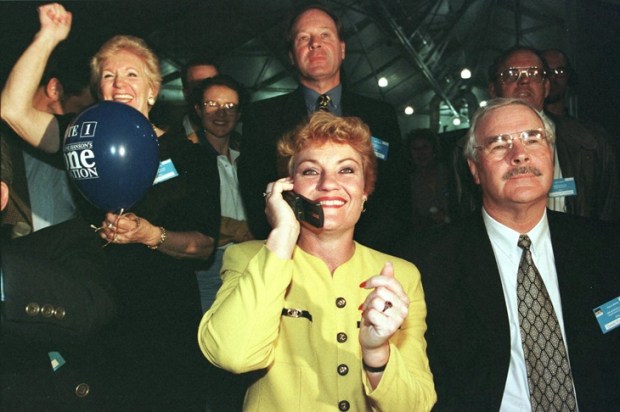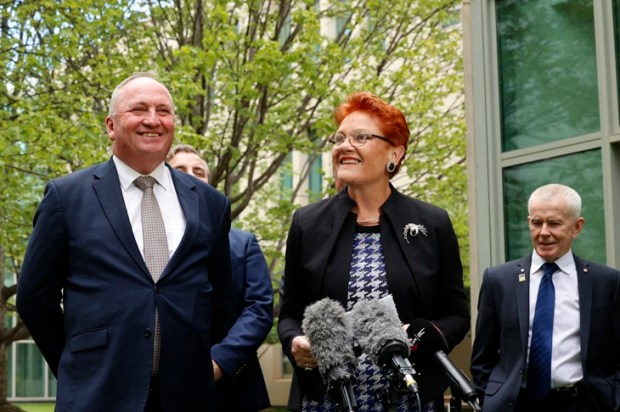
Pauline Hanson is often likened by her detractors to Donald Trump. Now, I don’t want to detract, but she’s no Donald Trump. However, their political styles do have a few things in common, trolling being one.
It is my opinion One Nation might have been trolling when Pauline Hanson rejected multiculturalism in favour of monoculturalism. It was a word likely to enrage her enemies and titillate her friends.
As with Trump, the best way to read Pauline is seriously, but not literally. When she said ‘monocultural’ her mind wasn’t a political vista full of identical pine trees, or fields of hybridised wheat.
She means there is one Australian culture.
You can come here and contribute to it, but if you come here you must be part of it, not part of something that is not Australian, and there is such a thing as Australianness.
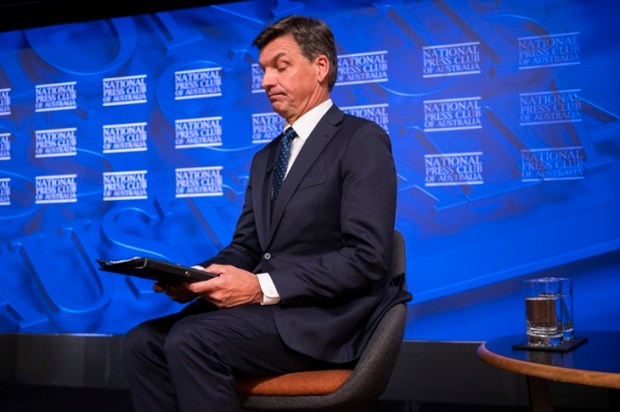
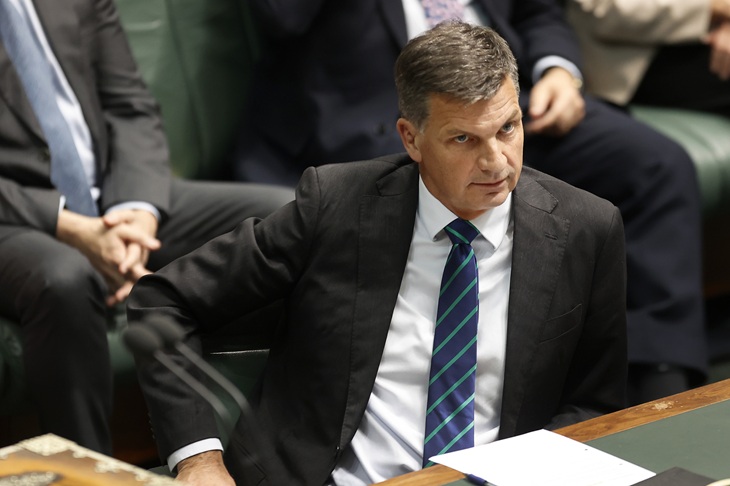
But Labor wanted to shore-up their ethnic constituency and wedge the Coalition – why not? That’s what political parties do. So, they put it on Angus Taylor – does he agree with multiculturalism?
There is a serious problem in the Liberal Leader’s office that this was not predicted and catered for. The answer was not to go on the defensive, but to attack Labor.
Labor’s idea of Australia is ‘hotel Australia’. If you live here, you are Australian, no matter how you identify, what language you speak, what country your allegiance lies with, whether you accept our values or not.
It is not an idea that most Australians share.
But the alternative is not a country of automatons who all believe the same things, dress the same way, go to the same schools, eat the same food, with 2.2 kids and a house with a white picket fence.
The alternative is ‘team Australia’ – a group of people with different skills, different habits, but the same ethos.
Labor’s multiculturalism worships difference as the essential good and demands no adjustment from migrants. Most of the Coalition’s constituency, if they say they believe in multiculturalism, believes that pluralism is an essential good, and integration an end goal.
This was the basis of John Howard’s turn towards integrationist nationalism – an emphasis on common citizenship, English language, loyalty to Australia, and the rule of law – which led to the adoption of a citizenship test in 2007, one of the last acts of his government.
Labor has been subverting this approach to immigration since the beginning of its recent term, and in October 2022 the Prime Minister announced a review of Australia’s multicultural policy settings, which resulted in the report Towards Fairness: A multicultural Australia for all.
Instead of putting Albanese on the spot for his anarchic and unpopular approach, represented by that report, to multiculturalism, Taylor hedged. Not a bad hedge, but a hedge nevertheless.
A less than perfect response is survivable, but the ill-discipline of his team could be fatal. The Coalition contest that One Nation cannot govern, but it’s an open question as to whether the Coalition can either. Taylor was undermined by his many members of his party, including senior ones, who all had to have their say on the issue.
At one stage we even had the coach of the team, Federal Liberal President Tony Abbott, opining on the issue. Although this was before Taylor was put on the spot, and was the best of all the responses.
In the aftermath of the Bondi Beach and October 7 massacres, I’m sure that the word multiculturalism conjures up, for many of us, images of immigrants who bring their troubles here. And to others, a form of postmodern colonialism in which migrant cultures set up enclaves where they speak their own languages, administer their own law, and owe allegiance to overseas organisations and countries within a host nation with an incompatible culture.
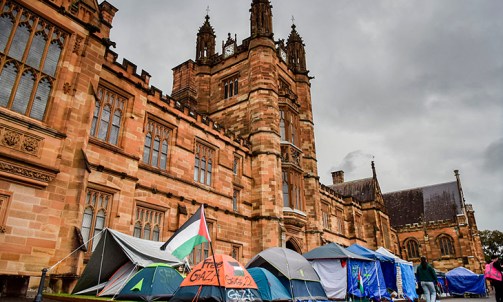
It wasn’t just the massacres, it was the ‘spontaneous’ marches against Israeli genocide that sprang up even before the Israelis had responded. It was also explosion of antisemitism, condoned or promoted in our universities and cultural organisations, and barely rebuked by our governments.
I’ve always had problems with the concept of multiculturalism, right from the days of Whitlam. Australia has a culture of pluralism, but it is one culture with many expressions. Is that a monoculture? Not unless you could call something like a rainforest a monoculture. Just as with the forest there are boundaries, and we can identify alien plants even amongst the vast range of different species.
Tony Abbott is right when he says ‘Australia has a core Anglo-Celtic culture … we have a foundational Judeo-Christian ethos that should never change’.
It is worth reading Towards Fairness to get a more detailed idea of what multiculturalism means to Labor. Every culture gets a mention, apart from the cultures that made modern Australia what it is.
The report starts with a preface by an Aboriginal leader who assures us that from the beginning Australia was a multicultural nation because it had 700 distinctive language groups before the Europeans arrived.
But there was no country called Australia until the Europeans arrived, and even then, not until 1901 with Federation. Before the Europeans it was a continent with 700, often warring, tribal groups. This is not multiculturalism.
There is an identification of multiculturalism with ethnicity, but the ethnicities that built this society – the English, Scottish, Irish, Welsh, Cornish, later the Italians, the Greeks, the Poles, the Germans and other Europeans are practically invisible.
There is a table of organisations that were consulted. None are Anglo-Celtic, as far as I can see, apart from one association, and arguably, the Anglican Church. As far as I could tell there were 61 from South Asia, 54 either Islamic or Middle East, but only 17 from Europe.
More than half those consulted were actually organisations involved in the multicultural policy ecosystem: agencies, service providers, settlement bodies, peak councils, advocacy groups, and selected ethnic/religious organisations.
The consultation list tells the story. The institutional voices of multiculturalism were heavily represented; the inheritance of the country into which migrants are being integrated was barely visible.
Unsurprisingly many of the recommendations proceeded on the basis that these ethnic cultures were so important to the immigrants who come from them that the government had to provide assistance to maintain them.
The Howard government instituted ‘Harmony Day’, the report wants to lean away from it. It makes the claim that Australia is a racist country, when the best evidence is that Australia is one of the least racist countries in the world.
It rehearses the revisionist position of Australia having been conquered, rather than settled; widespread massacres; land still belonging to Aborigines and so on. All the sorts of things that, if true, make first-generation migrants complicit to some extent in crime, like receivers of stolen goods.
This is then used to claim that:
Communities … conveyed … a strong desire for Australia’s diversity to be recognised and fully embraced, including through highlighting the significance of First Nations histories and integrating them into the education system for new arrivals in Australia. This …is seen as essential for genuine reconciliation and the need to achieve equality for all, without which multiculturalism is incomplete.
In my view, this suggests a world where multiculturalism is incomplete without the indoctrination of new migrants into a disdain for the Judaeo-Christian culture that actually makes us who we are.
If the Liberal Party wants to have a future as the major centre-right party in Australia, then it needs to re-examine its knee-jerk affirmation of multiculturalism amongst other things. Signing-up to Labor shibboleths is what makes around half their former base think they are Labor-lite.
Angus Taylor is promising a full slate of policies before the next election as his winning strategy. Billy Sneddon, Opposition Leader between December 20, 1972 and March 21, 1975 tried the same tactic, producing a 136-page document titled The Way Ahead.
It got them closer to Labor in the 1974 double dissolution election, but it took a change of leadership to a conviction politician, Malcolm Fraser, to seal the deal with a record landslide election result.
Policies are important, but until the Coalition can work out what principles it stands for, it has no chance of regaining its majority opposition status, let alone winning an election. And those principles should include a rebuff to Labor’s Hotel Australia multiculturalism.