I miss the New Labour years, when the government gushed money at cultural initiatives and Britain, previously a backwater in the art stakes, began to look like a serious international player. Sculpture was big and inescapable, and for a brief period it felt as though we’d found our groove: the Italians and Spanish had their old masters while New York bagged canonical modernism; France did both. But, from roughly the mid-1990s to whenever it was that Big Brother stopped airing, we had the best of the new – and ‘the new’, in character, was either ribald, bizarre or monumental. This last register, as executed by the likes of Antony Gormley and Anish Kapoor, was unashamedly populist but given legitimacy via the pseudo-philosophical rationale of its creators.
It’s not the artist’s fault that even the good stuff carries a
whiff of super-yacht yuck
Aggressively self-righteous, Kapoor (b.1954) was by some distance the least likeable but also the most obviously oligarch-compatible. Gormley frequently worked high-minded talk about humanism or whatever into his art, but it was more difficult to square Kapoor’s lofty (if doubtless sincere) patter with his actual output. And yet he made some of the most memorable art of the period, giving us optical illusions that appeared to defy physics and gargantuan sculptural installations engineered with an unrivalled degree of precision.
On the strength of this current exhibition, not much has changed. Kapoor is still churning out the sort of things he was producing 30 years ago and still demanding absolute technical exactitude. He is still capable of astonishing and still, too, posing as a sage, with impressive pomposity. The show mostly consists of new works, including a bunch of pieces created with the aid of ‘Vantablack’, supposedly the blackest pigment conceivable, that was developed by his studio and licensed exclusively to his business.
To be clear: I enjoyed it, sort of, and can still only marvel at the accomplishment of Kapoor’s delivery. All sense of perspective is skewed and defied by his mirrors and room-filling interventions – resembling giant Babybels – and his abstract wall-paintings in Vantablack. Meanwhile, what looks like a black circle painted over the floorboards turns out to be a deep hole. Another room’s walls support huge, meat-hued forms shrink-wrapped in transparent PVC, resembling cuts of beef in a supermarket: they’re scary, uncanny, horrifying – surreal, in the proper, frightening sense of the term.
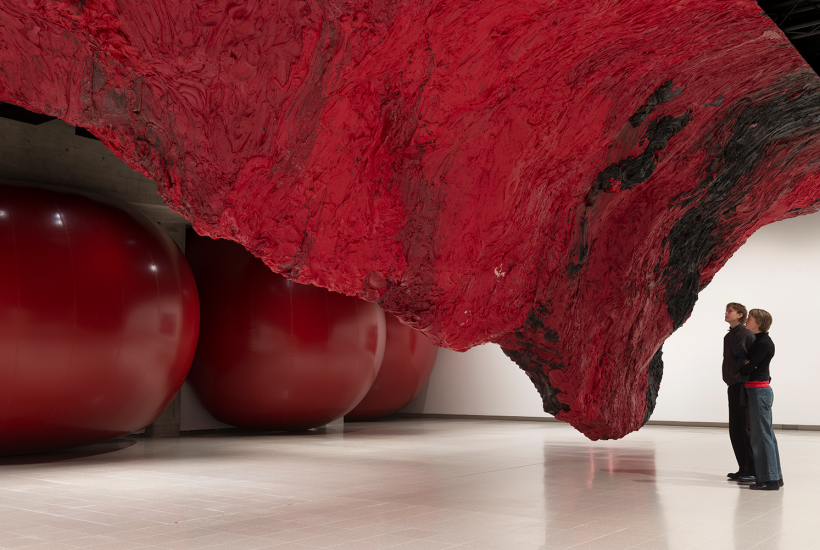
If Kapoor could only keep his trap shut, then the show’s first half might have been a spectacular demonstration of art’s capacity to thrill. Alas, he can’t hold back and, as the work gets less interesting, his explanations become ever more florid. ‘Ha Makom’ (2026) is a vast, tentacular sculpture that dominates the Hayward’s top floor and was apparently inspired by a visit to Uluru in Australia. Resembling an abandoned watchtower that has somehow come to sprout the roots of a giant redwood, it’s an obstacle to passage hewn from god-knows-what and painted in a vivid shade of red.
Its title is Hebrew for ‘The Place’ and is intended, according to a caption, ‘to express the presence of the divine across space and time’. It’s undeniably impressive in terms of sheer scale, yet it falls short of its creator’s ambitions to the spiritual. This is partly the Hayward’s problem – it’s always been a tricky space – but that red doesn’t land the way it should, and instead of something profound, what we get here in every respect is a luxury art object. It’s not the artist’s fault that even the good stuff carries a whiff of super-yacht yuck; he was popular with yesterday’s plutocrat class, and who could fault him for profiting? Yet while a slippery ironist like Jeff Koons might get away with such associations, Kapoor, on account of his grandiose philosopher-king stance, cannot. It will be interesting to see how his aesthetic fares in the long run, but at present it seems stuck in a distant, vulgar, pre-crash past.
Also when Kapoor is bad… crikey. He’s attempted to transfer his vision to canvas, setting vaginal forms against red or flesh-tone backgrounds. Other big sculptures, heavy on the silicon and resembling piles of guts, are accompanied by further expressions of the artist’s wisdom: ‘The red of blood is violent but also the matter of life.’ Yet these works are less visceral than naff, resembling offcuts from the showpiece anatomical exhibit at the Millennium Dome. And you can’t get more New Labour than that.
Got something to add? Join the discussion and comment below.
You might disagree with half of it, but you’ll enjoy reading all of it. Try your first month for free, then just $2 a week for the remainder of your first year.