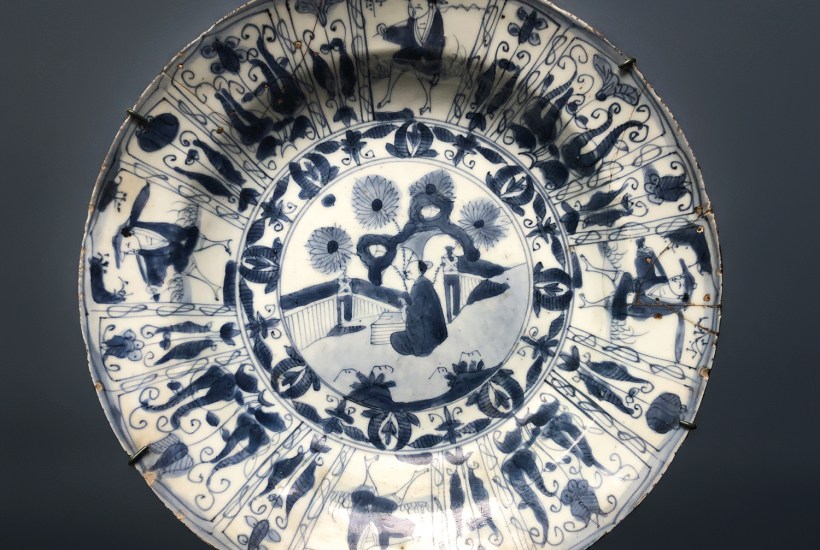
My granny used Spode willow-pattern crockery for everyday use. There was another grander service for Sunday lunch, also blue-and-white chinoiserie: Booths dragon, picked out with a gold border. Willow pattern evokes for me the taste of slightly stale ginger biscuits, which I liked very much, and coronation chicken, which I was less keen on.
The idea of owning a table service now seems close to antediluvian; too formal and too much washing-up, although this was a ritual that mattered greatly to Granny. People now prefer plates that give a dull clunk when flicked, rather than fine china’s dulcet ping. Such changes of fashion were a factor in the 2008 closure of the Spode factory in Stoke-on-Trent, which had been producing willow-pattern plates since the 1790s. You can still buy it new, but it will probably have been made in China.
A beautiful exhibition exploring the entanglements of china, the stuff, and China, the place
Although much of the Spode works stands empty, it houses a plucky little museum, with a café selling Staffordshire oatcakes on blue-and-white plates, and a tremendous treasure trove of a shop selling old ceramics for a song. It has put on a beautiful and stimulating exhibition using willow pattern to explore the entanglements of china, the stuff, and China, the place.
It might have been tempting to make this merely a hectoring story of orientalist cultural appropriation. Certainly the various love stories attached to the willow pattern were largely hokum, and the pattern is a muddle of misunderstood motifs. Subsequently the formalised transfer-printed wares of the English ceramics tradition can come off as stiff and naive, especially when placed in direct competition with the lithe and entertaining painted decoration of the real thing.
The exhibition tells a significantly more interesting story of cross-global give-and-take which is essentially a tale of two cities. These were the two greatest centres of ceramics production the world has ever seen: Jingdezhen on the banks of the Chang River and the Staffordshire potteries centred on the six towns of Stoke-on-Trent.
At its height during the late-Ming period, Jingdezhen employed an estimated 100,000 people in ceramic manufacture and was known as ‘the town of year-round thunder and lightning’. Whether the fabled 82 hands that each piece was meant to go through during its manufacture was in fact the case, it was still a fantastically complex proto-industrial operation, involving many stages and prodigious craftsmanship. The exhibition allows you to scan a QR code, and then turn around on your mobile a 3D scan of the porcelain bowl in front of you.
You can see why Europe went crazy for the ‘white gold’ of Chinese porcelain. The early attempts by Staffordshire to ape the taste have a goofy charm, but were clearly distinctly second-division stuff. The industrial revolution that transformed this situation is normally told through that outstanding self-promotor Josiah Wedgwood, but with willow pattern as the lens other family-run businesses come into focus. After seeing the exhibition, make a pilgrimage to nearby Stoke parish church, the Valhalla of the potteries, to see the memorials to these families, the Spodes, the Copelands, the Mintons, as well as the Wedgwoods. They, among many others, would go on to make hundreds of millions, if not billions of willow-pattern plates. The plates rapidly traversed the social scale, and were exported across the globe. In Middlemarch George Eliot uses the pattern as a signifier for the humdrum everyday when she describes a scene with ‘the doors all open, the oil-cloth worn, the children in soiled pinafores, and lunch lingering in the form of bones, black-handled knives, and willow-pattern’.
There is an obvious difficulty in building an exhibition out of a product that through sheer ubiquity risks sliding into banality. Unchanged in fundamentals over the centuries it takes a connoisseur to date it. Objects have been carefully chosen to tell a story that is essentially one of inestimable replicability. A copper engraving plate showing elements of the pattern randomly dispersed across its shiny surface elucidates how the plates were made. The cultural afterlife of the pattern, in plays, songs and cartoons, is also explored, especially its increasing use as a xenophobic proxy for Chinese culture. I liked though a 1942 cover of the New Yorker, where the eternal doves are transformed into battling fighter planes.
By the 20th century China was sending delegations to Stoke to learn from its expertise in kilns
Stoke’s rise was Jingdezhen’s fall. By the 20th century, China was sending delegations to Stoke to glean from its expertise in chemistry and tunnel kilns. But recent history has seen a further dramatic volte-face. Jingdezhen is flourishing, and takes its ceramic heritage seriously, while Stoke has experienced an infuriating story of outsourcing, asset stripping, factory closures, the draining away of expertise, and a calamitous policy of thinking you can demolish your way into prosperity.
Yet it is a place to treasure. As this exhibition demonstrates the city tells an epic story, which moves from the pot-bank floor, through international inspiration and world trade routes across the globe, before finally ending up on granny’s table.
Got something to add? Join the discussion and comment below.
You might disagree with half of it, but you’ll enjoy reading all of it. Try your first month for free, then just $2 a week for the remainder of your first year.