The momentous 18 June Makerfield by-election in Wigan, in northern England’s once-industrial heartland, marks the second time the town has come to notice in the wider world. Exactly 90 years ago, George Orwell chose Wigan to study at first hand those at the bottom end of British society. He asked a local which was the worst place to stay. The grim account of the boarding house where he lodged, smelling of tripe and unemptied chamberpots, became a vivid part of his fifth book, The Road to Wigan Pier. In the decades since, Wigan has transitioned from Depression-era squalor to the shambles of modern Labour: the area where Orwell stayed has the country’s highest concentration of ‘Houses of Multiple Occupation’ (HMOs), accommodating illegal immigrants.
The area covered by the Makerfield electorate has mostly been a Labour stronghold since Edwardian times. But recently, its still overwhelmingly white (97 per cent), blue collar voters began to drift away from Labour. In 2016, they voted 65 per cent for Brexit. And at last month’s local elections Labour was wiped out in favour of Nigel Farage’s Reform UK. When Makerfield became vacant and Manchester mayor Andy Burnham announced he would run, many thought this crazy, given that the electorate seemed to be Farage territory.
But at the by-election, Reform’s Robert Kenyon won only 34 per cent of the vote, while Burnham romped home with 55 per cent. What went wrong for Reform? Kenyon, who was born and bred in Makerfield and runs his own plumbing business, was an authentic, popular local choice who talked much common sense and, overall contrasted starkly with the slick machine-politician Burnham. But he seemed out of his depth when the BBC exposed him to a predictably hostile audience on its Question Time programme. Even more damaging was a history of off-colour social media posts about women which Labour relentlessly used to damaging effect. Reform clearly needs to improve its candidate-vetting procedures.
Still, the Makerfield result was unexpectedly good for Labour and surprisingly disappointing for Kenyon, especially given Burnham’s lacklustre record as Manchester mayor, plus unremitting recent bad-news stories for Labour. Yet Burnham’s open objective of overthrowing Keir Starmer was highly popular with the Labour base. Many on the wider left, from the Tories and even, astonishingly, some from Reform, backed him. Meanwhile, the Tories forged a non-aggression pact with ex-Reform Rupert Lowe’s Restore, whose central motivation seems to be hatred of Farage. It significantly damaged Reform, winning seven per cent of votes. Questions linger over whether Farage could have handled Lowe better and prevented this mess.
Farage’s bad day wasn’t limited to Makerfield. While Reform trounced the Tories at last month’s Scottish elections by coming equal second with Labour after the Scottish nationalists (SNP), the Conservatives achieved a rare win in Aberdeen South, where the big issue is net zero’s destruction of the North Sea oil and gas industries and the local economy. The Tories in government were as much to blame for this insanity as Labour and the SNP, in contrast to Reform, which has consistently promised to scrap net zero. Its failure in Aberdeen looks like an odd, missed opportunity to hammer home a key policy. The Tories also won two local council by-elections from Reform in Essex, suggesting not all is going well with the county council it won only a month ago.
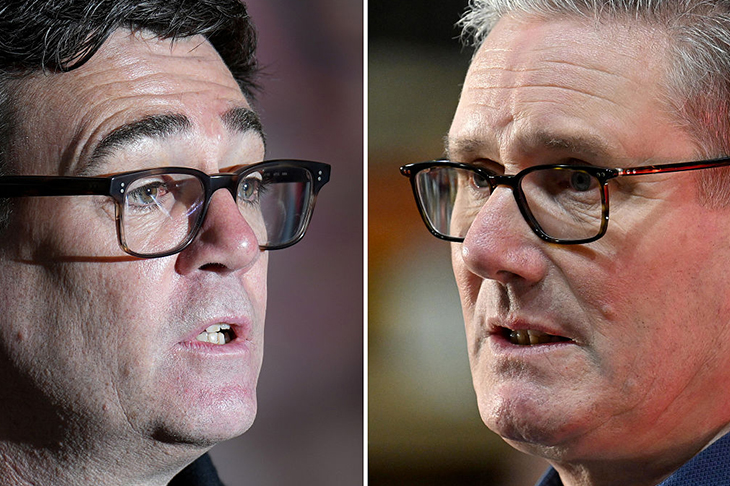
The Liverpool-born Burnham, whose accent recalls The Beatles, is likeable and normal, certainly compared to the odd, robotic Starmer. His other key selling points are that he hasn’t been tainted by involvement in Labour’s disastrous government and that he’s now shown he can win in a Farage-friendly electorate. Proclaimed by many as Labour’s saviour, support for Starmer has evaporated. Predicted first by a gleeful Donald Trump, Starmer has announced his resignation and, assuming, as seems likely, that there’ll be no other challengers for the leadership, will be replaced by Burnham as prime minister on 17 July. This is a historic first: no previous British Labour prime minister has been ejected from office by his own party.
Many in Labour would welcome a contest to clarify what Burnham stands for. As the joke has it, a Blairite, a Brownite, and a Corbynite walk into a pub and the barman says, ‘What’ll it be Andy?’ He seems to be most comfortable talking about football and music; on politics, his default setting is to spout platitudes over ‘hope’, ‘unity’ and (unexplained) ‘change’. Even Burnham advisors have said they’re unsure what he stands for and that ‘he isn’t a massive details guy’.
His one clear view is that Andy Burnham should be prime minister. Otherwise, his views are all over the place. He’s described himself as ‘soft left’ and has suggested Labour shouldn’t worry about the bond markets or its borrowing-fuelled spending. He’s also pleased the left by spouting net zero zealotry, usually opposing tougher immigration policies and privatisation, and declining to rule out an electoral pact with the Greens. But campaigning to win over Makerfield’s Farage-friendly voters, he shifted gear: he said the welfare bill ‘must fall’ (including to boost defence spending), dropped his previous support for rejoining the EU and for higher taxes – while questioning punitive taxes on farmers and private schools – and questioned woke policing and the ban on North Sea oil and gas drilling. He also reversed gear on accepting that men identifying as women are women and said he was ‘100 per cent behind’ the conservative Daily Telegraph’s campaign to save Britain’s pubs (which are being strangled by Labour’s taxation and wage policies).
Burnham’s likely coronation will produce a poll bounce which could tempt him to gamble on an early general election. But Makerfield was probably one-off good news for Labour. With more or less the same leftist ministers as under Starmer, Labour under Burnham is unlikely to change much. Fuelled by popular anger over the issues where Labour will always resist change – immigration, net zero, woke state institutions – Reform will soon probably return to its previous lead in the opinion polls.
If Burnham misjudges, he’ll risk being remembered not as Labour’s saviour, but the man who opened Number 10’s door to Nigel Farage.
Got something to add? Join the discussion and comment below.
@markhiggie2
You might disagree with half of it, but you’ll enjoy reading all of it. Try your first month for free, then just $2 a week for the remainder of your first year.