Has the government actually met the promises it made with the Prime Minister’s speech opening the May 2025 election?
Were those promises the right ones?
In a democracy we are allowed to debate and reconsider, even write a short truncated annual report card, partial or relatively polite and neutral.
With a wonky compass or inspired seamanship, the government is steering the ship of state on to the rocks or to a workable modern welfare state.
Which is it?
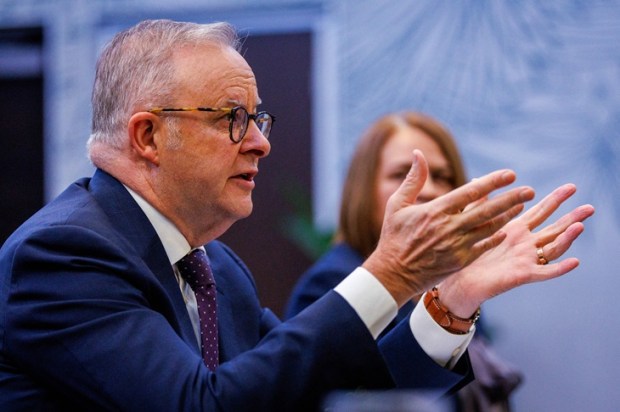
The Prime Minister said on April 13, 2025 in Perth that his government was elected to end ‘denial and delay on climate change and embrace the opportunities of renewable energy’.
The Productivity Commission said our climate change-focused utilities sector, of which energy generation is part ‘was the worst performing industry in Australia. The electricity sector itself did not fare much better’. The comparison was 2016-24. Long-term increased power prices may be the result.
The June 2026 budget says government ‘is improving Australia’s longer-term resilience to energy shocks, securing more affordable gas and shielding Australians from the worst impacts of climate change through our transition to Net Zero’.
In an April election speech, the government said it wanted to ‘build an economy that rewards people for their hard work’.
Our productivity growth is negligible: ‘On an hours worked basis, market sector MFP fell 0.5 per cent in 2024-25, following a 0.1 per cent increase in 2023-24.’ Government is introducing new taxes on assets, as well as small income tax cuts.
Government has supported increasing wages and conditions. And other parts of the ‘safety net’ allegedly including promoting house builds. But wages trail inflation.
Many but not all (e.g. the US is an exception) first-world economies are also experiencing longer-term productivity problems. Is this mitigation?
Has the government focused enough attention on productivity, on boosting the animal spirits of the economy. Or is it a grey welfare government crowding out the private sector.
A more economically orthodox government might conceivably cut government spending, put the proceeds into income tax cuts for wage earners, lessen the climate change penalty which boosts power prices, and would boost defence. Reducing government to leave more scope for private sector growth. No new asset taxes. But such a government was not elected.
Smaller government was not a stated objective in the April 2025 election speech. Instead, the speech condemns ‘cutting’ by the other side of politics, a key point of differentiation between the parties.
Welfare spending in the June 2026 budget is on one estimate 37.1 per cent, health 16.4 per cent, education 6.9 per cent, debt servicing etc 19.6 per cent (SBS). There is no overall estimate of the budget and economic cost of climate change measures. Is this responsible or not?
Efficiency is not an overall priority that is mentioned in the speech. ‘Acting on the cost of living’ is done through spending, not cutting taxes on business or reducing the scope of government.
Government has repeatedly promised spending on health, child-care and education, housing, closing the gap for Indigenous people, climate change, energy and the environment, and veteran affairs. It supports multicultural, arts, and culture spending.
The ‘gap’ between Indigenous people and the rest of the population is not ‘closing’. It is generally agreed that only four of its 19 targets are close to being met.
Whether any government has succeeded in this area is a reasonable question. Is this a mitigating circumstance? Should we have a ‘closing the gap’ process or something else?
Or accompany it with a national audit of Indigenous spending to see whether it is wasted or usefully spent.
‘The proportion of Australia’s population born outside Australia was 32.0 per cent.’ (ABS) This is the highest since Federation. It is now generally agreed that we face severe problems with community cohesion. The policy of multiculturalism itself is under direct challenge as are our immigration settings.
We do, in many respects, have a negative approach to our own country’s achievements and traditions. A lot of warring grievances are expressed, at odds with what is on any measure one of the most successful and beneficial societies in history.
Is this all working well? What is your decision or verdict on our high levels of immigration, social spending, including health, welfare, education, and multiculturalism?
On housing, builders report in January 2026 that ‘the government may again fall short of the National Housing Accord target of 240,000 new homes per year for a second financial year in a row’. We fell short of target by over 60,000 new houses during the Accord’s first year. (MBA)
The election speech referred to ‘investments we make in our defence, our security and our international relationships – in our national interest’. According to Australian Defence Magazine ‘the defence budget for 2026-27 declined to 2.02 per cent of GDP’.
Is that good enough to address our geopolitical threats, unprecedented since the second world war? Has the government balanced its welfare, economic, and defence responsibilities?
Further, ‘traditional owners of the land’ were acknowledged at the beginning of the speech. Do you support this and other similar acknowledgements and ceremonies?
The May 2025 election contest was just that, a contest. An election may be as much a rejection of the other side as endorsement of the winner.
The government has introduced new taxes on capital gains and negative gearing, along with limited income tax cuts. The electorate will assess the performance of tax changes if and when they pass Parliament, and in what form. It will also assess the government’s change of mind or breach of promise. It ruled such changes out before the election.
Governments need to later address changed circumstances. But we are only in the second year of a three-year term.
The next federal election must be held by 2028. Which will be a very real, not imagined, reckoning and trial for everyone.
The Hon. Reg Hamilton, Adjunct Professor, School of Business and Law, Central Queensland University