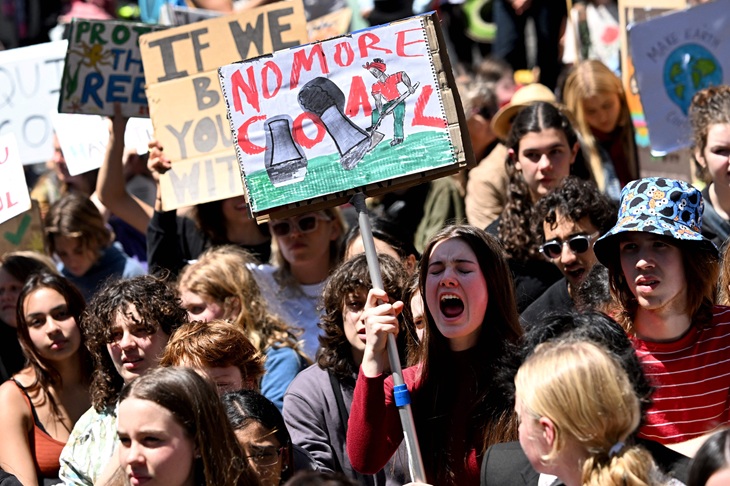
The past two decades have seen an explosion in climate anxiety among children, defined as the chronic fear of environmental doom from the supposed catastrophic impact of climate change.
Some organisations with links to climate investment and climate technology fund management firms, argue that climate anxiety has been the result of children witnessing and experiencing climate change in person in real time.
This is literally impossible.
Climate is the average weather conditions for a particular location over a long period of time, typically at least 30 years.
A person over the age of 30 cannot, by definition, be considered a child.
Recent studies by the Institute of Public Affairs revealed that dogmatic climate indoctrination through the education system is at least partly to blame for the rise of climate anxiety in young people in Australia.
In the research paper: Evidence Over Ideology, child psychologist and IPA Adjunct Fellow Clare Rowe concluded:
The National Curriculum must be revised to ensure that environmental education is developmentally appropriate and psychologically safe. [So-called] ‘Sustainability’ should be removed as a cross-curriculum priority for primary school students.
A review of the National Curriculum, documented in Dr Bella d’Abrera’s new book, Mindless, found that Australia’s education system is ‘turning children into indoctrinated, illiterate, and innumerate pupils, paralysed by climate anxiety’.
There is no solid evidentiary basis for the pseudoscientific notion that mankind is in the midst of a climate emergency. In fact, multiple studies, including a comprehensive review published by the United States Department of Energy, found that climate panic is unwarranted.
Last year, IPA Facts listed just some of the most outrageous failed climate predictions which rested on the notion that anthropogenic climate change is real and catastrophic, including the prediction that the Arctic would lose its ice by 2018, eastern Australia will be in a state of permanent drought, polar bears are dying out, and snow will disappear from Britain.
None has come true.
The Arctic is still covered in ice. Eastern Australia has experienced many extended periods of torrential rain. Polar bear numbers have been increasing. And snow has not disappeared from Britain. In fact, snowfalls were quite heavy in late 2025.
The 2023 assessment of the Intergovernmental Panel on Climate Change estimated that average global temperatures had increased by only about 1.1℃ between 1850-1900 and 2011-2020. Perhaps because of the mildness of this period of warming that the term ‘global warming’ is today less frequently used by activists than ‘climate change’.
The trendier term allows material changes in the weather to more easily be mistaken for sizeable changes in the earth’s climate, the effect of which has been to terrorise children exposed to catastrophic climate messaging by the media and at school.
An audit of the Australian National Curriculum by IPA researchers Colleen Harkin and Margaret Chambers found: ‘Core skills and academic development are [being] undermined as valuable classroom time is wasted and subject integrity compromised by prioritising climate activism.’
Rather than focusing climate education exclusively on understanding fundamental scientific and mathematical concepts, such as spatial and temporal averaging, electromagnetism and radiative forcing, and how equilibrium climate sensitivity estimates are derived, children are being groomed into activism with little understanding as to what they are protesting for and against.
Young protesters on the street, or indeed even their teachers, are unlikely to be aware of – let alone be able to understand – the phenomenon of carbon dioxide fertilisation, otherwise known as ‘global greening’.
This is a phenomenon by which the increase in carbon dioxide concentration in the air, from about 0.028 per cent in pre-industrial times to 0.043 per cent today, has significantly contributed to the greening of the planet, including large parts of Australia.
CSIRO Research Scientist Dr Randall Donohue remarked: ‘Australian vegetation seems quite sensitive to CO2 fertilisation. This, along with the vast extents of arid landscapes, means Australia featured prominently in our [greening] results.’
While carbon dioxide remains a trace gas in the atmosphere, invisible and odourless, its increase has done wonders for plants on Earth.
Children and young people, especially aspiring teachers, benefit from basic scientific literacy. Accordingly, the teaching of carbon dioxide fertilisation, as a phenomenon, should be made compulsory in the science curriculum as well as teacher-training courses.
Learners and educators should also have a strong fundamental grasp of the importance of coal, gas, and oil in day-to-day life.
Pseudoscientific alarmist material and activism starter kits should be removed from Australian classrooms. And children should develop critical thinking skills by questioning climate alarmist claims, many of which have already been proven wrong.
Teachers that present and use teaching material containing erroneous or exaggerated alarmist claims, which risk exacerbating climate anxiety in young children, should be re-educated in fundamental science and mathematics.
Importantly, the so-called ‘Sustainability’ cross curriculum priority, which has been the vehicle for creating climate anxiety and grooming children into activists, should be abolished so that any discussion on climate change is exclusively grounded on scientific evidence and mathematically grounded reasoning.
Dr Kevin You is a Senior Fellow with the Institute of Public Affairs