The alleged abduction and murder of five-year-old Kumanjayi Little Baby from an Alice Springs town camp should have shattered one of the most poisonous illusions in Australian public life: that compassion consists of averting one’s eyes.
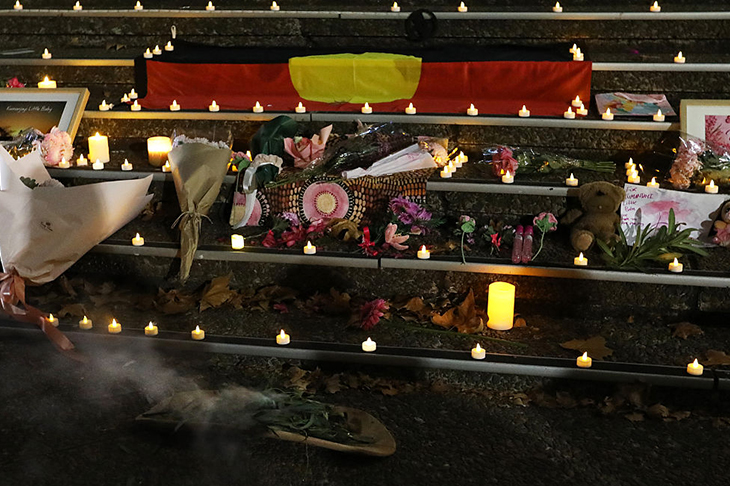
For a few days the nation looked. There were vigils, flowers, condolences and the familiar chorus that tragedy must not be ‘politicised’. This is the standard incantation whenever politics has failed so completely that no other word will do. A child is dead. A legal process must run its course. But the conditions in which too many children live in Central Australia are not an act of God. They are the product of policy, ideology and official cowardice.
Children are being raised in circumstances that would trigger immediate intervention in a leafy suburb. Overcrowded houses, drunken adults, violence, school non-attendance, neglected health, absent policing and a welfare system that asks almost nothing in return are not ‘culture’. They are state failure dressed up as sensitivity.
The most disgraceful manifestation of that sensitivity is the reluctance to remove children from dangerous homes quickly and permanently enough. But the fear of being accused of creating another ‘stolen generation’ has produced the opposite cruelty: leaving children in danger so adults can congratulate themselves on cultural respect.
If a child is unsafe, the first question should be where the child can be safe tonight, not whether prospective foster parents satisfy the racial theology of the activist class. A stable home is not wicked because the adults are white. Adoption outside kin networks should never be the first resort when safe family care is available. But nor should it be treated as contamination. A child’s right to life, sleep, food, school and safety outranks historical symbolism.
Alcohol is the other forbidden subject. The Northern Territory is not without restrictions; Alice Springs has dry days and regulated takeaway hours. Yet alcohol continues to circulate through households and camps where children pay the price. If restrictions reduce violence, enforce them. If they fail, redesign them. The indefensible position is enough regulation to claim action, not enough to rescue communities from the grog economy.
And then there is money. Australia spends magnificently on failure. It spends less effectively on ending it. The Northern Territory is the supreme beneficiary of the Commonwealth Grants Commission’s fiscal equalisation machine. Because of its small population, remoteness and assessed service needs, the Territory receives GST far above an equal per capita share. The NT receives a little over $5 billion. On a population basis it would receive about $1 billion. The difference is more than $4 billion a year.
That $4 billion is not a supplementary payment. It is the fiscal bloodstream of the Territory government. Remove it and Darwin faces destitution. The excess GST is roughly a third to two-fifths of the NT budget. No government can lose that and remain intact.
Here lies the perversity. The NT is paid because it is assessed to have extraordinary needs. If those needs fell dramatically – if living standards rose, communities became safer, school attendance normalised, health indicators improved and dysfunction declined – fiscal equalisation would eventually reduce the grant. The Territory government would have succeeded morally and failed fiscally. Lives would improve; the balance sheet would deteriorate.
This is not an allegation that ministers consciously preserve misery. The system does not need villains. It creates a structure in which need becomes a revenue asset and failure becomes a claim on the rest of the federation. The Grants Commission calls this ‘capacity’. In plain English, it is a subsidy for disadvantage, paid annually to the government that presides over it.
Western Australia discovered the same perversity from the other end. During the mining boom of the 2010s, the old Grants Commission formula threatened to siphon away virtually the entire benefit of WA’s iron ore windfall. The Morrison government rewrote part of the rules, capping the share any state could lose and having the Commonwealth finance much of the difference. Even now Western Australia loses about 18 per cent of its GST population entitlement. Without the 2018 repair job, it would be surrendering billions more each year. NSW taxpayers have also been conscripted: the equalisation shortfall is about $660 per person.
So richer states are taxed to fund a system that impoverishes incentives in the poorest jurisdiction. This is not federation. It is a circular firing squad with a spreadsheet.
The alternative is not to abandon Aboriginal communities or bankrupt the Territory overnight. It is to stop pretending that an open-ended GST premium is an Aboriginal advancement policy. It is not. It is a transfer to a government. Canberra should replace the annual $4 billion-plus equalisation windfall with time-limited, direct, audited grants targeted to improvements in Aboriginal living standards.
Those grants should fund safe housing, repairs, sanitation, child protection, school attendance, community policing, health services, addiction treatment and employment infrastructure. They should be transparent down to the project. They should have deadlines, independent audits and published outcomes. They should be renewed only when they produce results. Money should follow children, houses and safety, not bureaucratic need formulas.
There will be howls that this is paternalism. Perhaps it is. But what is the alternative? A five-year-old can vanish from a bed in a town camp; children can grow up amid violence and neglect; alcohol can destroy households; and billions can keep flowing through a fiscal machine that punishes success. If that is anti-paternalism, it has become an alibi for abandonment.
The death of one child cannot settle every argument about race, welfare, alcohol, child protection and federal finance. But it can expose the obscenity of the present settlement. Australia has built a system in which the Northern Territory’s solvency depends heavily on the persistence of problems everyone claims to deplore.
The first duty of government is not to protect reputations, formulas or ideological myths. It is to protect children. If that means more removals from dangerous homes, stronger alcohol controls, stricter welfare obligations and the destruction of a sacred fiscal mechanism, so be it. The scandal is not that such measures would be called harsh. It is that the soft, sentimental, well-funded alternative has proved so brutal.
Got something to add? Join the discussion and comment below.
You might disagree with half of it, but you’ll enjoy reading all of it. Try your first month for free, then just $2 a week for the remainder of your first year.