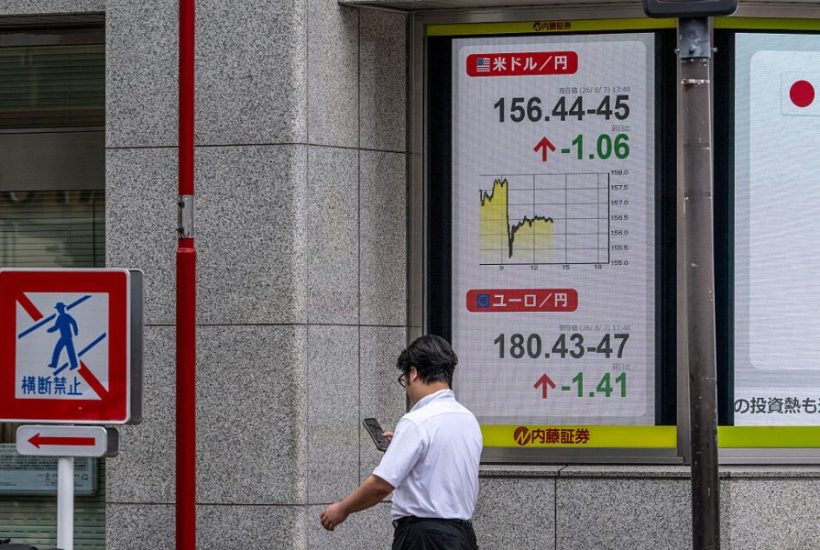
In an extremely rare bilateral move, the US and Japan have intervened to shore up the Japanese yen, which has been steadily losing value and sliding towards a 40-year low. The news was confirmed by the Japanese Finance Ministry this morning. President Trump preceded the announcement by explaining that the US was “always there to help Japan.” In truth, there wouldn’t have been much point in denying it – a Reuters photo showed a memo on US Secretary of the Treasury Scott Beasant’s desk with the simple instruction “To Do – Buy Japanese Yen (JPY) 5-10 billion.”
The dollar fell to 157 yen after the announcement, well down from the 164 (considered by Morgan Stanley the highest tolerable point for the Japanese government) of the previous week.
This is an extraordinary move. It is the first joint intervention since 2011, which is hardly comparable, as that was when the Japanese economy was reeling from the after-effects of the earthquake, tsunami and nuclear accident. It hints at a certain desperation from Tokyo, especially as Prime Minister Sanae Takaichi is building up to launch her signature 21 trillion yen ($134 billion) economic stimulus package.
At the heart of all this is the terrifying specter of inflation
The weak yen is mainly a consequence of much lower interest rates than comparable countries but also a symptom of a beleaguered economy, beset by low productivity, labor shortages and a sclerotic economic model. Foreign intervention is the latest attempt to save the currency, the Japanese government having already spent the equivalent of $74 billion trying to do so this year, which worked for about three weeks.
What is in it for the Americans? The willingness to “help out” sounds nice, but in reality, the move is likely a signal of deep concern from the US about what Japan might do if the going got really tough. There has been considerable speculation in the press in recent weeks about the prospect of Japan repatriating some of its vast overseas assets, which include $1 trillion worth of US Treasury securities.
Finance Minister Satsuki Katayama recently urged pension funds – including the world’s largest (Japan has a lot of pensioners), the Government Pension Investment Fund – to prioritize domestic investments. She also floated the idea of a tax-free investment program for individuals, which would include government bonds.
Even the prospect of bringing home part of Japan’s massive US holdings must cause American policymakers sleepless nights. Such a move would push bond prices down and increase yields and interest rates at a time when the US national debt has reached almost unimaginable levels. Japanese funds are vital in maintaining investment in the US economy and infrastructure projects around the country.
Some think the long-term cozy relationship of Japanese investors choosing US bonds for a decent return on their savings, and in the process keeping demand for such bonds healthy and interest rates low, may now be coming to an end. Money has been quietly being withdrawn from the US for at least a year and reinvested in Japan.
Of course, Japan cannot mandate what investors do with their money, but the government does have influence. Government urgings aside, Article 589 of the Japanese Civil Code mandates agreed interest rates between lender and investor, which gives the government some control over where the yen resides. Some see significance in the recent liberation of crypto (legally recognized as a financial asset since 20 July). Japanese banks can now hold and use crypto to buy back their own bonds. Tax breaks have been offered to facilitate the repatriation of Crypto assets.
At the heart of all this is the terrifying specter (to the Japanese) of inflation (“infla” – it’s such an alien concept the Japanese have no native word for it). Covid is partly to blame. As countries around the world printed money to deal with the global economic shutdown, Japan almost uniquely demurred, and kept interest rates at zero. However, as inflation infected the global economy, and Japan imports most of what it needs (priced in dollars), the economy started to break. Wages and prices started chasing each other. This was exacerbated by the oil shock and has become especially urgent with an ambitious new government touting an expansionary fiscal policy.
The fact that borrowed Japanese money is vital to the American economy and its withdrawal would be something of a nightmare gives the Japanese, despite the seemingly moribund economy, considerable leverage. It’s about the only card policymakers in Tokyo have to play; and from the suspiciously altruistic seeming intervention by the US to save the yen, it looks as if they may be playing it.