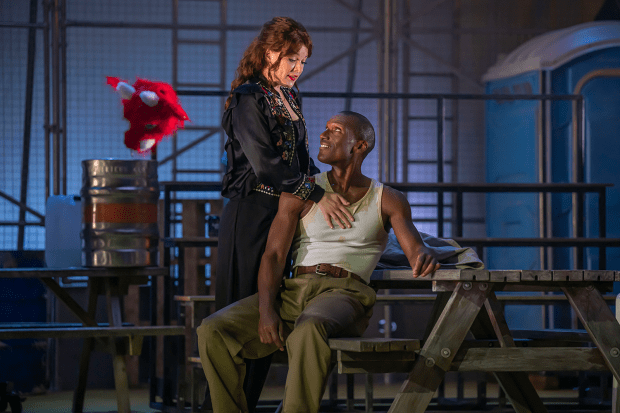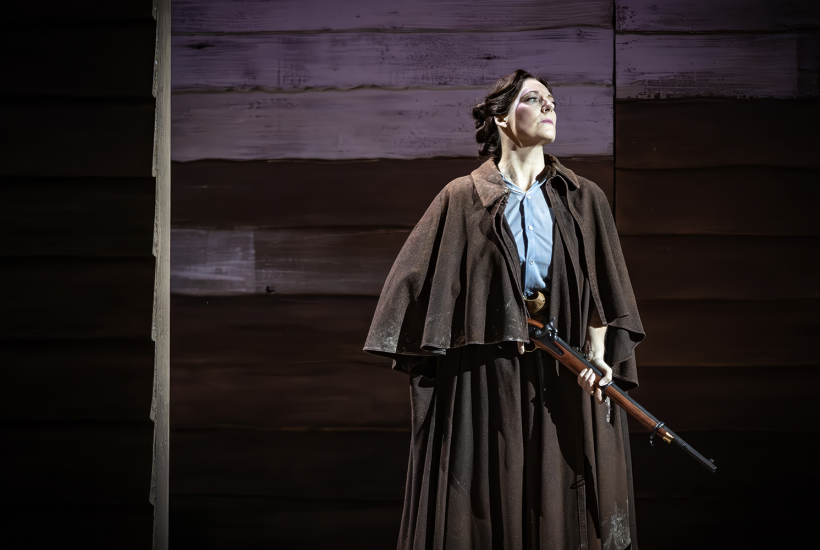
Nature smiled on the opening week of Opera Holland Park’s new season. There’s no better advertisement for semi-outdoor opera than an unseasonal heatwave, and it brought its own authenticity to Puccini’s La fanciulla del West, in a new production by Martin Lloyd-Evans. The wooden cabins and trestle tables of the set had a parched look and you could imagine the smell of pines and sagebrush as the evening grew dark in real time. And never more so than in the final scenes, where Puccini’s gunslinging heroine Minnie gets her man and the world flushes red and gold as they venture off into the sunset.
True, you needed to factor out the squawking of the Holland Park peacocks – and the blizzard that Puccini specifies in Act Two – but the point stands. La fanciulla is an unfamiliar opera (by Puccini’s standards, anyway) and Opera Holland Park prides itself on reaching new audiences. That means hiring directors who put storytelling front and centre, and it’s actually rather satisfying to see Puccini’s only Western done straight, with costumes and sepia-toned sets (by Anna Reid) that recognisably evoke California during the Gold Rush of 1849.
Lloyd-Evans’s production, meanwhile, is proof that a traditional setting needn’t cramp anyone’s style. With an almost entirely male cast, La fanciulla doesn’t sound like any other Puccini opera, and in Lloyd-Evans’s detailed direction every character is an individual – reflecting the subtleties of the choral and orchestral writing. The City of London Sinfonia (under Matthew Kofi Waldren) has rarely sounded better or more polished at Holland Park, and the same goes for the vitality and precision of the chorus. The reason for this opera’s unpopularity is surely its lack of a hit tune; you keep waiting for a ‘Vissi d’arte’ or ‘Nessun dorma’ that never comes. But when the score is realised as vividly as this, the absence feels a lot less noticeable.
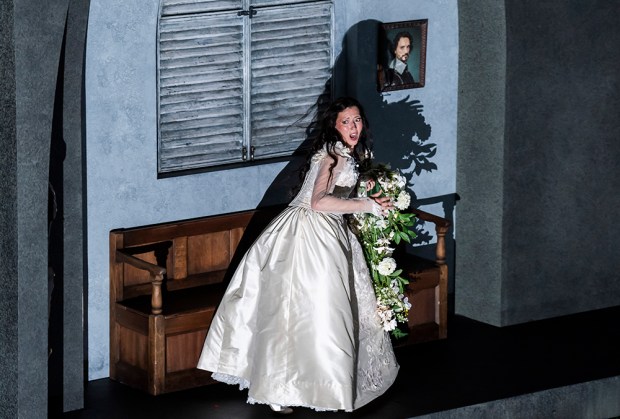
So Lloyd-Evans skilfully lays the all-male scene, with its roughhousing and nostalgia, and positions the Sheriff Jack Rance as the agent of fate: that mythic figure of the old West, the man in black; embodied and sung with rugged grandeur by Robert Hayward. When Minnie (Amanda Echalaz) makes her long-awaited appearance – the first female voice we’ve heard – she’s as transformative as Puccini intended: pouring her swooping, smoky soprano like oil over the restless music of the miners, and conveying a careworn sort of toughness that only gradually begins to soften and yield into something like vulnerability (her solitary scenes in her cabin, in Act Two, are particularly touching).
La fanciulla del West depends absolutely on its Minnie, and in Echalaz, OHP’s casting department has struck gold again. Her scenes with Hayward quivered with tension, and when she sang against Jose de Eca’s bronzed, high-tensile tenor (he played her love interest, the bandit Dick Johnson) both voices seemed to light up from inside. Add a supporting cast who sing as engagingly as they act (Aidan Edwards as Sonora and Zwakele Tshabalala as Nick are particularly fine) and you’ve got a show that is a lot bigger than the sum of some impressive parts. La fanciulla del West might be second-string Puccini, but in the hands of Opera Holland Park, it’s a first-class night out.
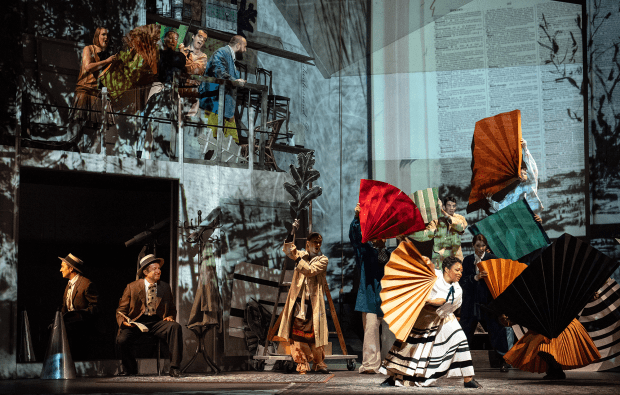
At Wormsley, Garsington Opera was making the most of the weather with Der Rosenkavalier; and no question, that post-coital opening scene acquires an extra something when real sunlight dapples the stage and Strauss’s orchestral dawn chorus is supplemented by all the birds of Oxfordshire and Buckinghamshire. Bruno Ravella’s Covid-era staging scrubs up well – a dove-grey dream-space of rococo swirls and Grace Kelly frocks – though some of the characters still appear to be social-distancing. More troublingly, they’ve kept the reduced orchestration from 2021 (Finnegan Downie Dear conducts, briskly), so there was no cymbal starburst when Octavian makes his Act Two entry, and (worse) there’s a piano, an instrument that should be nowhere near the first two acts of this opera. It’s like tasting Xylitol in your champagne cocktail.
Perhaps that won’t bug you as much as it bugged me, though, because the cast is enchanting and directed with wonderful sensitivity. Pride, pity and hurt ripple across the face of this Marschallin (a radiant Matilda Sterby) before she composes her expression into sweetness. Niamh O’Sullivan is a sunny Octavian (a boy whose swagger is never quite as self-assured as he imagines) and Soraya Mafi is as bright and delightful as Sophie as she is in everything. And then there’s Andreas Bauer Kanabas as Baron Ochs, who resembles Great Uncle Bulgaria in his orange whiskers and plus-fours and is soon wombling free over the whole show – a preposterous, manspreading comic presence with a bass that must be shaking windows in High Wycombe. Strauss and Hofmannsthal originally planned to call this opera Ochs auf Lerchenau, and at Garsington you can see why.
Got something to add? Join the discussion and comment below.
You might disagree with half of it, but you’ll enjoy reading all of it. Try your first month for free, then just $2 a week for the remainder of your first year.