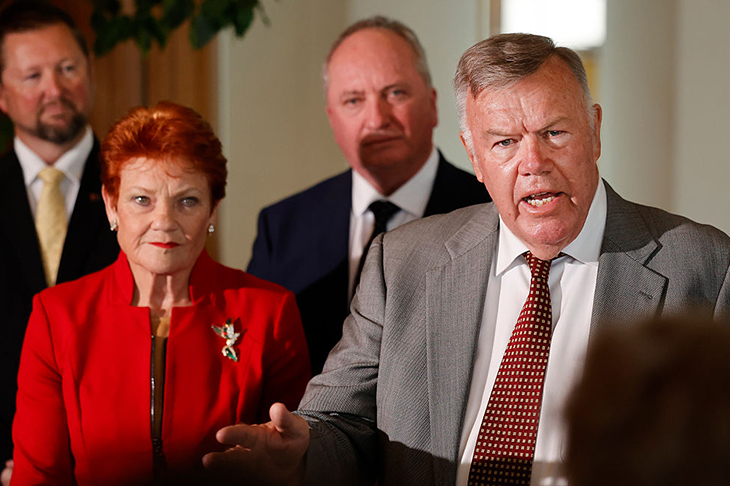
One of the more dubious claims in Australian politics at present is that One Nation represents the future of Australian conservatism while the Liberal party represents its past.
The argument is often framed in terms familiar to Liberals. Robert Menzies spoke of the forgotten people. John Howard appealed to his battlers. Tony Abbott was propelled into power by Tony’s tradies. We are now invited to accept that the mantle of the forgotten people belongs to a new movement headed by Pauline Hanson. It is said that she alone can channel the interests of Australians who feel ignored by political, corporate and cultural elites.
This has superficial appeal, but it overlooks the most important thing Menzies believed.
Menzies’ reflections on the forgotten people are often remembered as a stirring defence of the middle class. Less often recalled is the constitutional philosophy that sat beneath them. Menzies believed healthy societies were built from the bottom up. Power should be distributed. Authority should be accountable. Institutions should be larger than the personalities who happened to occupy them. The Liberal party was literally constructed on those assumptions.
Menzies was not principally concerned with who happened to hold power at any given moment. His deeper concern was how power was organised, constrained, dispersed and therefore made accountable.
Indeed, one of the defining characteristics of the conservative tradition is a suspicion of concentrated authority. Conservatives do not merely distrust concentrations of power in government. They tend to distrust concentrations of power generally. They worry about monopolies, over-mighty bureaucracies, autocrats and oligarchs. They worry about institutions that become detached from those they claim to serve. Most importantly, they worry about political power becoming too dependent upon the wisdom, judgement, character or interests of a single individual.
Edmund Burke understood that free societies survive not because rulers are always virtuous, but because institutions continue to function when rulers are not. The question was never whether a particular leader could be trusted. The question was what happened when that leader was replaced by somebody else.
For Burke, liberty depended not only upon constitutional structures but upon the existence of what he regarded as the ‘little platoons’ of society: families, churches, voluntary associations, businesses, local communities and political organisations. Authority was dispersed throughout society rather than concentrated in one place.
Menzies founded and led the Liberal party for a very long time because the structure he created, together with its philosophy and values, was uniquely suited to the times. It was never intended to be a personal vehicle for him. It was deliberately federal in character. State divisions retained substantial autonomy. Branches met and debated. Parliamentary representatives remained connected to local membership. Leaders were respected and given latitude to lead, but no part of the organisation was entirely sovereign.
The result was, and remains, occasionally untidy. Internal disputes occur. Different parts of the organisation pull in different directions, sometimes almost terminally so. Yet those tensions reflect the underlying philosophy of the institution itself. Authority is dispersed because dispersed authority is a virtue.
In that respect, the structure of the Liberal party mirrors our broader constitutional arrangements. Our Commonwealth divides authority between federal and state governments. Executive power is balanced by parliament and the courts. Between elections prime ministers operate within cabinets and party rooms.
That inheritance reaches back to the constitutional settlement that followed the Glorious Revolution. Over time, British government evolved away from personal rule and towards collective responsibility. Prime ministers became powerful figures, but they exercised authority through cabinet government and parliamentary confidence. They were leaders, not rulers.
It is worth recalling that Westminster did not begin with modern political parties. Eighteenth-century Britain was governed through shifting factions, interests and parliamentary alliances. Yet over the nineteenth century, responsible government, organised opposition and cabinet solidarity increasingly came to depend upon political parties capable of sustaining parliamentary confidence and providing orderly succession.
That is not to say Westminster systems require the same parties to exist forever. One of their strengths is their capacity to absorb political change. Britain accommodated the rise of Labour and the decline of the Liberals. Canada witnessed the emergence of Reform and the reconstruction of the Canadian conservative movement. Australia itself has experienced repeated realignments and upheavals.
New political movements are not a threat to Westminster democracy. They often emerge because established institutions have failed to respond adequately to concerns held by large numbers of citizens. Populist movements frequently identify problems that established parties have been reluctant to confront. Over time, Westminster systems have proved remarkably adept at adapting to such moments.
The more interesting question is what happens next. Because political movements and sustainable political parties are not the same thing. Movements derive much of their authority from leaders. Parties derive theirs from institutions. Movements ask supporters to place their trust in people. Parties ask members to place their trust in rules, processes and institutions that endure beyond particular individuals. That distinction may not matter quite as much in opposition. It matters considerably more in government.
The challenge facing any movement that seeks to govern in a Westminster democracy is whether it can gradually transform itself into an institution and disperse authority beyond the founder who first gave it life. Can authority become distributed rather than concentrated? Can leadership succession occur smoothly? Can decisions be tested, challenged and refined through internal processes? Can the organisation continue to function when its founder departs?
However attractive a movement’s message may be, governing requires something rather more than just slogans, cut-through or charismatic leadership. It requires policy development and the management of hundreds of people exercising delegated responsibility. It requires people turning up, day after day, to do the hard and often thankless work associated with governing a country. Much of this is not glamorous. Much of it is positively boring. I hate to break it, but Westminster systems have survived for centuries because they evolved to value and ultimately reward boring.
And that is why Menzies, whatever frustrations he might have felt about the modern Liberal party, would have recognised that the true test of a political organisation is not whether it can attract followers in a particular moment. It is whether it can build institutions capable of outliving its founder, dispersing authority and resisting the perennial temptation to concentrate power in fewer hands.
That was a central challenge facing political movements and parties when Menzies founded the Liberal party. It remains a central challenge today.
Got something to add? Join the discussion and comment below.
You might disagree with half of it, but you’ll enjoy reading all of it. Try your first month for free, then just $2 a week for the remainder of your first year.