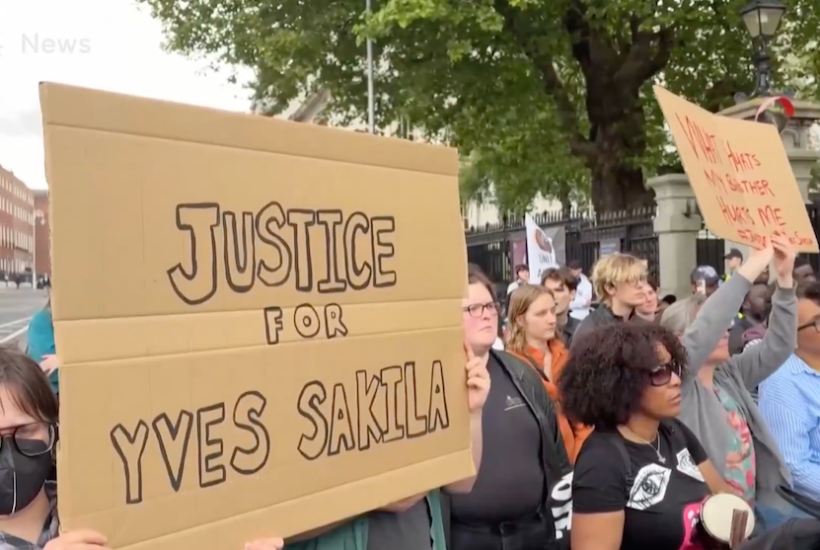
Ireland is in the midst of its own ‘George Floyd moment’. At least, that’s how a string of international headlines have portrayed the death of Yves Sakila, a Congolese shoplifter who was pronounced dead in hospital after being restrained by security guards, one of whom appeared to kneel on his head or neck. The circumstances of the 35-year-old’s death are being investigated, but, as yet, there is no evidence it resulted from racism or excessive force. Court records show Sakila had a history of theft, and a post-mortem reportedly found no signs of foul play or visible injuries on his body. That has not stopped activists and parts of the establishment from co-opting a personal tragedy to fuel a campaign of racial grievance.
It seems one of the few American imports still immune to tariffs are its racial psychodramas
Sakila’s body was barely cold when the vigils began along with the demands for racial justice. Addressing a large crowd in Merrion Square last week, Senator Eileen Flynn claimed that ‘seven men’ had ‘murdered a black man’ and that Sakila would not have died if he was white. ‘Yves died a hero, his name will live on in legacy in this country,’ Flynn concluded. Dr Ebun Joseph, Ireland’s racism tsar, held forth with impassioned non-sequiturs about immigration sceptics ‘abusing the tricolour’ and Ireland’s founding fathers. The Taoiseach, Micheal Martin, called for a thorough investigation into what he hastily deemed a ‘deeply concerning’ situation. It seems one of the few American imports still immune to tariffs are its racial psychodramas.
Ireland’s government, media and NGO complex mobilised with remarkable alacrity to portray Sakila’s death as a rerun of Floyd’s. One week after the incident, the most-read story on RTE was headlined: ‘Concerns “excessive force” used against Congolese man.’ The organisation raising those concerns to the state broadcaster was the Irish Network Against Racism (INAR), a state-funded NGO, who asserted that Sakila’s death ‘appears to have the hallmarks of a case of excessive use of force.’ The next sentence may shed some light on INAR’s reasoning: ‘The death of a black man in such circumstances is extremely worrying.’ It seems that, to Ireland’s expanding body of race-relations entrepreneurs, the superficial resemblance this incident bore to Floyd’s death means that insinuations of foul play can be made while an investigation is still underway. The lack of evidence so far that Sakila’s death was racially motivated has proved no impediment to manufacturing narratives before the truth finds its trousers.
The cynicism of this spectacle is shown by the double standard applied here. Two days after Sakila’s death, Alexander Coughlan, a 37-year-old insurance worker, was beaten to death near Blanchardstown, north west Dublin. Of the two suspects, who have been charged, one is a dual national. Coughlan was heard pleading with his attackers, yet his death has been met with silence by Ireland’s race-relations industry, garnering a fraction of the national attention afforded to Sakila. The usual suspects were similarly missing in action when Yousef Palani, an Iraqi-Kurd, murdered two gay men, beheading one, in a homophobic attack in Sligo in 2022. When Riad Bouchaker, a naturalised Algerian migrant, allegedly stabbed three white children and assaulting their minder that same year, Irish officials were preoccupied with condemning the violent backlash to the incident. To suggest that the background of these men played a role in their alleged crimes was simply not the done thing: that, it seems, is reserved exclusively for when the perpetrators are white and the victims are not.
Sakila’s death, like Alexander Coughlan’s, was a tragedy. But only one of them has been hailed as a ‘hero’ as a result. Will there be clarion calls for a ‘racial reckoning’ for Coughlan, as accompanied the death of Floyd? I wouldn’t hold your breath. Does INAR find the death of a white man in such circumstances ‘extremely worrying’? Perhaps, but its silence would seem to provide its own answer. The truth is Ireland may indeed be undergoing a George Floyd moment, in that a man’s death is being deployed to sow racial division in a society where demand for racism far exceeds the supply.