With 16 per cent of all Australian boys aged five to seven now on the National Disability Insurance Scheme, our political leaders need to consider the extent to which they have redefined disability to capture what was previously thought of as normal childhood behaviour.
Nowhere are the consequences more visible than in the classroom.
Classroom teachers today have been placed in the impossible situation. Teachers are expected to plan and manage an ever-widening range of individual programs, support and reporting requirements for an ever-increasing cohort of individual children with individual needs – alongside teaching the rest of the class.
Schools were never intended to function this way. Schools were never meant to be places of individual tuition. And the load on teachers is unsustainable.
Boys, in particular, have always had a tendency to be more active, less compliant, slower to develop certain skills, and more prone to behavioural challenges in structured environments like classrooms. These are not new traits. What is new is our tendency to interpret them through a clinical lens. What was once managed through time, discipline, and good teaching is now increasingly labelled as disability.
The NDIS was created and intended for Australians with profound and permanent disabilities. Today, the scheme runs at an annual budget similar to our national defence budget of about $50 billion. Like any system, it responds to incentives and when incapacity is incentivised, more people will identify with it. When funding, support and lowered expectations are tied to diagnosis, diagnoses will rise.
And when institutional thinking, particularly that which is imposed on schools, reinforces a worldview that emphasises fragility over resilience, additional demands become mandated and identity becomes entrenched.
The NDIS is now a significant economic problem, but it is not only, or even primarily, a fiscal issue. We are losing something deeper – as is the over-analysed child.
We are losing the expectation that young people can overcome difficulty. We are losing ability to recognise that the unconventional is not the same as disability. We are losing tolerance for difference without diagnosis, and that struggle is part of growth. In doing so, and we are placing extraordinary, unrealistic, and unsustainable demands on teachers at the coal face.
A system that increasingly frames children through the lens of vulnerability, trauma, identity, and disadvantage should not be surprised when those children grow into adults and see themselves as incapable. The consequences are now visible beyond school.
At the turn of the millennium, just 0.3 per cent of Australians aged 25-34 told the Australian Bureau of Statistics they were ‘permanently unable to work’.
Today, that figure has more than quintupled to 1.6 per cent.
Among women, from 0.2 per cent to 1.3 per cent. Among young men, it has surged from 0.3 per cent to 2 per cent.
Even more alarming, since mid-2025, more men aged 25-34 report being permanently unable to work than men aged 35-44.
This is not only a health crisis. It increasingly reflects a cultural and institutional shift. We are witnessing the normalisation and incentivisation of incapacity.
We cannot pretend this begins in adulthood.
It starts in schools.
The Australian national curriculum embeds a steady diet of victimhood narratives, identity-based grievance, climate doom, and ecological guilt and a diminished sense of agency and resilience. At the same time, we have lowered expectations for behaviour, discipline, and academic rigour. And fewer are encouraged to push through difficulty and realise potential. It ought not be a shock then, when young Australians opt out altogether.
Of course, the question is not whether disability exists. The question is whether we have expanded the definition so far that we are now capturing normal variation in human development, particularly among boys, and locking it into a lifelong identity.
If we continue down this path, we should not be surprised by more young people who believe they cannot work, and more who do not try.
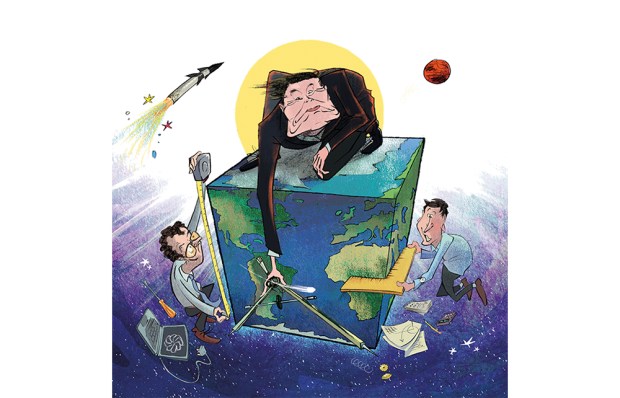
If Elon Musk were in an Australian classroom today, we might never know what he was capable of because before he proved what he could do, we might have already quietly decided what he couldn’t.
Colleen Harkin, Director of Education and Research Fellow Institute of Public Affairs