He was the man with the most even temperament that I have ever known.
Knowing my father as a person didn’t really start until I went to university. Before that, I knew him simply as ‘my Dad’, which was a thoroughly good experience. Dad was measured in his speech and even in tone. If he did raise his voice (which was rare), the contrast seemed like the archangel himself might be addressing you.
I still remember the shocked look on the face of our children, his grandchildren, the first time they heard ‘that voice’. They were beautifully behaved for the next few hours. To be fair, they were usually great kids, but that comment from on high took everything up another level.
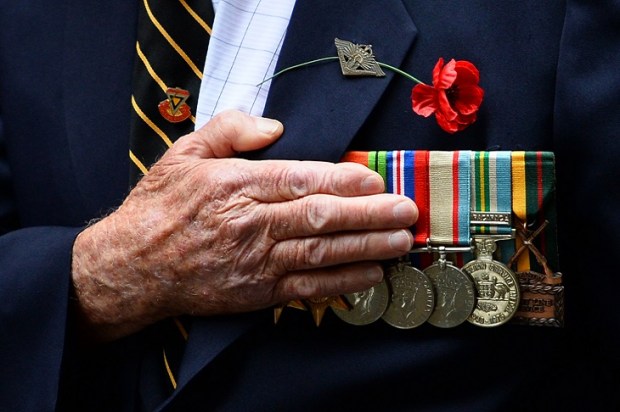
I spent some of this Anzac Day wondering why this happened.
Dad wasn’t scary by any measure. He was not erratic. He was not pompous, nor a wowser, nor a killjoy. Such a person would never have attracted my mother to them for a start.
But Dad was unusual for a reason which today seems even more counter-cultural than it was back then.
He was a faithful man.
When Bill (known affectionately as ‘old Bill’ in his later years) gave his word, he kept it. No fuss, no complaining, no trying to hedge the commitment. When he said it, he meant it, and it happened. This gave him an authority that was a million miles from being authoritarian. This gave him a sincerity that was equally as far away from sloppy sentiment.
I believe that is why there was wisdom to be found if you listened to old Bill. I think it is why I developed the habit of sitting on the end of his bed (he would normally retire before me, who was, like his mother, a night owl) and just spray out my thoughts about what I was reading and thinking. It was indeed a precious time – one that I think not many men have had made available to them.
That treasured part of our relationship continued into my twenties when I finished university, started work, married, and then gave Dad three grandchildren – the delight of which was so clearly seen in his eyes for those who remembered to look.
Dad was not effusive, but caring became just who he was.
Yet he could have played the role of victim of circumstance – the kind of thing we hear about almost constantly today. I often heard it when counselling addicts. The story goes along the lines of, ‘My parent(s) was so bad, so I just followed, even though I didn’t want to.’ But I never heard one of them who had to work while 14 years of age and still at school to help keep food on the table. Nor did I hear of their fathers dying in the gutter due to their alcohol abuse. Nor of what happened to brothers who followed the same direction (apart from my Uncle, who interestingly married a good Catholic woman. Her love helped postpone the early death cycle somewhat).
These younger men I listened to had not lived through the depression, nor gone to war, nor come back and started from the factory floor while marrying, moving out West (as Regent’s Park was back in those days) to build a house with whatever material you could find but have enough dirt in the backyard to grow your own vegetables. Oh, and to then study at night to move from being a floor manager to an accountant.
Mind you, the other men and women in that neighbourhood were on the same trajectory – and as children, we knew them all. That childhood was within what I call the best of post-war suburbia. It was a basic life in many ways. But it was clean, safe, and filled with the joy of living in a community where we were known as people.
That generation had been through rationing and war. As they rebuilt their lives, they determined that the place for their families was going to be different, and it was. If we kids did anything wrong while out and about, the mother’s network sprang into action. We learnt to never be disrespectful towards a person or property.
Even the three churches got along – the Catholics up on the hill (of course); the Anglicans in the strong brick building; and the Baptists next to the Bowling Club in the lay-built hall (church). If any of the gents came out of that club having drunk too much, the surrounding good folk of Regent’s Park would make sure they got home (I know, we lived between the Baptist Church and the Club).
What do I still learn from these memories?
Many, many life lessons.
At the everyday level, I was instructed and taught how to live a decent life, being not just respectful but kind and where possible, encouraging. To work hard and trust for the rest. To give my word and keep it. (‘If you are going to be a man son, then when you say, you do,’ said Dad.) To enjoy life without needing psychotropic substances to prop it up.
Why was my Dad not an addict like all the others in his life? (Which is what I was taught in psychology, and which is still the dominant paradigm today – ‘if you have a predisposition and the wrong social context, that will make you an addict’.)
Standing in the snow at the end of the war, Dad told me heard a voice saying, ‘Bill, you don’t need this.’ It is what psychologists like Jonathan Haidt or Lisa Millar call an experience of the elevated or transcendent.
Dad simply said, ‘It was God.’
He didn’t smoke or drink after that day, although sometimes when he and I were alone together, he did lament missing the joy of having the odd cigar.
It is no wonder so many of our young men are casting around looking for their ‘old Bills’. What they see as models for life are so, so different, particularly on the Woke media where identity is so fluid that they cannot even commit to their sex with confidence. What a mess.
Lest we forget the old Bill’s of life? I will never forget mine.