Five of them came aboard our sailing boat at 8 a.m. on Saturday. Naval and Royal Marine personnel rebranded as police officers, immigration and customs officials, and, for some reason, a French-speaking fisheries protection officer. Other Royal Marines stayed on their assault boat. Whilst individually perfectly pleasant, they were all there to make sure life did not become too comfortable for the six Chagos Islanders who have returned to their ancestral home. Agents of the British state, climbing over our vessel, poking into crates, writing on clipboards – an act of sheer malicious spite by Keir Starmer’s government, which hasn’t managed to stop a single boat closer to home.
Our trip was a humanitarian resupply run. It was organised after a High Court judge ruled last month that the Chagossians now on Île du Coin, on the atoll of Peros Banhos, have right of abode. These people have a legal right to be where they are, and yet, while the British government fights the ruling on appeal, it is doing everything it can to make their lives on the island impossible. You cannot tell a people they may stay and then refuse them a net to keep the mosquitoes off at night. But that is what happened on Saturday.
The origins of the Chagos debacle were long in the making
The officers – wearing blue uniforms and baseball caps – had a list. They made a longer one. Every box was opened and its contents checked against the manifest the Commissioner of the British Indian Ocean Territory (BIOT) had approved. The mosquito net was held up, noted, set aside. A pillow. A bed sheet. A pair of sunglasses…all on the pile of things we could not take to land.
A solar-powered emergency water-making machine, which makes seawater drinkable, also went the same way. (The six men are currently drinking rainwater.) So did an ice machine. As did a replacement phone for one of the islanders whose old one has a smashed screen. The officers said they would check later to see if these items had been smuggled onto the island.
Two months ago, none of the officers who boarded our boat existed. The BIOT was patrolled by one fisheries officer in one boat. Then six Chagossians went home, and the empty ocean grew a whole new cadre of uniformed men with forms.
Our skipper watched them work. We had launched our resupply from the Maldives, and on the quayside there, well-wishers had pressed gifts not on the list onto him – the bedding and mosquito nets, solar lights and fishing gear. These were strangers who had heard what we were doing and wanted to help.
The BIOT Commissioner wrote us a long letter explaining his reasoning. This civil servant is a senior Foreign Office diplomat based in London. He has never set foot on Peros Banhos, and from his correspondence clearly can’t imagine it either. I spent ten days there. The atoll is beautiful but harsh. The mosquitoes eat you alive. The sun is punishing. Water is a daily problem. We live under canvas. The oldest of the party is 72 and was born on the island before he was exiled, though (unlike me) he flourishes there.
The Commissioner objected to the thin lengths of timber we wanted to bring because the Chagossians might build a shelter out of it. I wanted to take it to ensure they did not use their dangerous chainsaw to cut up fallen coconut trees. He objected to cleavers unless we could prove they were for cooking, not carpentry. He objected to the replacement phone unless the broken one was shipped out first. He would, he wrote, be ‘minded’ to allow new tents if we could first demonstrate the old ones were faulty.
The craziest objection was to the fast boat we had brought, a 23-foot fibreglass launch with two engines. We bought it because if anyone on Île du Coin has a heart attack or a stroke, or cuts themselves with a chainsaw, our best-case medical evacuation is 80 hours to a hospital. The fast boat would cut that to 10 in the right weather. The Commissioner would not allow it to leave the Maldives. He wrote that its range was too great, which was rather the point of it. He suggested a traditional Maldivian rowing skiff instead. Try rowing a 72-year-old man with a stroke across the Indian Ocean.
The Commissioner – or perhaps more accurately, ministers – also objected to me. I had to watch the drama with the customs officers from 300 miles away, in the Maldives, refused permission to sail with our own crew that I put together and that I manage. I am also the person who has lived on the island with the settler party. I know them. I know their health and their moods and their fears. If one of them needs to be persuaded to accept a medical evacuation, I am the one they will listen to. The Commissioner says this can all be managed by video call. I would not persuade my own father to leave his homeland over Starlink, and I will not ask a Chagossian to. Keeping me on dry land 300 miles away does not protect the integrity of anything. It just makes a difficult job harder.
The Commissioner decided my presence on board was a risk to the ‘integrity’ of the permit regime because I had previously arranged for the Chagossians to reach their own homeland without first asking the British state’s permission. This is true. I did. It took months of quiet work, a world-beating captain and professional sailing team, and some amazing philanthropists who could see the injustice plainly and were willing to fund a boat and rather more. I make no apology for any of it. We are trying to return an indigenous people to their homeland: our ambition is not limited to six settlers. The Chagossians’ lawyers are going to be busy.
How did we arrive at this? The origins of the Chagos debacle were long in the making. In 2017, the United Kingdom lost its seat on the International Court of Justice – the first domino. Behind it stood a Foreign Office establishment obsessed with the strictures of international law and dismissive of British interests. That establishment has now found its guardian angel in a lawyerly Prime Minister. The result is a government that will hand away a strategic archipelago to please international lawyers and, in the same breath, deny bedding to the people it exiled 60 years ago.
As my former Conservative colleague Jacob Rees-Mogg has said, what we saw at the weekend was ‘sour grapes from a government that has lost the argument and now looks both inept and mean’. The Wilson government successfully removed these people in the 1960s and 70s in part by denying them resupply. The boats simply stopped coming. A government of self-described human rights lawyers is now repeating a version of the same act – making life hard enough that the Chagossians will, in the end, leave of their own accord. They are calling it biosecurity. They are calling it proportionate. They are calling it permit conditions.
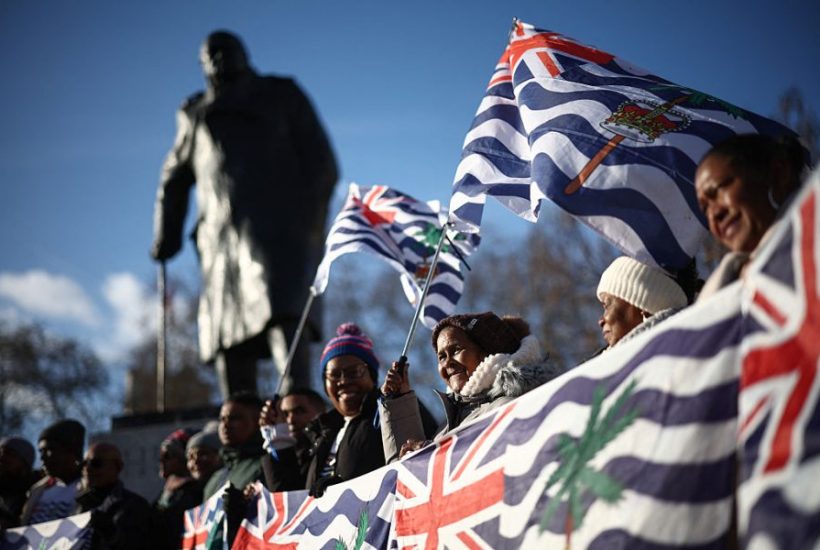
Misley Mandarin, the Chagossians’ extraordinary First Minister, has said plainly that his people are not leaving. If this government wants them off, it will have to send Royal Marines to drag them from the beach of their homeland. If that happens, we will film it. We will broadcast it. The British public and the beloved international courts will watch.
There is an alternative. A court has told the Chagossians that they have right of abode. If the government does not want us providing their supplies and their medical evacuation, it should provide them itself. These people were forcibly removed from their homeland – a crime against humanity – and dumped in Mauritius while all the things that make civilisation possible on Chagos collapsed under the jungle. Now our government refuses them bedding, days after a court said they can be there. If His Majesty’s government cares as much about human rights as it tells itself it does, it should now take some responsibility for these people.