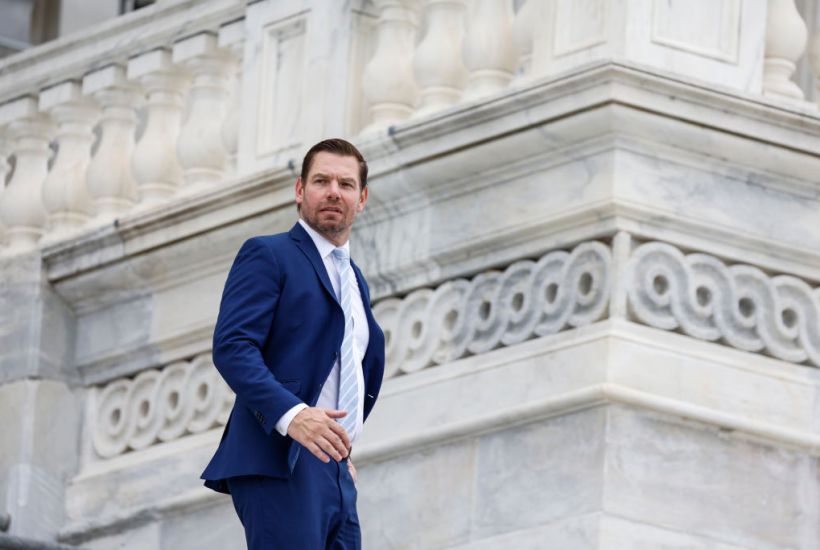
Eric Swalwell’s fall from viable gubernatorial contender to political casualty was swift and surgical. He was among the frontrunners to replace Governor Gavin Newsom until allegations of sexual misconduct from years ago were published in the San Francisco Chronicle. The response from major Democratic operatives was immediate, with labor unions and party figures quickly withdrawing endorsements. Swalwell formally announced the suspension of his campaign two days later, followed by his resignation from Congress the following day.
Some of the allegations are serious. In addition to claims of inappropriate and predatory sexual relationships with staffers, Swalwell has been accused of sexual assault. In a video statement, he denied any criminal wrongdoing. But he also framed the issue as “mistakes… between me and my wife,” an implicit acknowledgment of infidelity and inappropriate conduct.
The more revealing story is timing. By multiple accounts, Swalwell’s conduct was an open secret in Washington. CNN even hinted at similar issues in a 2017 segment about an unnamed California congressman. A reporter has said he knew of allegations as early as 2013, when Swalwell was a city council member. And yet the rumors didn’t derail his political career, nor did a formal investigation into an alleged romantic relationship with a suspected Chinese spy.
Swalwell survived so long because he was useful. He built his brand as an antagonist of Donald Trump, a fixture on cable news, and a prolific social media presence that earned him the label “Snapchat King of Congress” in 2016. If his gubernatorial run had not put him under a microscope, he might have remained insulated from consequences indefinitely.
The trigger for the sudden shift lies less in morality than in electoral math.
California’s June 2 primary uses the “jungle” system so that all candidates appear on one ballot, and the top two – regardless of party – advance. Usually, that benefits Democrats. This year, it may not.
That’s because Democrats crowded the field, with roughly eight candidates splitting the vote, while Republicans consolidated around two: Steve Hilton and Chad Bianco. Before the scandal broke, Swalwell was polling in the mid-teens, alongside Hilton and Bianco, with the other Democrats clustered just behind. That distribution created a real (though still slim) risk of two Republicans advancing to November, shutting Democrats out entirely. In a state where registered Democrats outnumber Republicans nearly two to one, that scenario would represent a stunning upset, but under this system it is not impossible. The state Democratic Party had been openly calling on candidates to drop out in an effort to avoid that outcome.
Allowing a candidate with unresolved baggage to advance from the primary carried real risk for Democrats. With at least one Republican likely to emerge from their primary, any long-simmering allegations surfacing afterward could leave Democrats with a weakened nominee heading into the general election, potentially opening the door for a Republican victory.
Who pulled the trigger on the story remains an open question. Many suspect Katie Porter’s campaign. She operated in the same Washington circles and would likely have heard the rumors. A poll showing Swalwell voters favoring her as a second choice strengthens the theory. Others point to Matt Mahan, the tech-backed moderate who entered late and may not have had time to deploy the information earlier. And if betting markets are any guide, billionaire Tom Steyer saw his odds improve sharply after the scandal broke.
What no one seriously disputes is that Democratic operatives drove the timing, given the obvious incentive.
Complicating matters, it is too late for Swalwell’s name to be removed from the ballot. He will continue to draw votes from low-information voters, loyalists or those casting protest ballots. His exit reshuffles the field, but it does not necessarily resolve Democrats’ core concern about a split vote that could hand the governorship to a Republican.
If this were purely about misconduct, there would have been immediate calls for him to resign from Congress. There were not – at least not from his former allies. The urgency was tied to the governor’s race. Although Swalwell did give into pressure to resign, the focus of the initial response was telling.
The race is veering toward the absurd. A recent poll floated Kamala Harris as a write-in candidate – an idea so implausible that some suspect deliberate mischief, perhaps aimed at further fragmenting Democratic voters. It is the most chaotic California gubernatorial contest since 2003, when Republican Arnold Schwarzenegger emerged from a field of 135 candidates that included a child actor and a porn publisher, among other characters.
The deeper question is how Democrats failed to avoid such a circus. The party has struggled to consolidate around a credible frontrunner, despite dominating statewide politics. Part of the problem is a thin bench shaped by years of rewarding loyalty over leadership. And the scale of California’s governing challenges has made the job less attractive to more capable would-be contenders.
Swalwell did not fall because Washington suddenly found its conscience. He fell because operatives calculated that he was a liability. And in a race already defined by fragmentation, Democrats may find that removing one problem candidate won’t be enough to fix a fundamentally broken field.