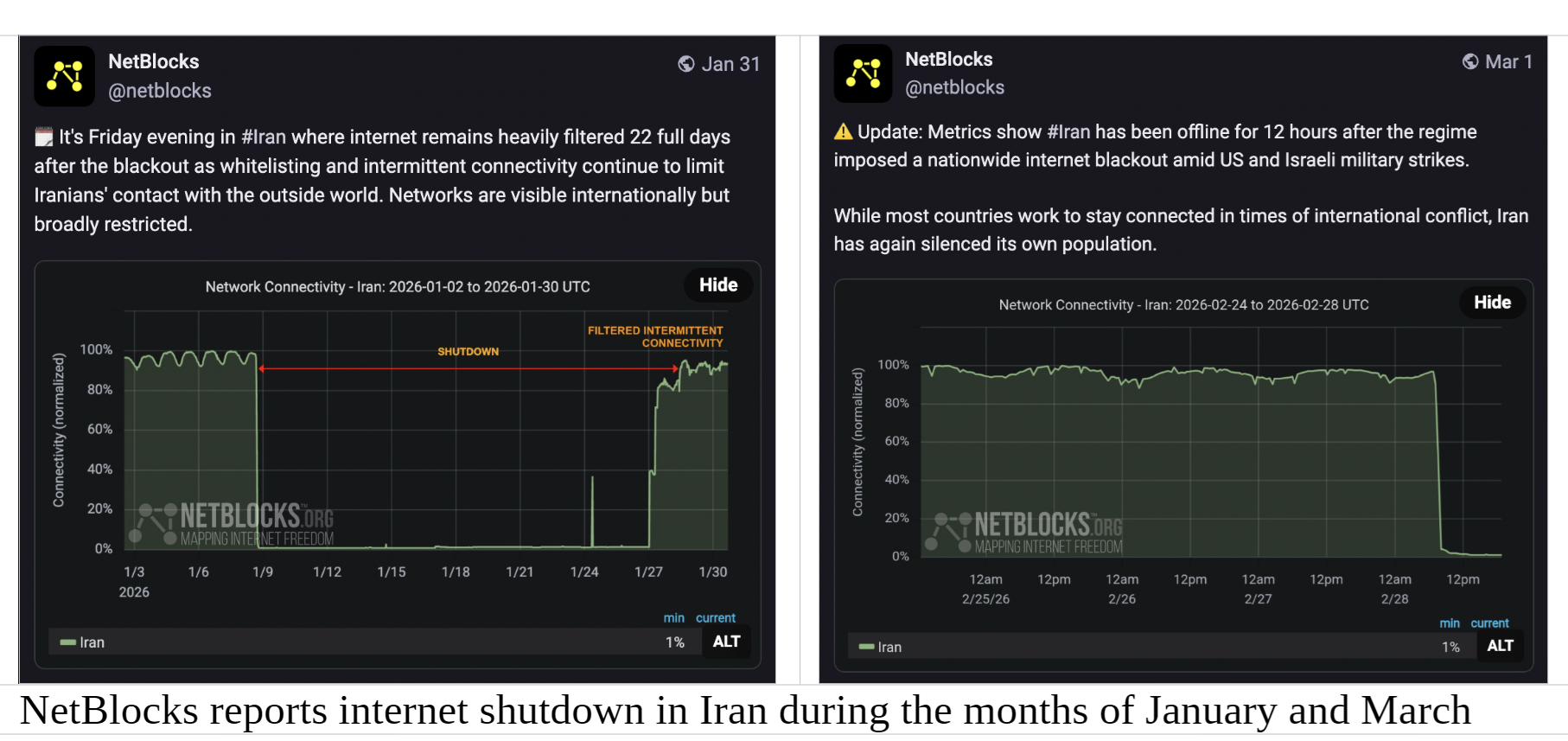
The Islamic Republic regime in Iran cuts off internet access to everyone whenever it faces a serious challenge. This is not a one-off event but a recurring pattern that has been repeated since 2009. The most recent shutdown began on March 1 and is already the longest the country has experienced. It creates an opaque curtain around the nation, preventing free information from flowing in or out. What are the potential impacts of this blockade on the rest of the world?
Early encounters
I clearly remember 2009, when protests over the disputed election results erupted in June, people quickly built networks of coordination using SMS and mobile messenger apps.
Facebook, which had only recently gained popularity, became the primary platform where citizens could voice their opinions, share stories, and shape public sentiment, unlike the one-way, agenda-driven coverage on state or satellite television. Shortly after millions took to the streets of Tehran, the regime shut down all public communication channels: mobile data was disconnected, SMS messages stopped delivering, and even voice calls were severely disrupted.
Weeks later, after a crackdown that killed dozens, internet access was gradually restored, but only after a long list of platforms (Facebook, Twitter, Flickr, Blogspot, and many others) had been blocked by the censorship firewall. International publications described the move as ‘one of the world’s harshest internet crackdowns’.
The situation never improved; it only grew worse, as is typical under totalitarian regimes. As new platforms emerged, the censorship apparatus evolved with them. By December 2017, Telegram had become the dominant messaging app when fresh nationwide protests broke out. The regime responded with a swift and brutal crackdown, once again severing network access to stop the unrest from spreading. Telegram was promptly blocked. In the aftermath, Iranians migrated to Instagram as their last remaining option, but the regime was already preparing something far more sinister.
The National Intranet Network
After 2017, the regime’s Ministry of Information and Communications Technology began rolling out a nationwide internal network known as the National Intranet. The explicit goal was to give the government tighter control over information flows and internet access points.
I recall the 1990s, when small private ISPs used satellite dishes on rooftops to provide service. Even during the first ‘moderate’ government of Khatami, the regime introduced filtering systems and centralised distribution through state-controlled ISPs. The National Intranet, implemented by the other ‘moderate’, Rohani, was the logical next step in that process.
In 2019, the largest protests yet erupted in more than 100 cities. The regime responded by cutting off the entire country’s internet, not just specific platforms, but all external connectivity. In the resulting total blackout, Islamic security forces of IRGC killed thousands of protesters in what remains the most violent crackdown to date. Through the National Intranet, the regime kept internal banking, propaganda outlets, and essential government services running while isolating the population from the outside world. I was in Australia at the time and could not contact my family for more than two weeks.
A political ransom
Many outside observers wonder why the Iranian diaspora – people living in safety, with full access to information and strong language skills – does not speak out more forcefully against the regime. The answer is simple and heartbreaking: the Islamic Republic treats family ties as political hostages. Any dissident abroad who criticises the regime risks permanent exile. Returning home can mean near-certain arrest at the airport, while any property or assets inside Iran are likely to be seized, just as the Revolutionary Guards confiscated homes and businesses from many who fled after the 1979 revolution. To preserve even the slim possibility of visiting elderly parents or staying in contact with relatives, most members of the diaspora remain silent and simply carry on with their lives.
During every major protest, the regime’s internet blackouts sever all contact between Iranians inside the country and their loved ones abroad. Families outside Iran lose every real-time update, not only personal messages but also any independent reporting on the scale of the unrest. This information vacuum, combined with the near-total absence of international media coverage, creates enormous psychological pressure on the entire Iranian community, both inside and outside the country. And none of this comes without cost to the host nations. In times of crisis, many Iranians abroad lose focus, suffer psychological distress, fall into unhealthy patterns of constant news-checking, and experience reduced productivity. These effects translate directly into a measurable financial burden on the countries that have welcomed them.
Iran’s diaspora numbers roughly 8,000,000 people scattered across the globe. Australia, for example, is home to about 100,000 Iranians. If even half of them experience the distress described above, the impact is significant. Given that most hold skilled professional positions, a simple calculation shows the potential economic cost to Australia alone could run into the billions of dollars.
Human Shield Done Right
In the past month, as well as the 12-day war of June 2025, the regime once again imposed a nationwide internet shutdown. Civilians inside Iran were left without access to any online warnings or evacuation alerts issued by either side in the conflict. At the same time, reports from the few remaining open channels describe the Revolutionary Guards (IRGC) using schools, hospitals, and mosques as temporary bases. The blackout, paired with the deliberate placement of military assets among civilians, turns ordinary Iranians into involuntary human shields with nowhere to flee.
Silence by the media
Western media outlets have covered the recent war extensively, focusing on casualties and collateral damage in the conflict involving the Islamic Republic, the United States, and Israel. The attention is understandable: Israel is one party to the conflict, and the US president is Donald Trump. The war also affected global markets, given Iran’s nearly 10 per cent share of the world’s oil and gas reserves. Yet the same outlets remained largely silent when, only a short time earlier, more than 40,000 people were reportedly massacred inside Iran in just two days. On the specific issue of the internet shutdown, an act that erases the voices of 90 million people, coverage has been almost non-existent, as if ordinary Iranians have no agency or role in the story.
The path to North Korea
Ayatollah Khamenei – the Supreme Leader whose only foreign visit was to North Korea – was killed on the first day of this war. Nevertheless, the regime continues his internal doctrine. The IRGC now runs the country in practice, and even before his death most domestic decisions were already delegated to it. For decades, the regime has waged war on freedom of information: banning satellite dishes, censoring newspapers, confiscating VCRs, and now systematically restricting or eliminating internet access. Its clear aim is to transform Iran into a North Korea-style state, one where no one can communicate freely with the outside world, where dissent is punishable by death, and a militarised regime enforces a hybrid of martial law and Sharia.
Although the stated goal of Operation Epic Fury was to dismantle Iran’s nuclear program and missile capabilities, no one can guarantee that a surviving regime would not simply resume those efforts. The real question is whether the United States will treat this threat with the seriousness it deserves or declare a quick victory and defer the problem for a later day. One can only hope it chooses the former.