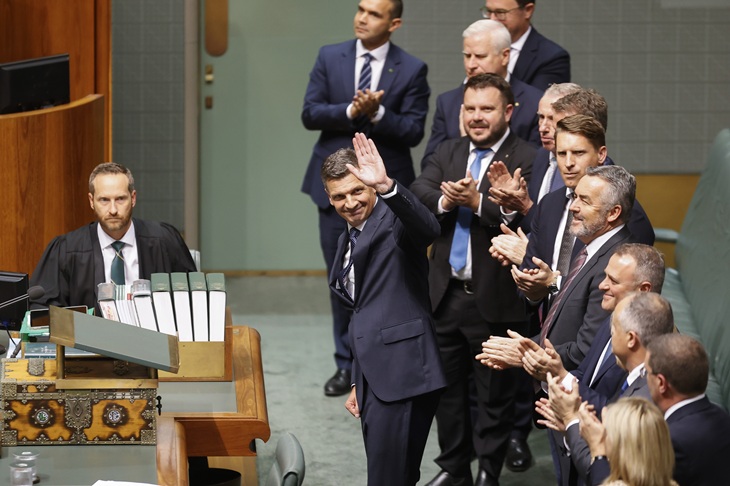
On Thursday night, Shadow Treasurer Angus Taylor delivered the Opposition’s Budget Reply, focusing on what he termed ‘generational tax reform’ and significant structural changes to migration and housing.
There is significant overlap between Angus Taylor’s 2026 Budget Reply and several long-standing One Nation policies, particularly regarding migration, welfare, and energy. Political analysts and Senator Pauline Hanson herself have noted that the Coalition appears to be ‘moving into One Nation territory’ following recent electoral pressure (specifically the Farrer by-election). Indeed, while most of the overlap relates to long-standing One Nation policies, few – if any – of these have previously been on the Coalition agenda.
This points to One Nation not being merely, as is so often claimed, a party of complaint. One Nation is, in fact, clearly a policy leader.
Key Similarities and Distinctions
- The ‘Housing-Migration’ Link: The core of Angus Taylor’s speech – that Australia should ‘only bring in as many people as it can house’ – is a rhetorical and policy mirror of One Nation’s ‘Clean up our own backyard first’ slogan. While One Nation uses a hard number (130,000), Taylor’s formulaic approach effectively achieves a similarly drastic reduction.
- Welfare Protectionism: Both parties are now aligned on the idea that welfare should be a ‘benefit of citizenship’ rather than a right for permanent residents. Taylor’s proposal to strip 17 specific payments from non-citizens is a more granular version of Pauline Hanson’s long-standing demand for a ‘migrant waiting period.’ She also proposes doubling the surprisingly short period currently required for naturalisation – a position originally detailed in a 2018 bill introduced into Parliament.
- Energy Sovereignty: Taylor’s vow to extend the life of coal-fired power stations reflects One Nation’s ‘Energy Security’ platform. However, the Coalition still technically operates within a framework of eventual transition (albeit delayed), whereas One Nation explicitly calls for the repeal of all legislated Net Zero targets and a total withdrawal from the Paris Agreement.
- Tactical Shift: Barnaby Joyce and other commentators have explicitly stated that Taylor was ‘reading off One Nation’s script’. This shift is widely seen as a tactical move to reclaim voters in regional seats where One Nation has seen a surge in support.
While the Coalition’s proposals are framed in the language of ‘economic common sense’ and ‘generational reform’, the structural mechanics – cutting migration to historic lows and prioritising domestic welfare for citizens – are remarkably close to the platform One Nation has long campaigned on. On migration, One Nation has a number of supporting policies, including the aforementioned naturalisation reform introduced in 2018, which would extend the residency requirement from four to eight years while making the application process significantly more rigorous.
The Hanson Critique
In her independent response to the Budget, Senator Pauline Hanson offered a sharper structural critique:
- Migration and Infrastructure: She linked the housing crisis directly to high migration levels, stating that no amount of tax reform would work while population growth continues to outpace housing and hospital capacity.
- Regional Neglect: Senator Hanson accused the government of ignoring the ‘realities faced by agricultural communities’ in favour of inner-city political priorities.
One Nation’s Alternative Proposals
Senator Hanson campaigned for a $90 billion reduction in ‘government waste’ to be redirected toward nation-building. Her specific proposals included:
- Abolishing Agencies: Scrapping the Department of Climate Change and the National Indigenous Australians Agency (NIAA).
- Media Reform: Defunding SBS entirely and restricting the ABC to regional and rural areas only, forcing it to rely on advertising and subscriptions.
- Infrastructure Investment: Investing in dams, railways, and ‘nation-building projects’ to stimulate long-term wealth.
The Bradfield Plan
A cornerstone of One Nation’s long-term vision – which Senator Hanson reaffirmed in her response – is the delivery of the Bradfield Scheme (or a modern variant of it).
Originally proposed in 1938 by Dr John Bradfield (the engineer behind the Sydney Harbour Bridge), it is a massive water diversion project designed to ‘drought-proof’ the Australian interior. The core idea is to capture water from the high-rainfall tropical rivers of North Queensland (such as the Tully, Herbert, and Burdekin) and divert it across the Great Dividing Range to flow into the western river systems and eventually toward Lake Eyre.
Under One Nation’s current advocacy, the plan would be delivered through:
- Large-scale Infrastructure: The construction of massive dams (such as an expanded Hell’s Gate Dam) and a series of gravity-fed tunnels or pumped pipelines to move water across the mountain range.
- Agricultural Expansion: The water would be used to irrigate roughly 80,000 square kilometres of ‘blacksoil plains’ in western Queensland, potentially turning the region into a major food production hub.
- Hydro-electric Power: Modern versions of the plan propose using the water flow to generate thousands of megawatts of ‘clean, green’ energy through hydro-plants.
- Funding: One Nation proposes funding such projects by redirecting savings from abolished government departments and withdrawing from international climate agreements like the Paris Accord.
Outlook – no grand coalition envisaged.
With polling now suggesting that One Nation is the most popular party in the country, the commentariat and the Coalition alike must take the party seriously.
The continuous refrain that One Nation is a party of complaint but not of policy is demonstrably false. Is it not about time the commentariat abandoned what is, in Australian terms, a furphy?
One Nation has clearly offered leadership on policy, especially to those Menzies called the ‘forgotten people’, those who are neither unionists nor massively wealthy. That is a fact.
The overarching reality is clear: if, in the coming election, One Nation and the Coalition win at least 76 House of Representatives seats between them, they will hold the numbers to reshape and save the country. This outcome becomes far more likely if the two sides can successfully negotiate an exchange of voting preferences.
Furthermore, should a governing framework be established, the Coalition must be prepared to reciprocate Pauline Hanson’s pragmatic offer: a guarantee that One Nation will support a Coalition-formed government on vital matters of supply and votes of no confidence, laying the groundwork for a stable, conservative alternative.
Pauline Hanson assumes that if One Nation and the Coalition have at least 76 seats, the one with the larger number will form the government. That is a reasonable but not mandatory conclusion. This would rule out a grand coalition which is not necessarily a bad conclusion.