
When Labour MPs eventually hoof Keir Starmer out of office, the Prime Minister and his neighbour in No. 11 will surely come to be remembered for one failing above all others: the youth unemployment crisis.
Look at unemployment among Britain’s young and an even bleaker, yet more concrete, picture emerges
Figures just released by the Office for National Statistics (ONS) show the unemployment rate climbed again to 5 per cent – up half a percentage point on a year ago. Worse: the true unemployment figure is probably a tad higher. The single-month estimate for February is implausibly low compared with neighbouring months and so, when it falls out of the three-month average next month, an even worse picture will likely emerge.
Looking at HM Revenue & Customs (HMRC) payroll data shows 104,000 jobs were lost in the year to March, falling by 28,000 in a single month. Provisional estimates for April suggest 210,000 jobs lost in a year and 100,000 in a single month. Though the ONS points out that April figures are always likely to be revised up due to their coming at the start of a tax year.
But look at unemployment among Britain’s young and an even bleaker, yet more concrete, picture emerges. Separate analysis from the Institute for Fiscal Studies (IFS), also released today, shows the fall in youth employment is not far off what we saw in 2008 and again during the pandemic.
Between December 2022 and the end of last year, 333,000 16 to 24-year-olds lost payrolled employment – a 4.3 percentage point decline. Relative to the pre-crisis trend, that compares with a 6.5 percentage point decline during Covid and 5.4 percentage points during the financial crisis.
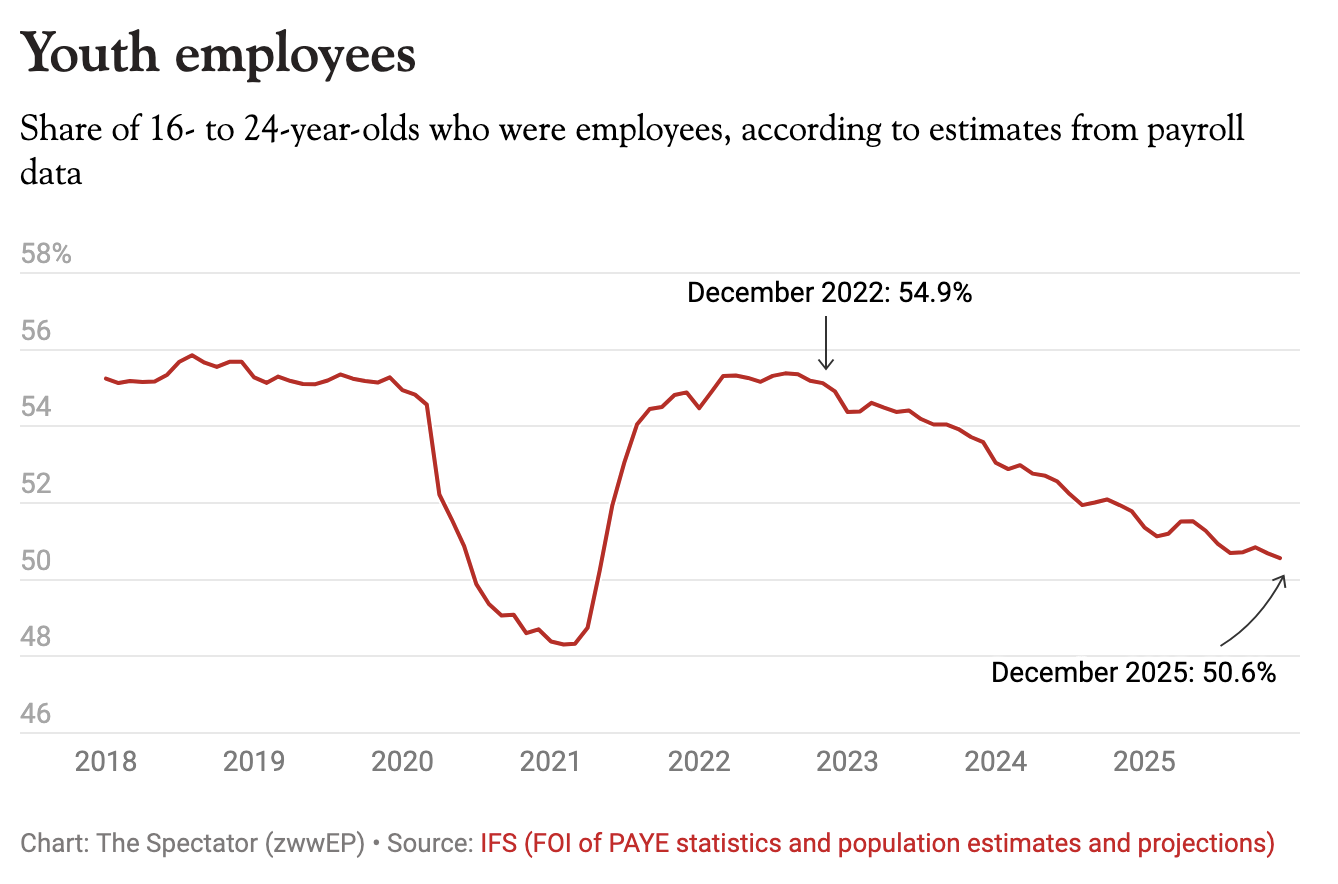
It is this collapse in youth employment, the IFS says, that is behind the surging numbers of young people not in education, employment or training – so-called Neets – which is not far off one million. And the result of all this is costing us: an increase of 84,000 16 to 24-year-olds claiming out-of-work benefits.
Now, the IFS report is careful not to blame any one particular party or policy for what seems now to be a structurally higher level of worklessness among the young. In fact, it is so kid-gloved as to be almost useless in actually explaining what is going on here.
And it is important to say that this trend was set in motion under the last government – presumably due to worsening mental health (and our acceptance of it) after lockdowns.
But it is unavoidably obvious – and businesses back this up – that, whatever the IFS says and does not say, the government’s policies on the minimum wage and national insurance have made the problem worse, while the general anti-business environment the government has created is destroying entry-level jobs. The largest fall in youth employment is among 16 to 17-year-olds, as the concept of Saturday and holiday jobs seems to be disappearing.
The ONS’s data is clear: vacancies are at their lowest in five years with ‘lower-paying sectors such as hospitality and retail’ experiencing ‘some of the largest falls in vacancies and payroll numbers’. If this was a purely mental health crisis those vacancies would not have disappeared – they would just be empty. And no one can seriously argue that AI is taking jobs in Wetherspoons or TK Maxx. It is inescapable to conclude that the increasing costs of employing people more generally have led to entry-level jobs being removed from the market entirely.
That is why this is Reeves’s and Starmer’s gravest mistake. The evidence is scary: many of the growing ranks of workless young will never work because worklessness is such a difficult habit to break. Even if this government are not to blame for setting this trend in motion, they bear responsibility for not doing enough to halt it. Instead, the Prime Minister and Chancellor have been midwife and obstetrician to the birth of a new dependant generation hooked on state support. That is a demographic and economic change that will scar Britain for years to come.