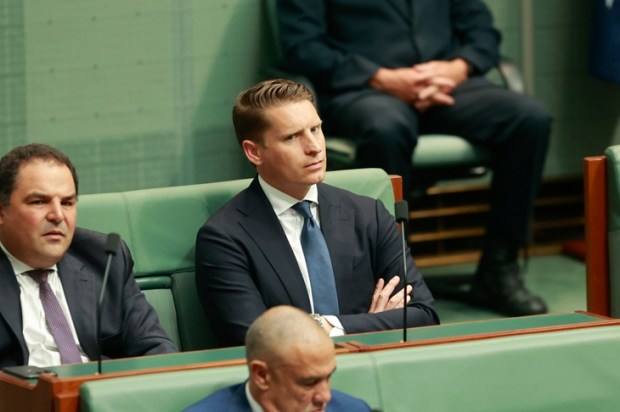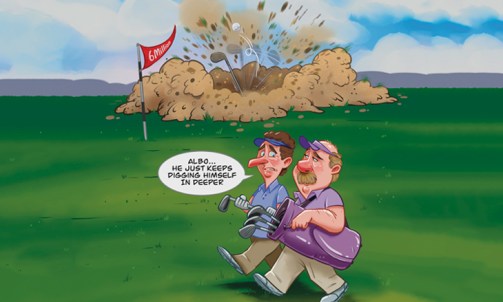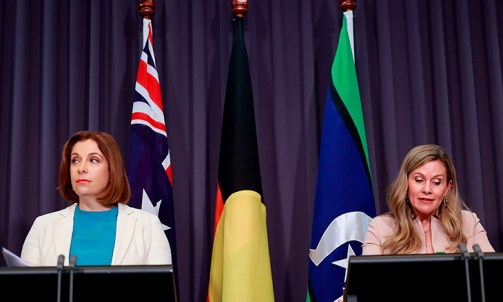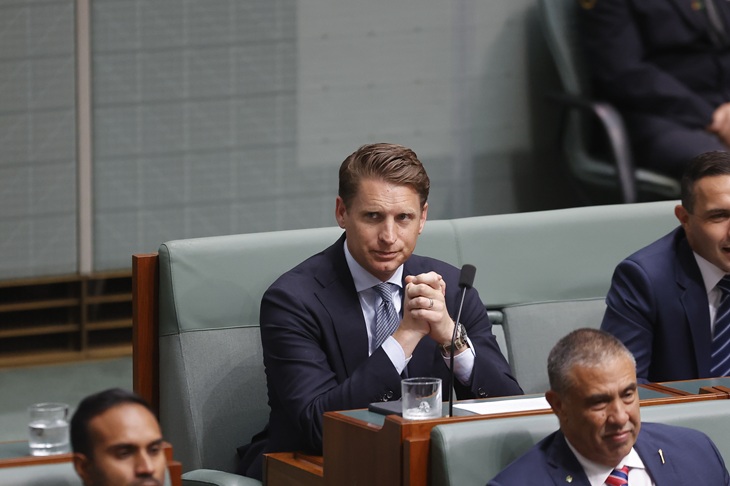
A few months ago, Andrew Hastie’s name was tossed into the potential leadership mix as the rumour mill tried to decide who would replace Sussan Ley.
Anyone, really…
Eventually Angus Taylor was decided upon as a factional compromise – the tasteful blueish hue with the well-worn wealthy professionalism necessary to speak to the wayward Teal seats. He was to be moderated by the shadow of Jane Hume.
Other conservatives were vocal in their support of Andrew Hastie as being more likely to draw back those who had left for One Nation, although that soured a little after he took to Instagram explaining why he flipped his stance on Labor’s Hate Speech Laws.
In particular, he directed ‘emotionally incontinent’ users to ‘unfollow’ him.
‘Despite the nastiness, I would still vote the same way. The mission was to get the best possible outcome for the country and we had to play the hand that we were dealt … politics is not for everyone. It’s like war: things go wrong, and you often only get a choice between multiple bad options.’
Indeed, Donald Trump might feel the same way about the hand he was delt by decades of incompetent US Presidents showering Iran with money and the decisions of allies to tiptoe around Iran’s terrorist empire.
Hastie finished with: ‘Purity is for keyboard warriors and paid influencers. Thanks for clarifying where you all stand.’
His popularity among the One Nation defectors never quite recovered.
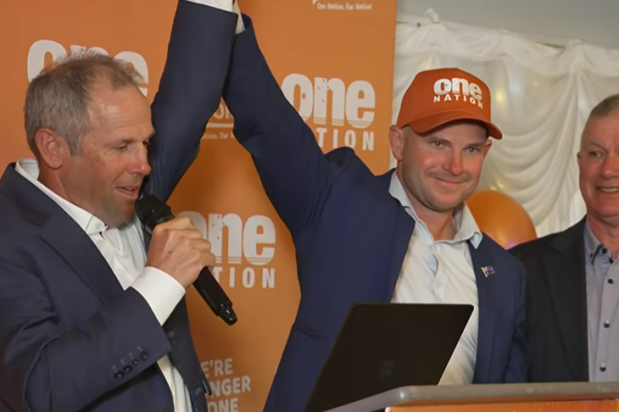
Aggressive words are nothing unusual for social media, however, the trick is to work out if you’ve upset the trolls or unsettled your voters. One Nation has been capitalising on the latter by absorbing Coalition walkaways.
Hastie himself noted that ‘One Nation’s rise in the polls is a symptom of that new reality’, adding:
‘Their anger is smouldering when you talk to them in person, but it’s breaking out like wildfire online when people have the freedom to post what’s really on their mind. The system is not working for Australians, and they are blaming the uniparty: the Liberals and Labor. That’s why One Nation, the Teals, and the Greens have risen in prominence: have acknowledged that the system is broken … I think it’s time that we did the same thing. That we acknowledged that we got it wrong, that the system needs a massive overhaul.’
Like it or not, conservatism is undergoing a ruthless revaluation. Purity tests are exactly what’s happening as voters determine what is, and is not, useful moving forward. The mob has been tasked with redefining modern conservatism with only the brute force of words.
As for Hastie, his popularity remains untested, and so he has been kept in reserve in case Taylor doesn’t work out. At least, that’s what the conservative faction chooses to believe, even though it’s far more likely Taylor is a one-off act of desperation.
That said, there have been some interesting comments from Andrew Hastie since the war in Iran began. His words go a lot further in criticising US President Donald Trump than anything Taylor has offered.
One wonders if Hastie is testing the waters to see if the right-wing supporter base is drifting away from their Maga era, although it could simply be Hastie’s natural reaction to world events.
What has the Shadow Minister for Industry and Sovereign Capability been saying publicly?
Speaking at the Australian National University’s Security College Conference, he voiced concern that Australia was not ready for the world created by the Iran war.
‘[He called for] a new effort of reindustrialisation … nation-building that will restore our resilience and our independence.’
It was here that he noted the ‘post-Cold War global order is now dead’ and that ‘buried alongside it in the cemetery is the peace dividend that underwrote our trade and prosperity’.
‘Unrestrained strategic competition and war have returned with a vengeance, and Australia is unprepared to meet that harsh new reality.’
Remember, Hastie has often described his formative years during tours in Afghanistan. Speaking at the ANU more than a year ago, he recounted stories of the ordinary people and then pondered, what makes Australia special?
‘I started to realise how blessed we are with our tradition of ordered liberty, open markets, rule of law, parliamentary democracy. These are things that I really value, and preserve having seen what it can really look like when power and violence dominate society as it did in Afghanistan.’
It was partly this, he said, that led him to join the Liberal Party a few years later.
In the same interview he admitted:
‘I think Australia has changed and I think the great moral and social consensus of the 20th Century is breaking down and we’re becoming more tribal.’
It is my own opinion that nations become more tribal when they perceive themselves to be under threat. Mass migration has sparked competition between imported cultures, values, and religions where once there was a unified and coherent Australian culture. Political parties can certainly encourage or exploit these tribal divides, but they are seeded by the underlying policy error which aggressively diminishes the supremacy of Australian culture and identity.
Hastie’s interview is interesting and goes on to discuss the new world order.
‘We’re living in a world that’s being increasingly shaped by revisionist powers. China, Russia, North Korea, Iran and their proxies. Whether it’s Hamas, Hezbollah, the Houthis… They are challenging what we would call the US global rules-based order. I call it Pax Britannica or Pax Americana. Our prosperity and security is tied to an English-speaking democratic power. And so these revisionist powers are threatening that. China is also being expansionist. And I think we’re seeing that as well. That’s why we’ve had disputes over the South China Sea. That’s why we’ve had the Belt and Road Initiative pushing out as far as the Pacific Island chain … every big issue that Australia has to make a decision on will be refracted through the geopolitical competition of the United States and the People’s Republic of China. And I think that’s going to be more accurate now that Trump has won the election. Trump and the people he’s nominated to be in his Administration have openly named China as the pacing threat. Pete Hegseth did that … Marco Rubio has a very strong record of taking on China.’
As you may have realised, this speech is from December 2024.
Let us pull out one more interesting point worth considering about the nature of defence in a multicultural society where you might be engaged in conflict with migrant homelands…
‘We won’t have cohesion because, you know, we’re a multicultural society. It’s increasingly challenging to have these conversations because people have different perspectives because of their different backgrounds.’
Our ancestors may have preferred to call this ‘divided loyalties’ and they used to go to great lengths to protect against it developing. Once it exists, nations fall to bits.
Hastie goes on to float the idea that the solution to the disunity caused by multiculturalism and foreign conflicts is some sort of mix of education, economics, and home ownership. I will respectfully describe this as naïve. The discussion included those marching for Hamas and Hezbollah on Australian streets. That is a religious affiliation and a deep-set cultural creed. Can Christians be de-converted from their faith with a housing stimulus package? There is no indication that extreme and incompatible views have a remedy except exodus.
Since then, Hastie’s comments, particularly relating to Donald Trump and the US, have evolved, going so far as to call the President ‘petulant’. This week he said of the Iran war:
‘This is Donald Trump’s choice. I’ve been pretty tough on Donald Trump over the last week because it’s people like Anna [a caller to the radio station] who get smashed. And I should remind you that One Nation has been pretty strong in supporting Donald Trump’s war – that’s not a point that’s made very often, but I want to make it to your listeners today.’
It’s not made very often because One Nation maintains ideological independence from the Trump Administration, like every other Australian party. They have been more cautious about the consequences of angering our most important geopolitical ally who essentially guarantees our national security, but they are far from a unified front of positivity on the war. There is more ideological variation permitted in the ranks of One Nation than the Coalition.
If you scroll through Pauline Hanson’s X account, you will find the majority of Iran war discussion relates to prior warnings about fuel insecurity and the role Iran has played as a sponsor of terror on Australian soil. As a party, they are determined to hold both Labor and the Coalition responsible for decades of decline in Australia’s fuel security and it to be fair, it was under the watch of both major parties that Australia lost its fuel security in favour of a discounted globalised world. They are presenting the Iran war as one of many possible events that would have exposed Australia’s strategic weakness.
It is a sensible political point for One Nation to exploit, as they are the only rising party with clean hands when it comes to the serious mistakes of the last hundred years and it seems the Coalition leadership is a little sore about it. Net Zero is another example of a policy that tears the Coalition apart.
There was an interesting comment in the 2GB transcript when Hastie was asked about the tension between One Nation and the Coalition.
‘I’ve always had a respectful relationship with Pauline; I’ve got no quarrel to pick with Pauline. But One Nation – they’re out to tear us down. There was an article yesterday in the Australian Financial Review where James Ashby – her chief of staff – said: “We’ve got to get rid of all the old players and start afresh.” And he was talking about the Coalition. So, this is a contest. I want to win. I want to deliver good, centre-right government for the Australian people. What we saw on the weekend in South Australia was a cannibalisation of the South Australian vote, which just empowered Labor to deliver more Labor government. I’m happy to work with anyone, but if it’s a competition, I’m going to fight hard.’
Hastie continued his observation of the Trump Administration:
‘President Trump thought he could go in and win the war in a week. And right now, Iran has the world economy held to ransom.’
One might argue that Iran always held the world economy to ransom, waiting for the opportune moment. Imagine if the mullahs had exercised this power in the middle of a Pacific conflict… By the time Trump is done, Iran may no longer have control over the Strait of Hormuz. Removing the strategic capture of the world’s chokepoints might end up being an enormous positive for the West.
‘This is an international crisis. Iran has globalised the war. They’ve globalised the Battle of Hormuz. And we’re affected because we’re right at the end of the supply chain, and 90 per cent of our fuel is imported.’
Hastie added his serious concerns that the Albanese government was not being transparent about its fuel security plans, or even its modelling.
Finally, when asked directly if Hastie supports the war in Iran, he replied that ‘I didn’t get a choice’ and that ‘Australians didn’t get a choice’.
‘We weren’t briefed. It just started, and now we’re dealing with the consequences.’
That’s all true, but his comment that ‘we didn’t know it was inevitable’ gave me pause.
Really? Iran might have been the most predictable war in recent history. The presenter pulled him up on that one too, and he conceded the point.
At least we had this comment in his ABC interview:
‘We’re one of the most vulnerable countries in the world … this is 40 years of failure as a country.
‘I think we thought we could deindustrialise our country, that we could rely upon globalisation and the United States to be the leader of the free world and underwrite our security, and everything’s changed.
‘We’ve seen Russia, China, and Iran flexing their muscles, and Donald Trump has pretty much torn up the global rules-based order – it actually said in that National Defence document that they put out last year. Things have changed, and Australia has been caught with our pants down.
‘I think the government should have done a better job of anticipating what might happen in the Middle East. We knew there was a big military buildup, we knew that Donald Trump was open to military action. As we saw last year … he went to Venezuela earlier in the year. And as one of the most trade-exposed nations in the world, we should have had a plan, and the government’s been caught asleep.’
Finally:
‘I like to quote this proverb: Honest are the wounds of a friend while an enemy multiplies kisses. And I think in a relationship with the US, we’ve got to be frank and open about these things. President Trump runs his own show, and he’s made it pretty clear that he speaks disparagingly of allies, and I don’t think it’s wrong to push back every once in a while.’
I’m not sure if we are any closer to discovering what a Coalition government would bring to the table, or if it has the nerve to go full Drill, baby, drill! and deliver refineries and new mining projects.
Nor do we know if there is any appetite to cease over-priced military orders with a foolishly long delivery schedule in favour of the cheap, nasty, but effective weapons we are seeing used by Iran to hold the US military machine at bay.
That said, at least we are starting to have more serious discussions about geopolitics which go beyond a social media hashtag and Hastie leaves us with some interesting points to consider in the evolution of Coalition conservatism.