Dubai is like the dazzling partner some people enjoy being seen with, but know deep down they would never marry. Style without substance. Attraction without culture. All the confidence but none of the charisma. A place associated with glitz and glamour, not class and intellect.
The carefully cultivated influencer-led depiction of Dubai as the best place in the world is falling apart
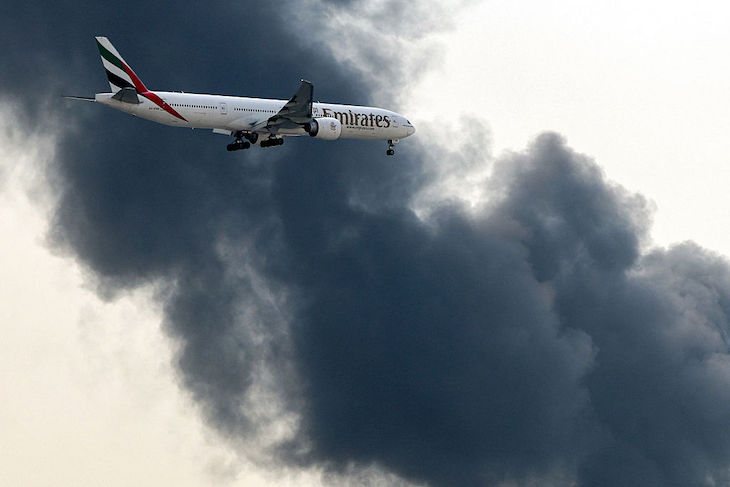
What attracted many Westerners to Dubai was the absence of income tax. In more recent years, as the quality of life in Britain has been declining, clean and safe streets have been pull factors for some Brits. But the Iranian regime’s drone attacks on the United Arab Emirates has shattered the illusion of Dubai as a safe haven. The carefully cultivated influencer-led depiction of Dubai as the best place in the world is falling apart like the ceiling of its international airport after another strike.
This hasn’t stopped the Emirati authorities from desperately trying to deny what is plain to see. A 60-year-old British man has been charged under cyber-crime laws after allegedly filming Iranian missiles over Dubai. For a place so popular with influencers, it’s ironic that the UAE has such strict laws around what is posted on social media. But it should hardly come as a surprise: it’s a stark reminder that the city is part of an authoritarian Islamic dictatorship run by families who ruled over little more than livestock, fig trees and sand until a few generations ago.
Enlightened thinking comes from centuries and millennia of richness of culture, ethnological depth and diversity and inter-ethnic tolerance and harmony. But these things don’t spring to mind when I think of Dubai. You are more likely to find easy money, fast cars and even faster relationships in the Persian Gulf.
It isn’t completely over for Dubai, of course. While the city’s image as a safe haven and holiday destination has suffered badly – perhaps irreparably – as a result of the fallout of the Iranian war, money still talks. And the government of the Emirati city – and that of other Arab countries in the Persian Gulf – has enormous oil and gas reserves, and therefore immeasurable wealth, along with their formidable portfolio of European and American real estate and (tech) companies.
The UK government has allowed plenty of British real estate to be owned by the governments of Arab nations in the Persian Gulf. This includes key parts of central London, from Mayfair to the de-Anglified areas of Knightsbridge and Belgravia, with institutions like Harrods, the Savoy Hotel and the Shard, and properties across Canary Wharf propping up Gulf Arab influence on British soil. As a venture capitalist, I can only applaud the investment decision makers of these nations – particularly as real estate in their own countries has relatively little fundamental resilience. The Dubai (DFM) Real Estate Index indicates the Dubai property market has lost a third of its value since the start of the conflict in the Middle East, while Dubai’s main share index, the DFMGI, has fallen by more than 18 per cent, wiping $229.61 billion (£170 billion) off its value in the same period.
Capital will continue to flow in and out of Dubai after this conflict, but it’s unlikely to do so at the same extent as before – particularly when Iran becomes a liberated, democratic country that is freely trading with the world.
People talk about how safe Dubai is – and it is – but they conveniently forget that, along with proper policing resources (unlike in the UK), they also impose excessively strict penalties for suspects and criminals, including the death penalty.
From what I’ve been told from friends who have lived there for many years, the (romantic) relationships are as artificial and superficial as the environment in which they start.
If you want to get an idea of the mentality, grace and honour of some of those people who choose a life in Dubai just google “Dogs Dubai”. You will see reports of residents abandoning their “beloved” pets in the street as they flee this once safe-haven for colder, safer, shores. Images of pets left tied to lamp posts or without water have been circulating on social media with vets said to be overwhelmed by the sheer number of abandoned pets. Not even beautiful and vulnerable creatures like dogs are safe from the shorttermness of an Emirati relationship.
The Iran war has exposed the shallow sands on which Dubai is built. But there’s another issue for the Emirates as a result of what is unfolding in Tehran: the Islamic Republic in Iran will fall at some stage, and, when it does, nobody will choose to live in Dubai.
The rise of Turkey and Arab nations in the Persian Gulf like the UAE, Saudi Arabia and Qatar have all come – directly or indirectly – as a result of the 1979 Islamic Occupation in Iran and the downfall of the Iranian nation and economy. The leaders of these Arab countries in the Persian Gulf know and fear where their countries would stand should Iran and its people return to the world’s stage as a free country.
The rise of Turkey and Arab nations in the Persian Gulf like the UAE, Saudi Arabia and Qatar have all come – directly or indirectly – as a result of the 1979 Islamic Occupation in Iran
The emergence and rise of the Arab nations in the Persian Gulf has been a temporary substitute for a suppressed civilisation. A sleeping giant of a civilisation that is on the precipice of its second awakening.
Iran, the oldest still existing nation state, with millennia of rich history, will welcome those who considered Dubai exciting and exotic. Though I think the country would prefer to do so for those who prefer somewhere with history, culture and depth – and those who didn’t abandon their dogs. After all, in Persian culture and Zoroastrianism, the true religion of Iranians, mankind was divinely mandated to care for dogs.
Situated between four biological regions, Iran’s varied geography includes Caspian rainforests, snowy mountains and arid deserts. Ranking among the world’s top nations for ecological and biodiversity due to its position at the intersection of major zoogeographical zones, Iran boasts exceptionally rich flora and fauna.
With its twenty-five ski resorts, Iran has some of the best and highest skiing in the world, and at altitudes of 3,500 metres, the season goes on until late May. In theory, if you wake up early enough, you can ski in the morning and scuba dive with turtles and dolphins in the afternoon, without leaving Iran.
From the ashes of the Islamic Republic, a free and democratic Iran will rise. The 170-page Iran Prosperity Project, the comprehensive, multi-phase proposal developed by HRH Iranian Crown Prince Reza Pahlavi alongside experts, and overseen by the National Union for Democracy in Iran (NUFDI), has outlined a roadmap for rebuilding Iran’s economy in a post-Islamic Republic transition period. It proposes tax breaks and economic reforms designed to be highly attractive to foreigners as well as the four-million-strong Iranian diaspora to reverse one of the largest brain drains in modern history.
The country with the second largest STEM graduate population per capita will build the Silicon Valley of the Middle East, if not Asia. And where the tax breaks lie and the innovation takes place, foreign talent and financial institutions alike will follow.
Iran will be the future hub of the Middle East and this great, historic nation and its talent will retake its place on the global economic and cultural podium as it once again becomes the gateway between East and West.