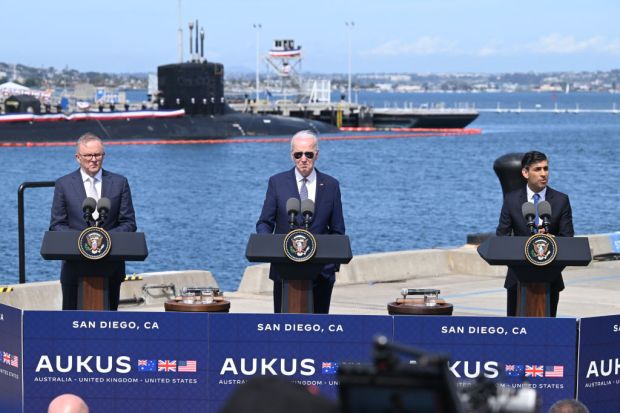
The Australian Prime Minister, Anthony Albanese admitted that three Australians served on the submarine that sank the Iranian frigate IRIS Dena, but that they did not participate in the operation.
After his announcement, members of the political establishment reacted with harsh criticism, describing Albanese’s admission as both concerning and insincere. Notably, Greens Senator David Shoebridge – a fierce critic of President Trump’s action in Iran – indicated that it is fanciful to believe that the Australian sailors stood aside during the operation:
…it is extraordinary that the Prime Minister … said that Australian personnel were on a US nuclear attack-class submarine that struck and sunk an Iranian frigate, but Australia is not directly involved in the war in Iran. These two facts cannot sit together in the same sentence. And what is becoming increasingly clear is that Labor’s statement since this war began, that Australia is not directly involved in the war, has been a lie.
Shoebridge may have a point because working within the confines of a nuclear-powered submarine requires the unquestioning support of all sailors, even if they are not involved in the decision-making process.
But, ultimately, the political squabbling over the sinking of the IRIS Dena is as relevant and trivial as the 17th Century dispute as to how many angels can dance on the head of a pin.
Why? If the world’s legal order, with its panoply of rules, is unable to avert a military confrontation in peacetime, it is fanciful to expect the combatants to adhere to a legal framework during a conflict. Subject to the validity of this point, international law is a house of cards that easily collapses because ‘law’ is inherently incapable of regulating war, the distinctive feature of which is precisely the absence of law. Hence, to objectively assess the IRIS Dena incident, it is necessary to consider the context of the sinking of the frigate, including the legal and moral frameworks which supposedly control such an incident.
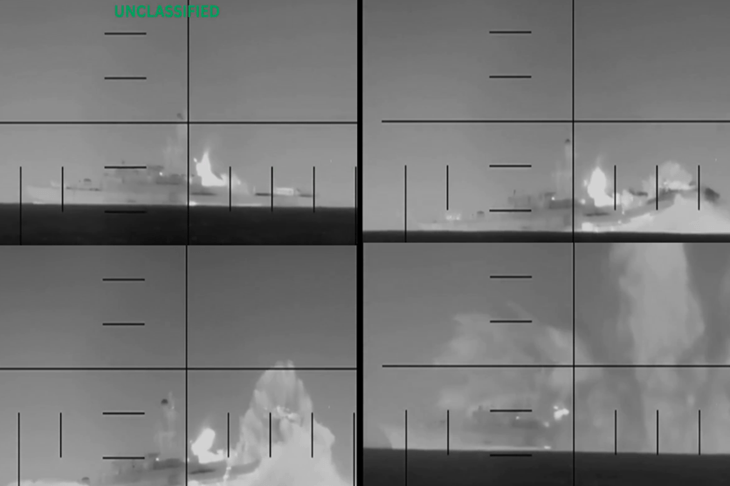
The torpedo strike on Iran’s warship, approximately 40 nautical miles off Sri Lanka by a US submarine, has triggered intense debate among scholars of international humanitarian law (IHL), the law of naval warfare, and the law governing the use of force. The incident occurred as the vessel was returning from India’s multinational naval exercise MILAN 2026, an exercise involving 74 countries, including the United States itself. The IRIS Dena was sailing home through international waters, not engaged in hostilities at the time of the attack. Viewing the incident in this context, the strike looks less like a battlefield imperative and more like the delivery of a strategic message, one that risks normalising long-distance naval destruction of state vessels.
Thus, as this was not a battlefield engagement in the traditional sense, it represented a deliberate, long-range projection of force into the Indian Ocean. The United States has argued that, from a purely strategic perspective, Iranian naval assets, even those operating far from the Middle East, constitute legitimate targets within a rapidly expanding conflict. The American Defence Secretary of War, Pete Hegseth, said that the Dena ‘thought it was safe in international waters,’ implying that the strike was intended to convey the message that no Iranian naval vessel is beyond reach of the American forces.
The attack, far from the Persian Gulf and in a major Indo-Pacific trade corridor, raises questions about legality, necessity, and humanitarian obligations.
Was the attack legal under the law of armed conflict? Legal experts in naval warfare assert that a state’s warship is considered a legitimate military target during an international armed conflict, regardless of whether war has been officially declared. These rules remain valid even if the overall use of force may be subject to legal debate. In other words, even if the United States had no legal right to wage war on Iran under international law, it still must follow the rules of naval warfare once hostilities exist. Under these rules, a warship may be attacked on the high seas or within the territorial waters of a belligerent state, but not within the 12‑nautical‑mile territorial waters of a neutral state. The IRIS Dena was reportedly outside Sri Lanka’s territorial waters, making it a lawful target under naval warfare law.
Commentators have noted that under the American Constitution’s domestic war powers, the attack would have been unquestionably lawful if the United States had declared war. But Congress has not done so. Thus, the strike may have been legal under international naval warfare law, but politically and constitutionally questionable under American domestic law. This duality is not unusual in modern conflicts, but it underscores the democratic deficit in how the United States wages war.
This incident can be further analysed through three legal frameworks: jus ad bellum, the legality of the US resort to force; jus in bello (law of naval warfare), the legality of the attack itself; and humanitarian obligations, the moral duty to rescue survivors at sea.
Jus ad bellum: Was the US use of force lawful? Under the UN Charter, the use of force is lawful only if it is authorised by the UN Security Council (Article 42) or is an act of self-defence against an armed attack (Article 51). There is no indication that the US strike on the IRIS Dena was conducted under Security Council authorisation. Nor is there evidence that the IRIS Dena posed an imminent threat at the time of the attack; it was sailing home after participating in a multinational exercise. Captain S.B. Tyagi, a military law scholar, notes that the legality of the sinking under jus ad bellum is distinct from the legality of the attack under the law of armed conflict. Even if the US resort to force was not lawful, the conduct of hostilities is governed by a separate legal regime.
Jus in bello: Was the attack lawful under the law of naval warfare? The law of naval warfare is a specific branch of international humanitarian law that applies even if war has not been officially declared or the use of force was illegal under international law.
Under the law of naval warfare, warships of a belligerent state are military objectives by nature. They may be attacked on the high seas or within the territorial waters of a belligerent, but not within the 12‑nautical‑mile territorial sea of a neutral state. As the IRIS Dena was reportedly outside Sri Lanka’s 12‑nautical‑mile territorial sea and not within neutral waters, under the law of naval warfare, the IRIS Dena constituted a lawful military target.
Even when a target is lawful, attacks must comply with military ‘necessity’ and ‘proportionality’. Because the IRIS Dena was a warship and the attack occurred at sea with no civilian vessels reported nearby, there is no evidence of disproportionate harm. The necessity of the strike is more debatable; the IRIS Dena was not engaged in hostilities, but necessity is interpreted broadly in naval warfare. The American submarine commander may well have considered that the IRIS Dena, rather than sailing home, would sail to Diego Garcia, a mere 960 nautical miles from Sri Lanka, where the United States have a major military base. Under jus in bello, the attack appears lawful, even if the broader war is not.
The Duty to Rescue Survivors: The law of naval warfare imposes a clear obligation on the victorious party to search for and rescue survivors of a sunken warship, unless doing so would place their own forces at undue risk. This obligation is rooted in the Second Geneva Convention of 1949, customary international law, and centuries old maritime tradition.
Legal specialists, such as Brian Finucane, point out that, unless it was not feasible due to operational constraints, the United States would have been required to carry out rescue efforts for survivors. Yet, on this occasion, the United States failed to conduct rescue operations. Instead, Sri Lanka, along with India, rescued injured Iranian sailors and brought them ashore for medical treatment. Sri Lanka conducted the initial rescue after receiving a distress call and India deployed ships and aircraft to assist.
The American failure to help in the rescue of the surviving Iranian soldiers is troubling because there is a centuries-old maritime tradition that sailors rescue sailors, even enemies. As the sea is unforgiving, there is a moral duty to conduct rescue operations, even in a wartime environment. In failing to rescue IRIS Dena’s surviving crew, the US may have complied with its operational priorities, but it disregarded a deeper moral imperative that transcends nations and wars.
So, any assessment of the sinking of the IRIS Dena needs to consider the wisdom of the operation. This incident expanded the conflict geographically into the Indian Ocean, a vital trade artery and it targeted a ship not engaged in active hostilities, fresh from multinational exercises. The military operation, although legal under international law, may have failed to uphold humanitarian obligations, leaving rescue to regional navies. This is problematic because it risks normalising long-range naval strikes, a precedent that could one day be used against the US Navy itself. Hence, even if the United States acted within the technical boundaries of naval warfare law, the strike could be characterised as strategically reckless, politically unmoored, and morally deficient. In particular, the failure to rescue survivors compounds the ethical cost. In an era where great‑power competition increasingly plays out at sea, the World cannot afford a precedent where major navies sink each other’s vessels far from conflict zones and then sail away without rendering aid.
Although the context of the action reveals that the submarine attack was legal, history will judge whether the failure to assist in the rescue of surviving sailors was wise.
But one thing is certain. Any analysis of the context surrounding the sinking of the IRIS Dena, involving the claim that Australia participated in its sinking because three sailors were aboard the striking American vessel, is an exercise in fatuity and misses the real issue: whether it was wise to sail away without rescuing the surviving Iranian sailors.